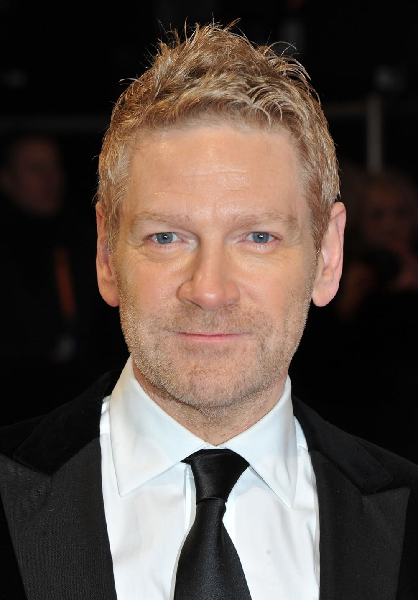
Kenneth Branagh, once hailed as the next Olivier, has returned full circle to play Prospero in Shakespeare’s The Tempest, his first Stratford appearance in 30 years. The RSC (Royal Shakespeare Company) started off his career with a flourish when he played to sold-out audiences in Henry V aged 24. Since then he has starred and directed Shakespeare films and branched out into the mainstream with, most recently Dunkirk, Oppenheimer, Harry Potter and Hercule Poirot.
His success is all the more laudable given his early Belfast upbringing which gave him an Irish accent which he erased at school because of bullying, learning received pronunciation which has undoubtedly heled his career.
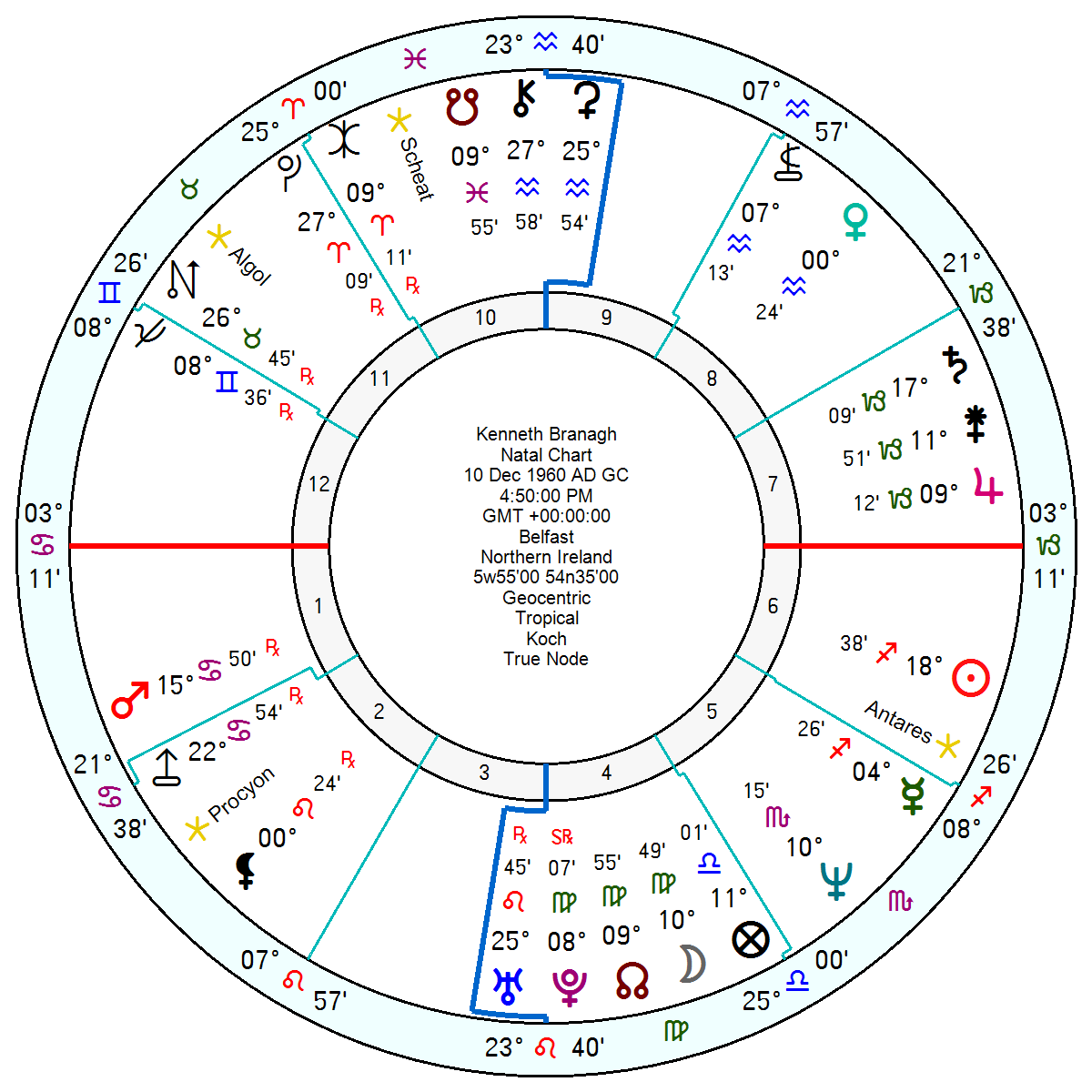
He was born 10 December 1960 4.50pm Belfast, Northern Ireland, and came to the UK when he was nine as his family escaped the Troubles. He has a Sagittarius Sun in the hard-working 6th house square a Virgo Moon. More significantly he has a hard-edged Mars in Cancer opposition Saturn, perhaps a hint of risks in his early Belfast days, in a talented Half Grand Sextile to Pluto North Node in Virgo and Neptune in Scorpio.
He has another Half Grand Sextile from Pluto opposition South Node in Pisces, sextile/trine Neptune and Jupiter in Capricorn.
His Mercury in early Sagittarius is on the focal point of a T Square to Pluto opposition his South Node.
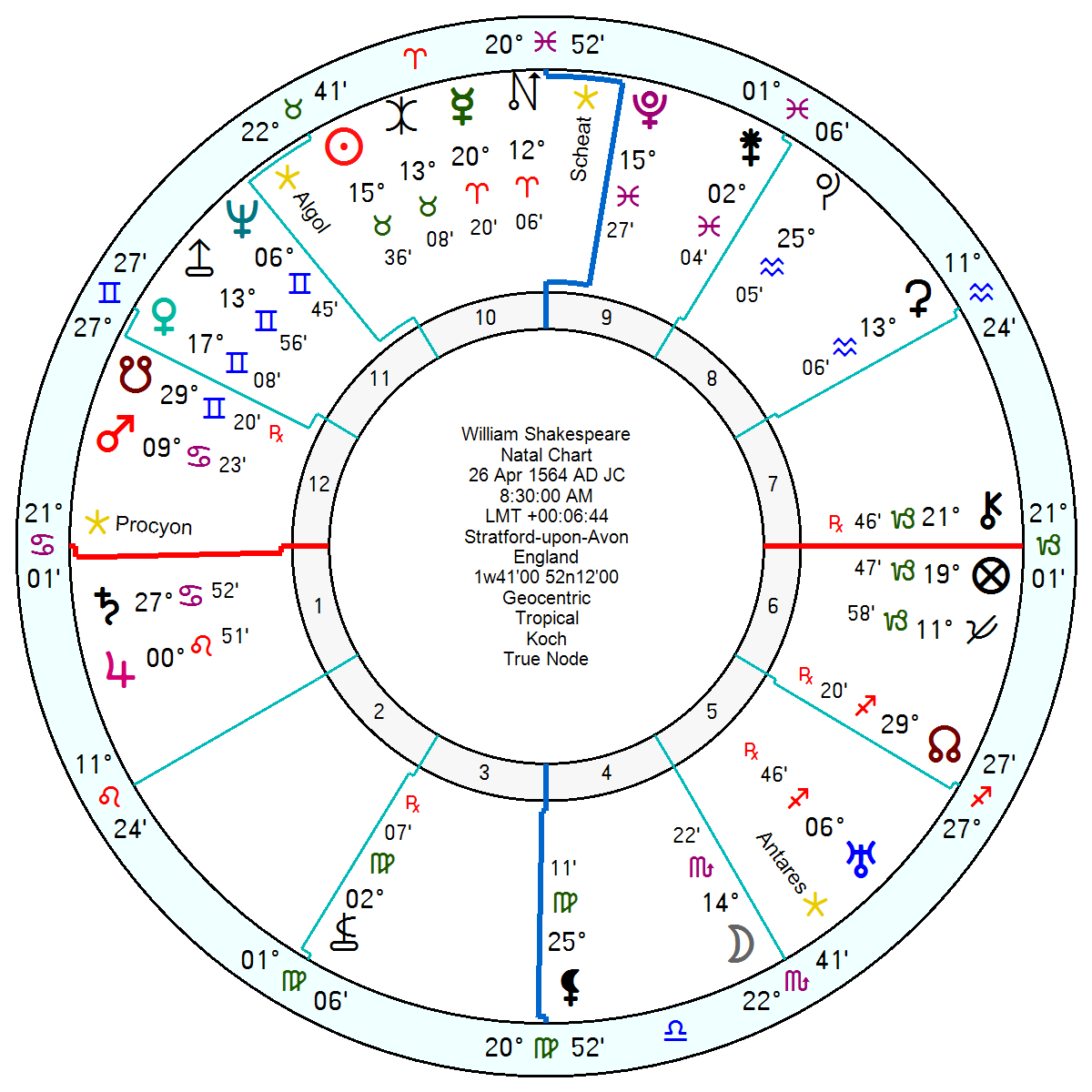
Shakespeare’s exact date of birth is unclear because of a muddle over baptism records but is around late April 1564 when Pluto was in mid Pisces and Uranus was in early Sagittarius opposition Neptune in Gemini – creative and inventive.
Both these placings in Shakespeare’s chart connects to the great actors who played his roles. Judi Dench and Branagh have their Mercury in Sagittarius conjunct WS’s Uranus and opposition WS Neptune; Alan Howard had his Mercury in Virgo square WS’s Uranus and Neptune.
WS’s Pluto falls in Branagh’s career 10th house and in Olivier’s 10th house as well, is square Judi Dench’s Sagittarius Sun, sextile John Gielgud’s Mercury, square Derek Jacobi’s Venus, and conjunct Peggy Ashcroft’s Mars and square her Mercury, and is square Alan Howard’s Nodal axis.
Clutching for straws in the intractable standoff with Iran with Trump sounding increasingly desperate and the Iranians stronger than before with the Strait of Hormuz forever after their winning strategy – two separate astro-thoughts.
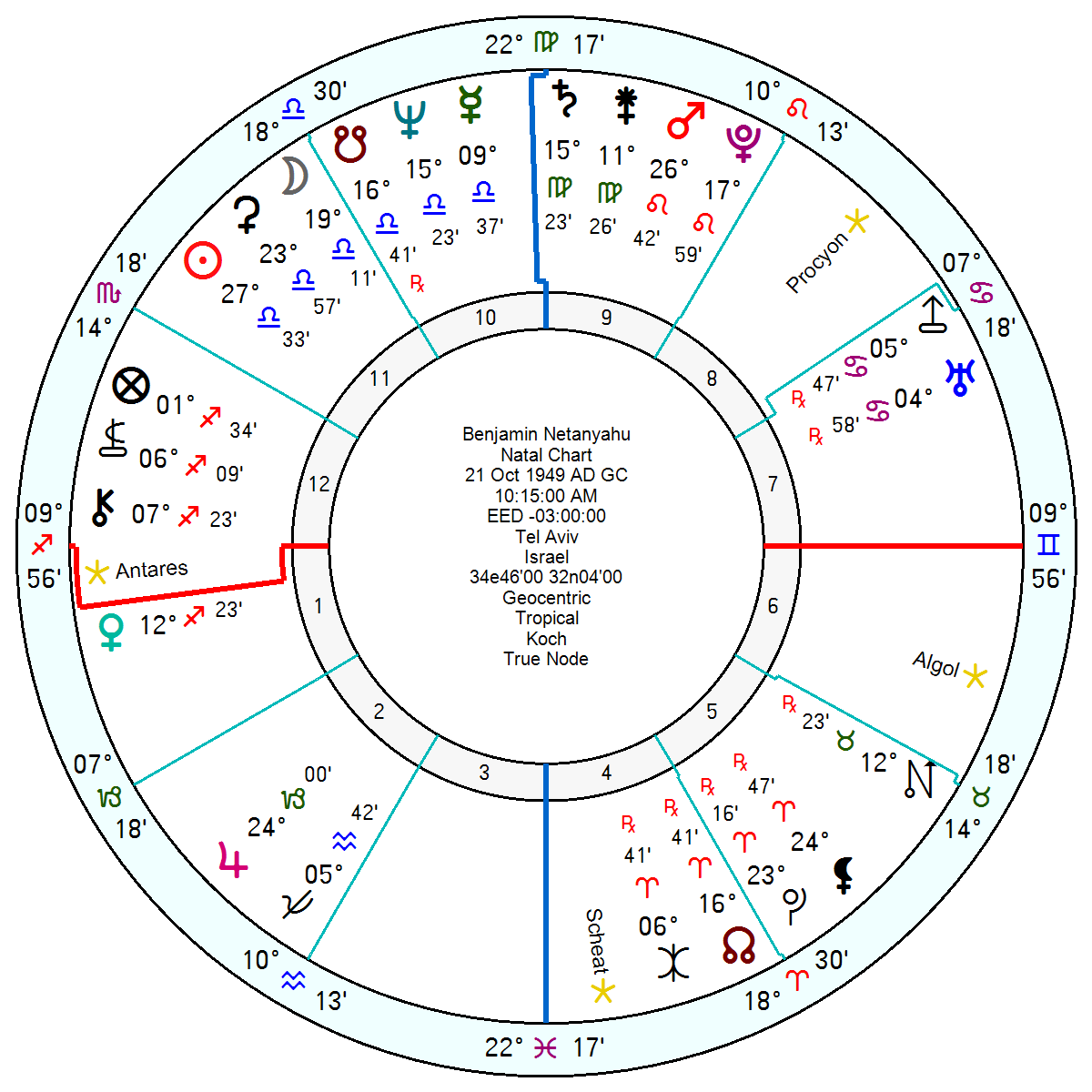
One is that this weekend till the middle of August tr Neptune at 4 degrees Aries will significantly impact Netanyahu, his relationship with Trump and Israel.
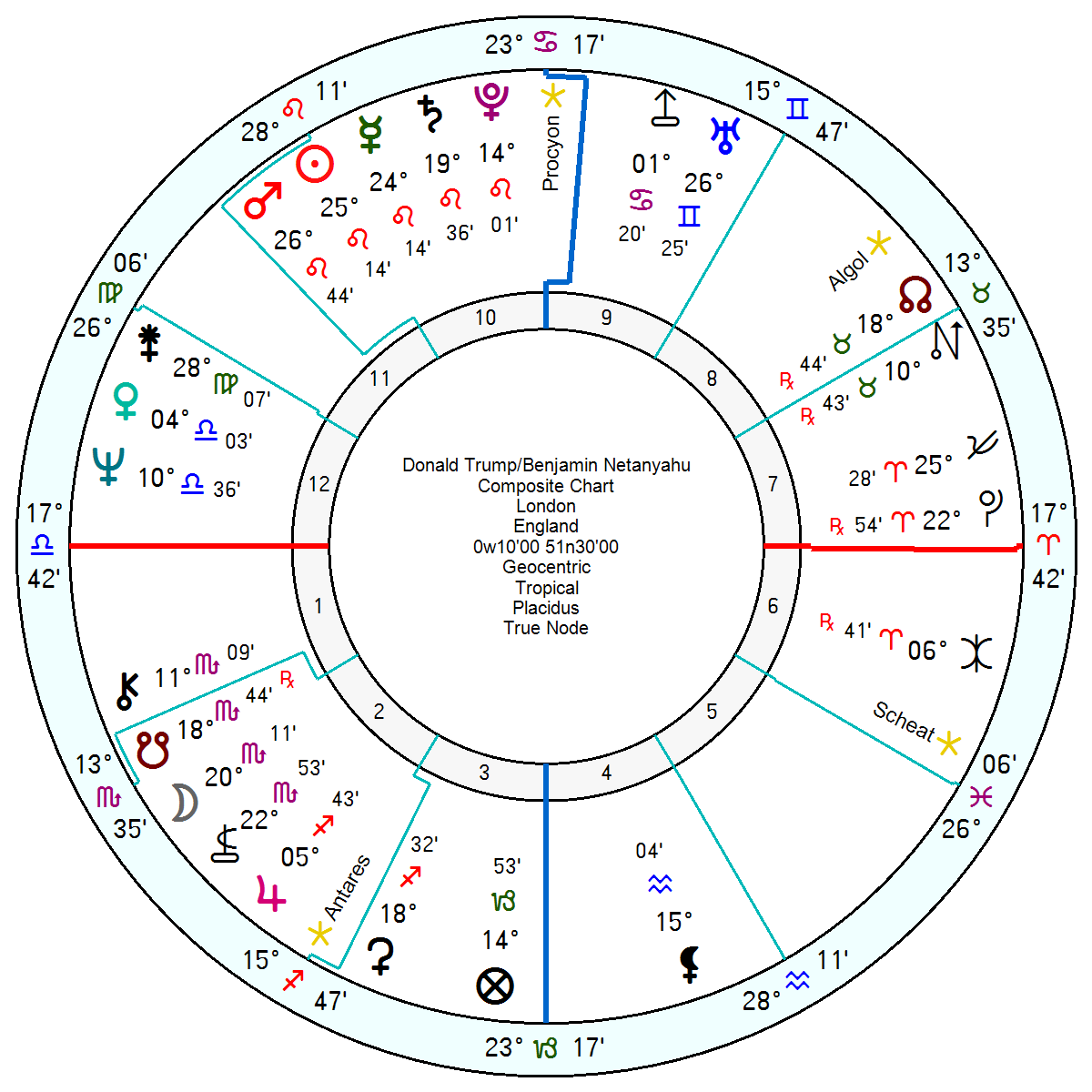
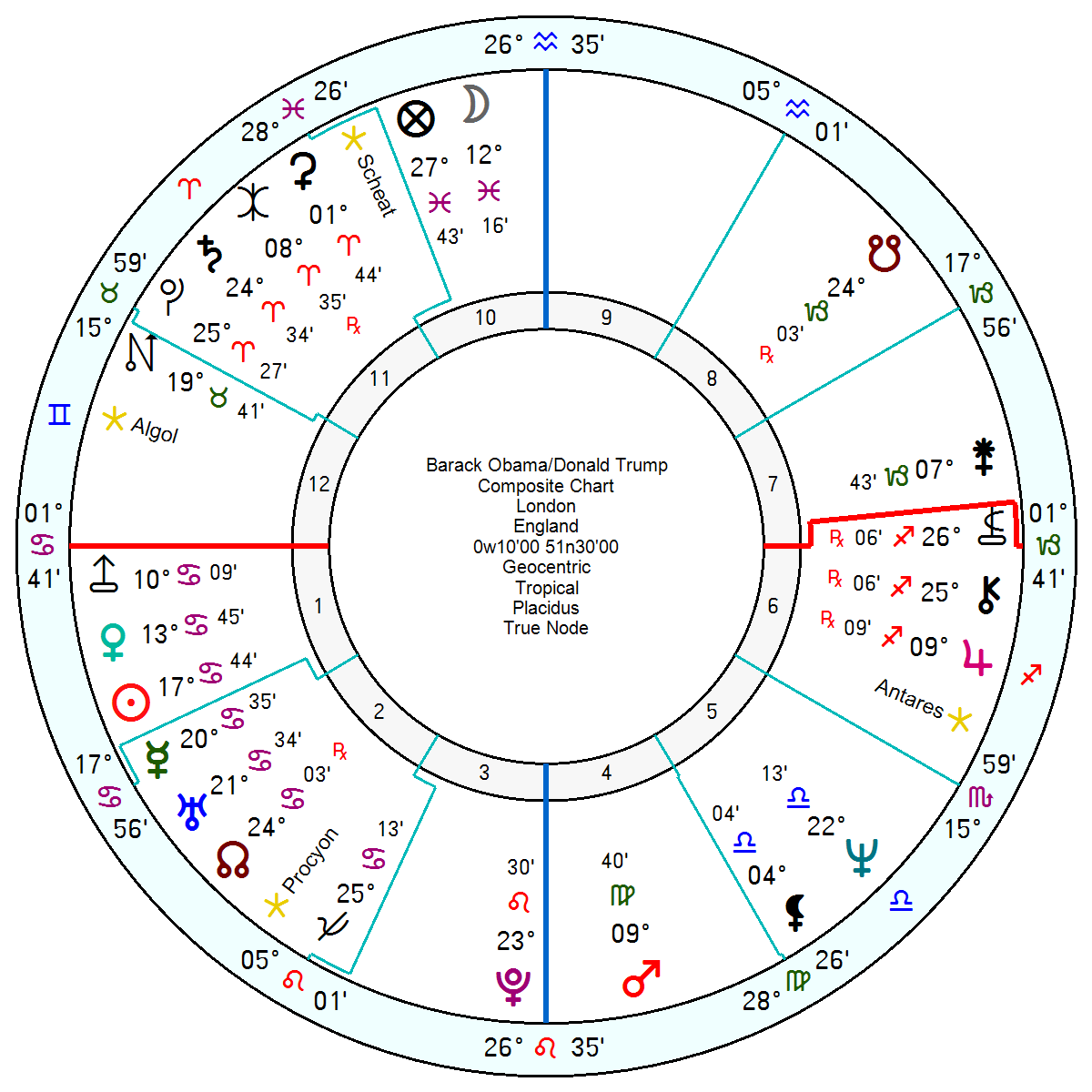
Working backwards. Israel’s chart will have a disappointing tr Neptune square its Venus in Cancer. Netanyahu’s Uranus in Cancer at the same degree will be nerve-stretched and agitated. His relationship chart with Trump has a composite Venus at 4 degrees Libra so disillusionment between them as well; with two composite Saturn midpoints also causing great uncertainty and suspicion in their relationship.
This Neptunian influence repeats in the spring 2027 and late year into early 2028 – if either or both are still standing by that time career-wise. With Netanyahu facing a messy career upheaval August to late October this year with tr Uranus square his Pluto/MC midpoint, it looks less than likely he will be a main player.
The other thought – oh sweet irony – is that Trump is likely to end up with a distinctly inferior deal to the one the Obama administration reached in 2015. Trump has called it “one of the worst and most one-sided transactions the United States has ever entered into” and claimed: “Never, ever, ever in my life have I seen any transaction so incompetently negotiated as our deal with Iran.” Hey ho, hoist up his own flagpole.
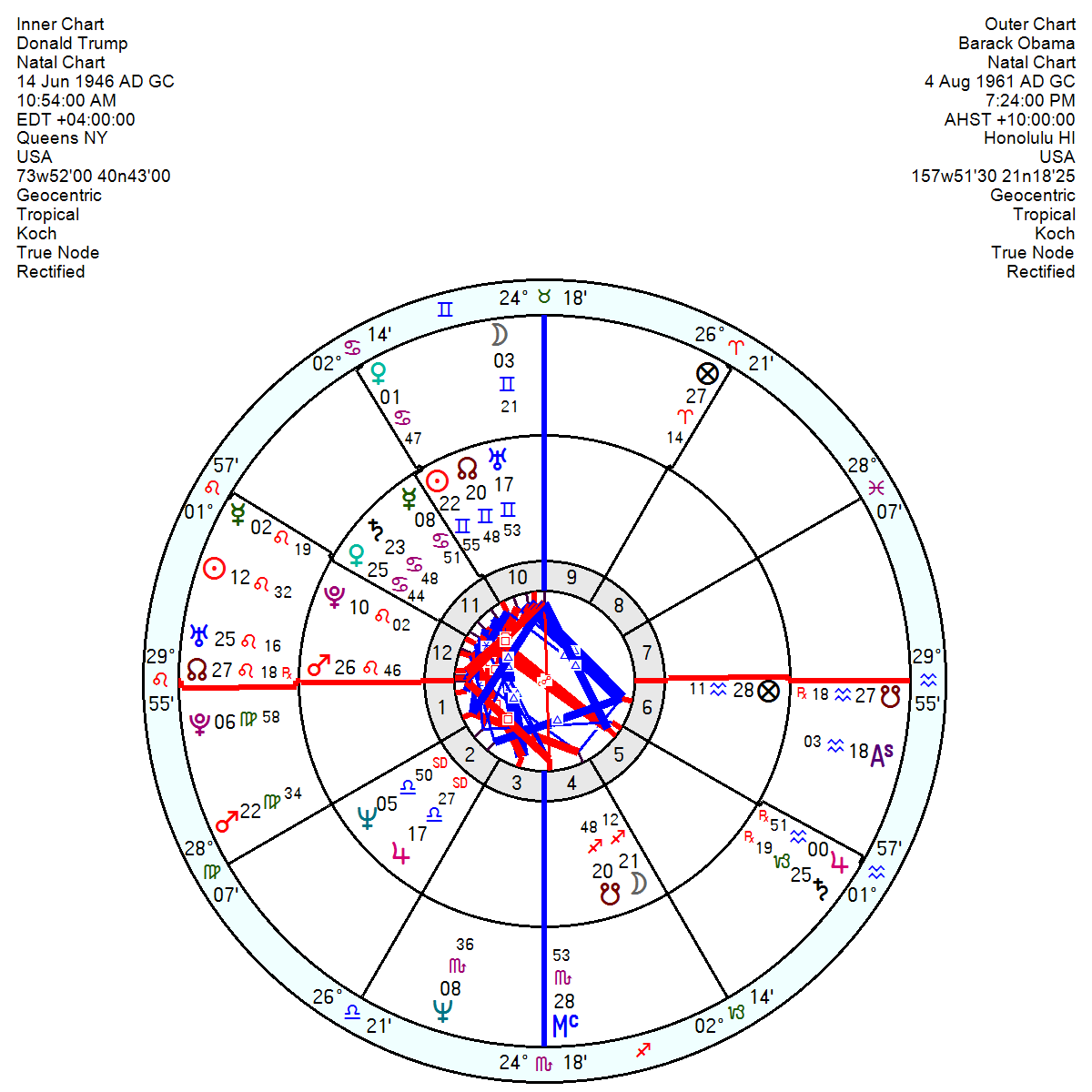
His obsessive dislike of Barack Obama, no doubt coloured by his inherent racism, antipathy to centrist politics – and envy of Obama’s popularity – is exacerbated by their synastry. Obama’s Leo Sun is conjunct DT’s 12th house Pluto stirring dark, subterranean feeling of envy, jealousy and rage in DT. Obama’s Uranus North Node are conjunct DT’s Mars Ascendant which is a recipe for an explosive chemistry. As if that wasn’t enough Obama’s Mars in Virgo is also square DT’s Sun Uranus and Moon for an angry clash of aims.
Their relationship chart has a bleak composite Saturn trine Pluto – stuck together and resenting it. Plus an impatient composite Moon opposition Mars square Jupiter conjunct the pugnacious Antares. And worse, composite Neptune opposition Saturn square Uranus, Mercury, Sun North Node = doubt, suspicion, distrust, differing agendas and an almost fanatically uncompromising streak.
The Iran attack took place when the tr Mars square Uranus was exactly conjunct and square the composite DT/Obama midheaven. Which hints the ill judged foray may have been, in part, an effort to outdo Obama – and wow did that ever backfire.
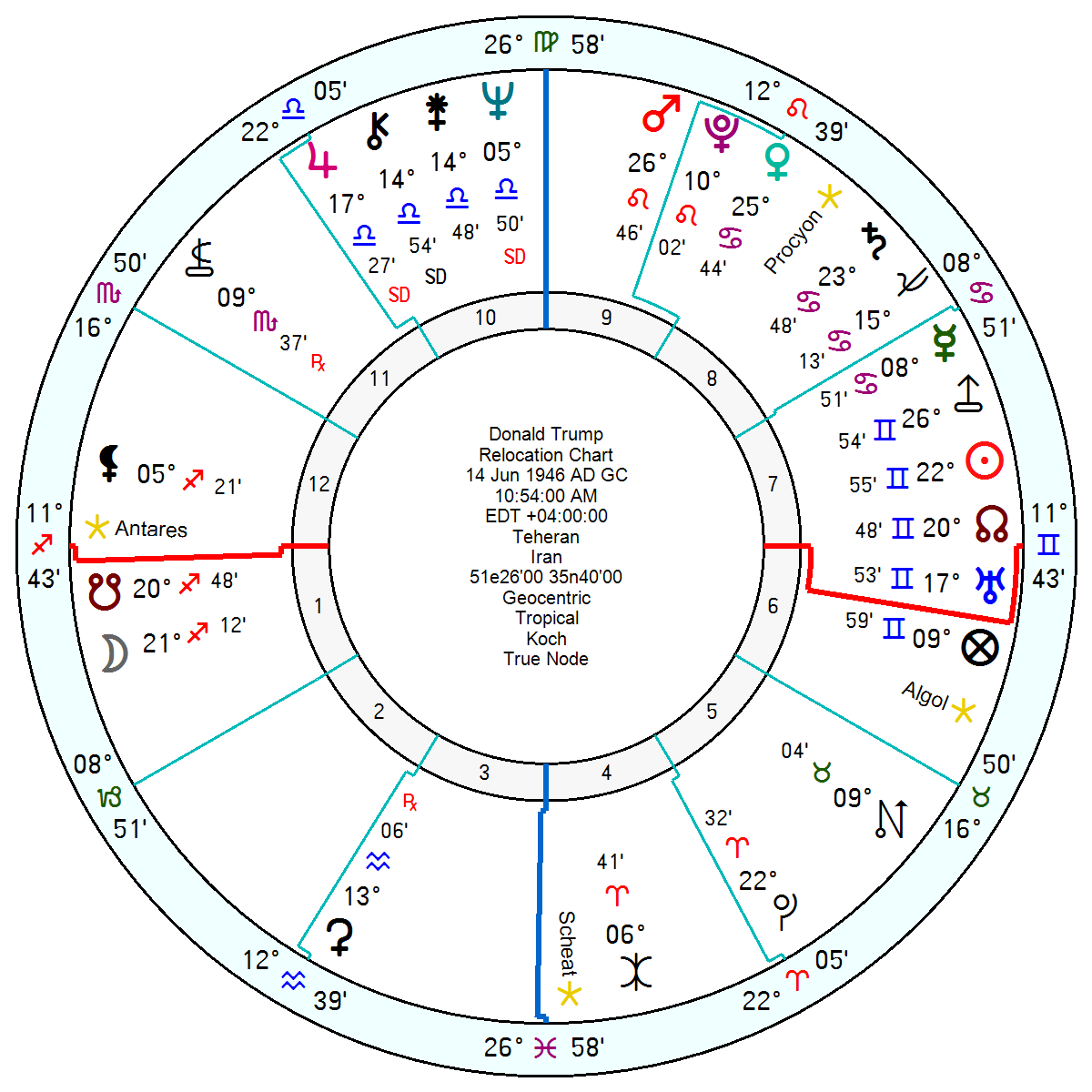
Other odds and ends – Trump’s chart relocated to Iran puts his wayward Uranus in the 7th house of allies and enemies; with an unrealistic Neptune in the 10th. The combative Antares sits on the relocated Ascendant and the unfortunate Scheat on the IC. His Progressed Moon is moving through the 12th house of his relocated chart for almost another year which is not generally progressive.
The FT has a couple of cogent pieces about how Putin and Trump both threw away strong hands in acts of ‘geopolitical self-harm.’
‘Russia’s inability to subdue Ukraine is the most expensive failed war in modern history. By intimidating neighbours like Finland, Putin has more than doubled the length of Nato’s boundary with Russia entirely through his own doing.’
‘Likewise, America’s sway over the Middle East is broken. In very different ways, Kyiv and Tehran are showing the world how to bring a colossus low.’
‘Each is burdening their countries with costs that will persist many years after they have lost power.’
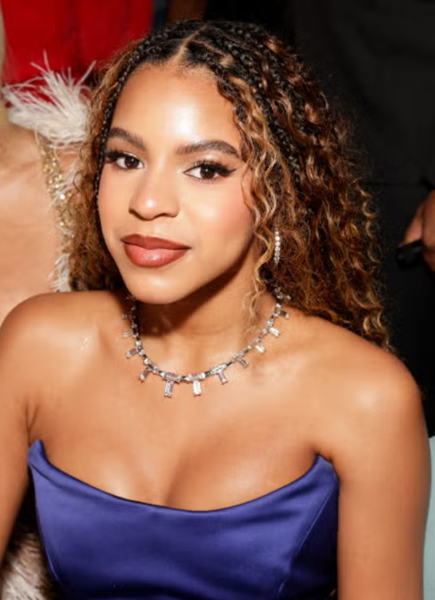
Blue Ivy Carter, daughter of Beyonce and Harper of the Beckham clan, both in their early teens, appear keen to launch themselves into adult careers, following their mothers’ footstep.
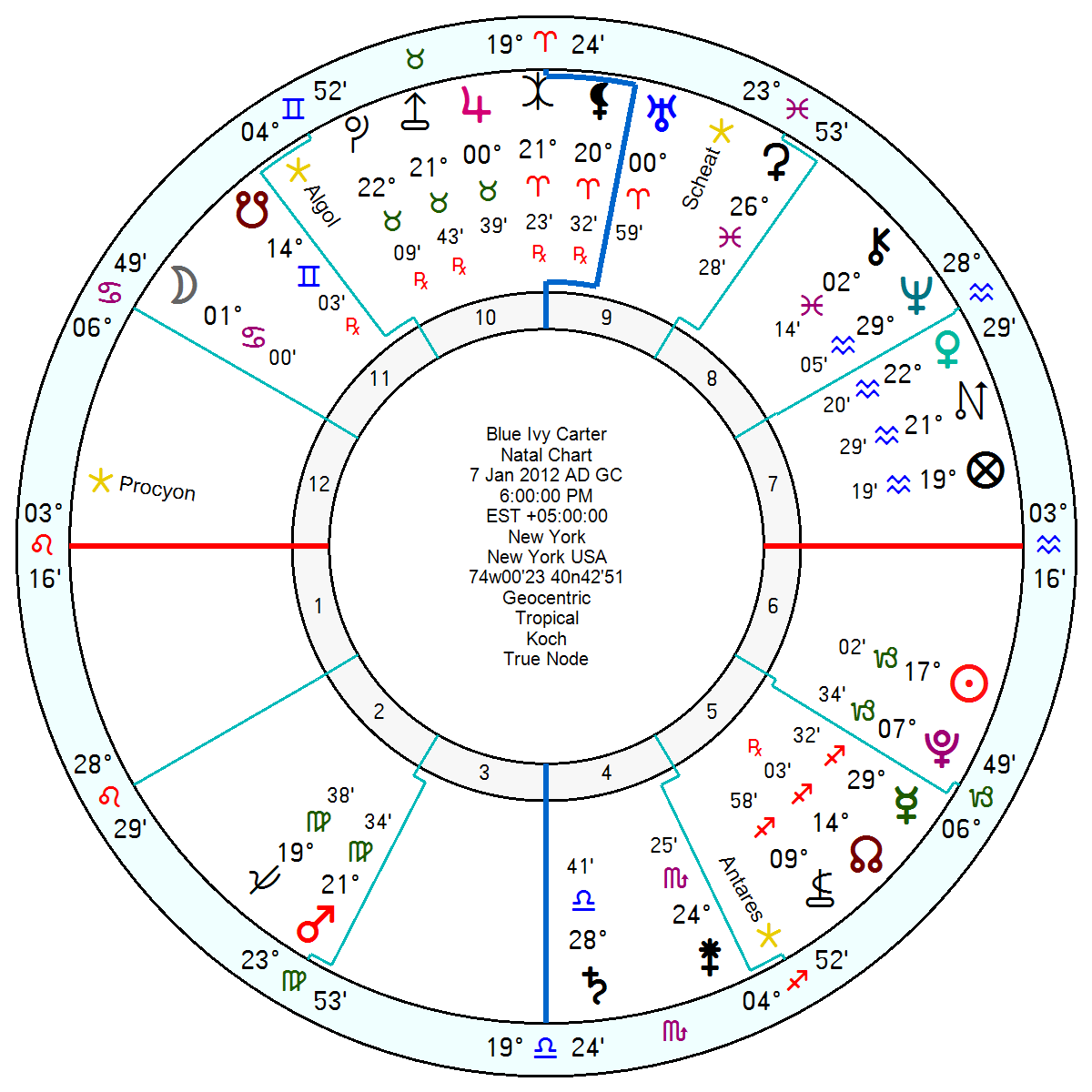
Blue Ivy, 7 January 2012 6pm New York, is listed as a singer, actress, and dancer. Her 2019 single, “Brown Skin Girl” (with Beyoncé, Wizkid and Saint Jhn), entered the Billboard Hot 100 and won Best Music Video at the 63rd Annual Grammy Awards, winning her a second Guinness World Record for being the youngest individually credited Grammy Award recipient. She made her feature film debut in 2024 in Mufasa: The Lion King, portraying Princess Kiara.
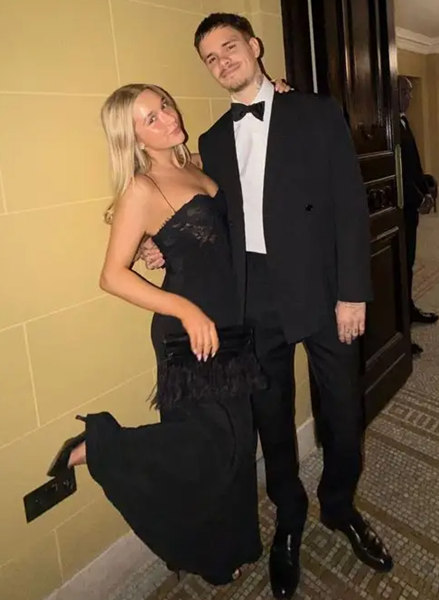
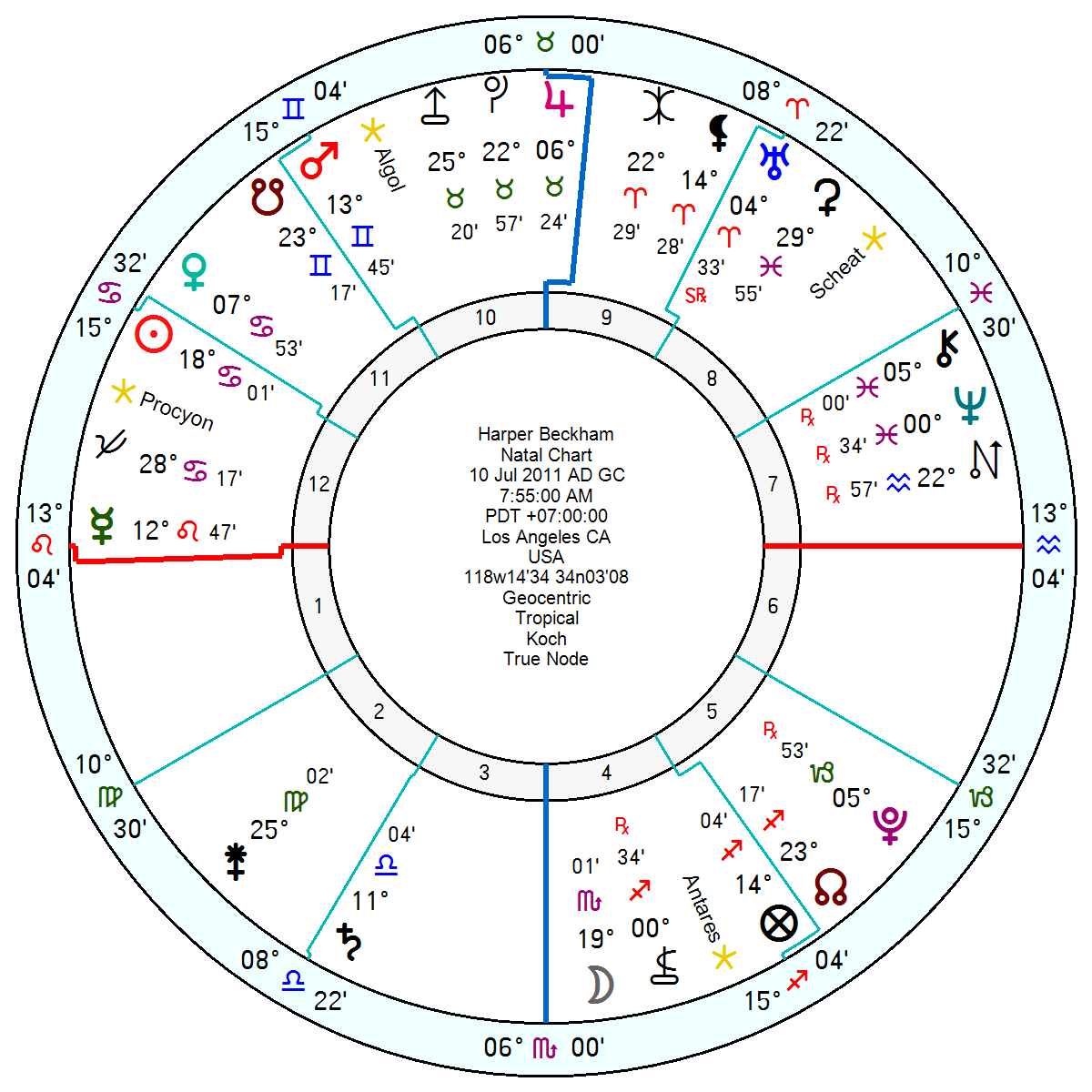
Harper Beckham, 10 July 2011 7.55am Los Angeles, appears in numerous Beckham family photos in the media and Instagram and is evidently about to launch her own skincare range, aged 14. The photo above in a sleek black dress, an echo of mother Victoria at a more mature age, was taken at an 80th birthday celebration for her grandfather with her brother Romeo.
Both have lucky, self-assured, indulgent and acquisitive Jupiter in Taurus in their 10th house of career in a confident trine to Pluto. So no doubting their ambition or good fortune.
Blue Ivy has her Pluto and Capricorn Sun in her hard-working 6th house with her Sun in an energetic trine to Mars in Virgo. Saturn in her 4th hints at a home life concerned with work and duty rather than play; and her Cancer Sun on the cusp of her 12th opposition Pluto square Uranus hints at an unpredictable and not always nurturing mother experience. She will be a strong-minded individual, rebellious at times and disruptive. Her Neptune in the 8th could bring her success as an actress from her ability to project a dreamy aura.
Harper has her intensely emotional Scorpio Moon in her 4th so a different family experience and much stability from her father to whom she seems close. Her Cancer Sun is in the creative 12th; with her Venus in Cancer adding to her design skills in her friendly 11th in a charming, seductive opposition to Pluto in her performing 5th house. She will be intent on making a splash no matter what she does.
[I don’t normally write up under agers but since their parents appear to flaunt these two it hardly seems necessary.]
Nicola Sturgeon’s former husband Peter Murrell has admitted embezzling £400,000 over 12 years from SNP party funds. She said she was “angry, hurt, sad and very distressed” by his admission but denied knowing anything about his actions. Critics said it was inconceivable she was unaware of what Peter Murrell was doing when they ruled the nationalists as a power couple.
After her surprise decision to stand down as first minister and party leader in February 2023, the police raided the couple’s home near Glasgow two months later. Murrell had been responsible for its day-to-day running of the party since 1999.
Murrell born 8 December 1964, Edinburgh, has a Sagittarius Sun opposition North Node in Gemini square a formidable Pluto, Mars, Uranus conjunction so more of a wild card than his boring-bank-manager image would suggest. He also has Jupiter in indulgent, acquisitive Taurus in a high-finance and scandal-prone opposition to Neptune Venus in Scorpio. At the moment his Solar Arc Sun is square his Neptune exactly and his Solar Arc Pluto conjunct – hinting at a year of devastation. Since his arrest the whole stellium of Uranus, Mars, Pluto in its Solar Arc positions has been tugging on his Venus Neptune opposition Jupiter.
When two chart configurations collide by Solar Arc it usually brings a life changing phase.
Nicola Sturgeon, 19 July 1970 3.16pm Irvine, Scotland, has a Sun Cancer conjunct Mars in Leo in the communicative 9th house as part of a Half Grand Sextile to Neptune in Scorpio opposition Saturn in Taurus sextile/trine Pluto and Sun Mars. She was under considerable pressure when she stood down, from criticism about failing public services to a misbegotten trans argument, as tr Pluto had been opposing her Sun and then Mars.
She is not out of the woods yet since her Solar Arc Mars will be conjunct her Pluto later 2026 into early 2027 which will be trapped and infuriating. Her Solar Arc Sun/Mars midpoint will conjunct her Pluto by 2029 and the Sun by 2031 – so a long run of blocked, scary influences. Plus this year she has had a highly strung SA Uranus conjunct her Neptune – so her entire life has been given, and will continue to get, a shake up of the negative variety. Her Progressed Moon is going into her 4th now for two years ahead so she will no doubt try to disappear into a protected space and keep her head down. Tr Uranus into her 8th within weeks and staying until the early 2030s hints at an erratic phase financially and emotionally.
The SNP, 7 April 1934 chart, is showing signs of an emotional upset this year with tr Uranus square the Venus; and their relationship with Murrell hints at intense disappointment with tr Neptune square the composite Mars Uranus opposition Venus now and for some years ahead.
The SNP relationship with Sturgeon, once hailed as she-who-could-do-no-wrong, is similarly undergoing disillusionment of considerable proportions with jolting surprises coming now and for three years ahead as well. Tr Uranus is conjunct the composite Mercury exactly now and conjunct the Sun Mars in future years; with a deeply uncertain tr Neptune conjunct the Saturn by 2028 as well.
ADD ON: Much derision in the media and comments columns as Nicola Sturgeon claimed she had been married to someone “I obviously didn’t know at all” and suggested some of the attacks on her were because she was a woman, claiming there were people in society who “look for a woman to blame” when a man “does something wrong”.
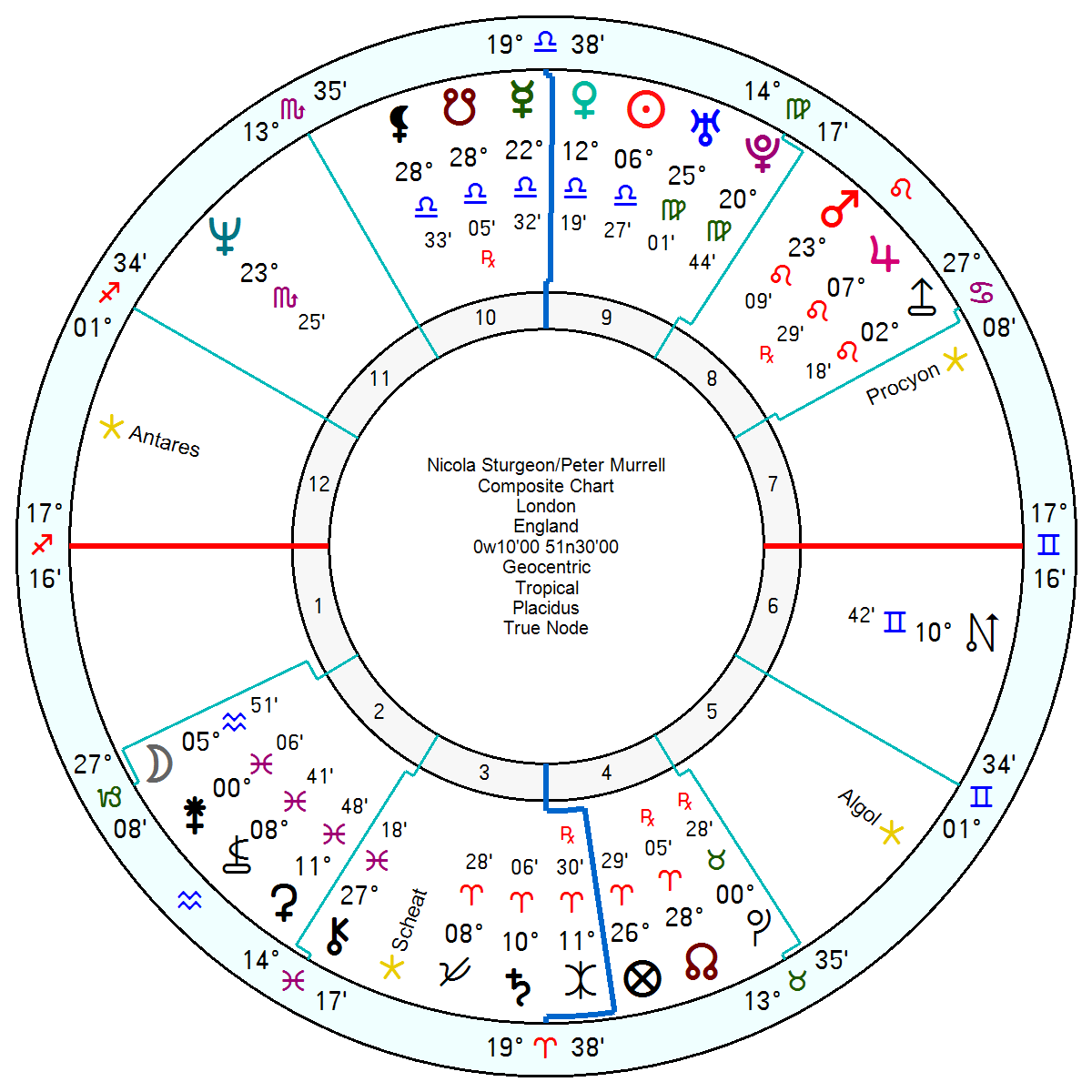
Murrell’s afflicted Sun and South Node fall in her 2nd house of finances, suggesting financial cooperation; though the Sun individual may also cultivate the other for their own purposes. Both have Moon in Aquarius and both have Neptune in Scorpio. His Jupiter in indulgent Taurus falls in her 7th conjunct her Saturn, initially offering enthusiastic support. What is interesting is his Saturn in Aquarius in her 4th house = home used for business) is on the apex of a yod to her Pluto sextile Sun Mars conjunction – inextricably bound together by fate.
Their relationship chart has an affectionate composite Sun Venus in a cool opposition to Saturn so work came first. There is also a publicity seeking Mars square Neptune; and a home-comforts Jupiter probably opposition Moon.
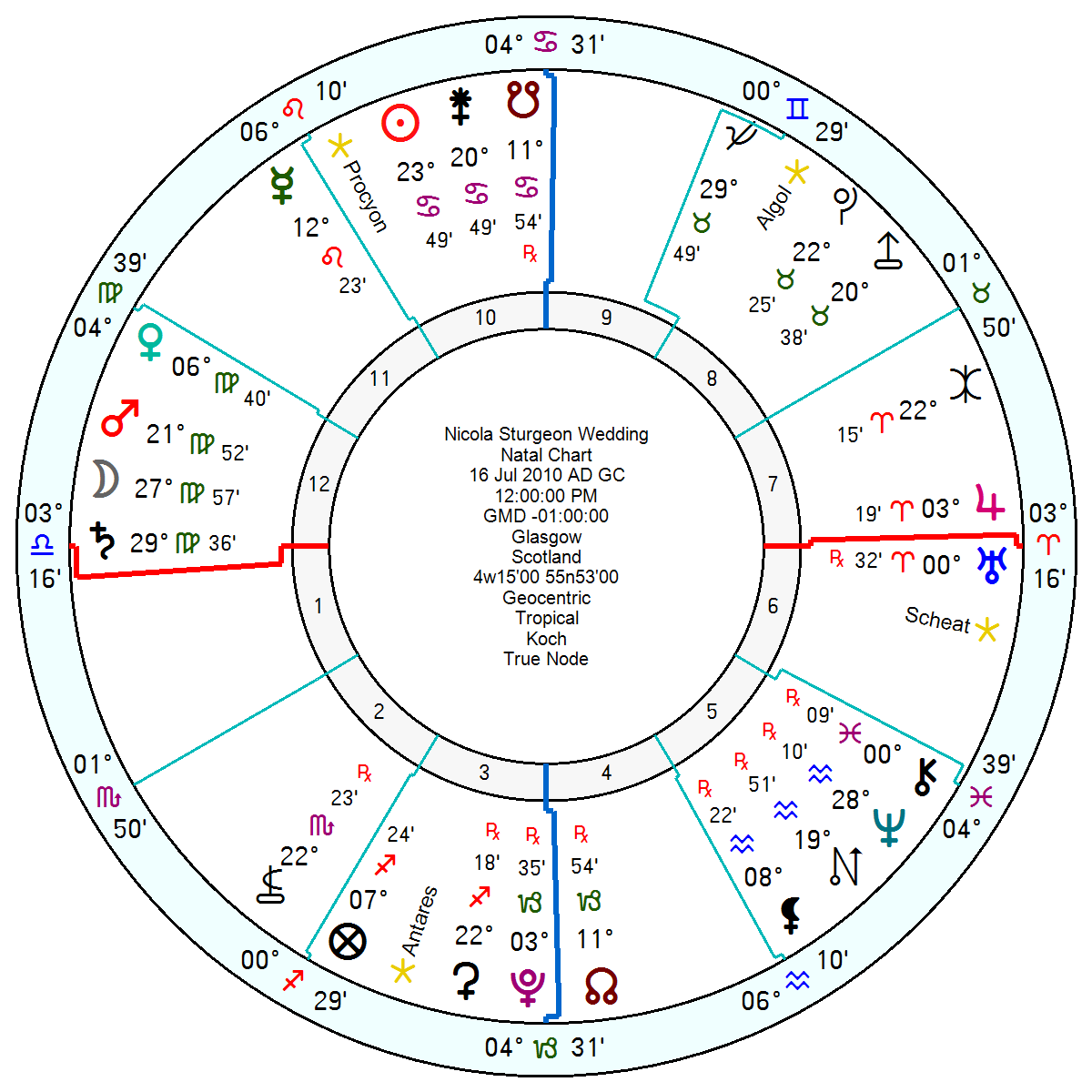
Their wedding chart, 16 July 2010 Glasgow, hints at equal parts good fortune and equal and opposite of aggravation. A lucky Jupiter Uranus conjunction was opposition a downbeat, workaholic Saturn in Virgo in an iron-control, rules-don’t-apply-to-us square to Pluto. There was also a yod of Sun sextile Mars inconjunct Neptune and Nessus – for a hard-driving relationship that ended in disgrace.
The astonishment of it all is that they remained the ‘golden couple’ for so long, spraying venom on any criticism, before the house of cards tumbled.
Ben-Gvir, the Israeli minister in charge of police and prisons caused outrage within and outside the country with his behaviour towards the Gaza flotilla activists. He is the unacceptable face of Israel’s extremist fringe to whom Netanyahu handed the keys in an act of expediency to save his own political skin.
The IDF and Shin Bet, the domestic security agency, have become alarmed by Ben-Gvir’s success in politicising the Israel police, replacing independent commanders with loyalists who tolerate settler violence in the West Bank and crack down on anti-government protesters. He praises those who use lethal force and has fired commanders who have shown restraint. The far right increasingly views the army as an instrument for a messianic purpose: the permanent possession of biblical land in the West Bank.
Matthew Gould, former UK ambassador to Israel, writes in The Times: “The real danger of Ben-Gvir is not that he is an eccentric anomaly who will eventually be rejected by the immune system of a robust democracy; the deeper tragedy is that he is winning the argument among a substantial minority of young Israelis and that the demographic shift is on his side.”
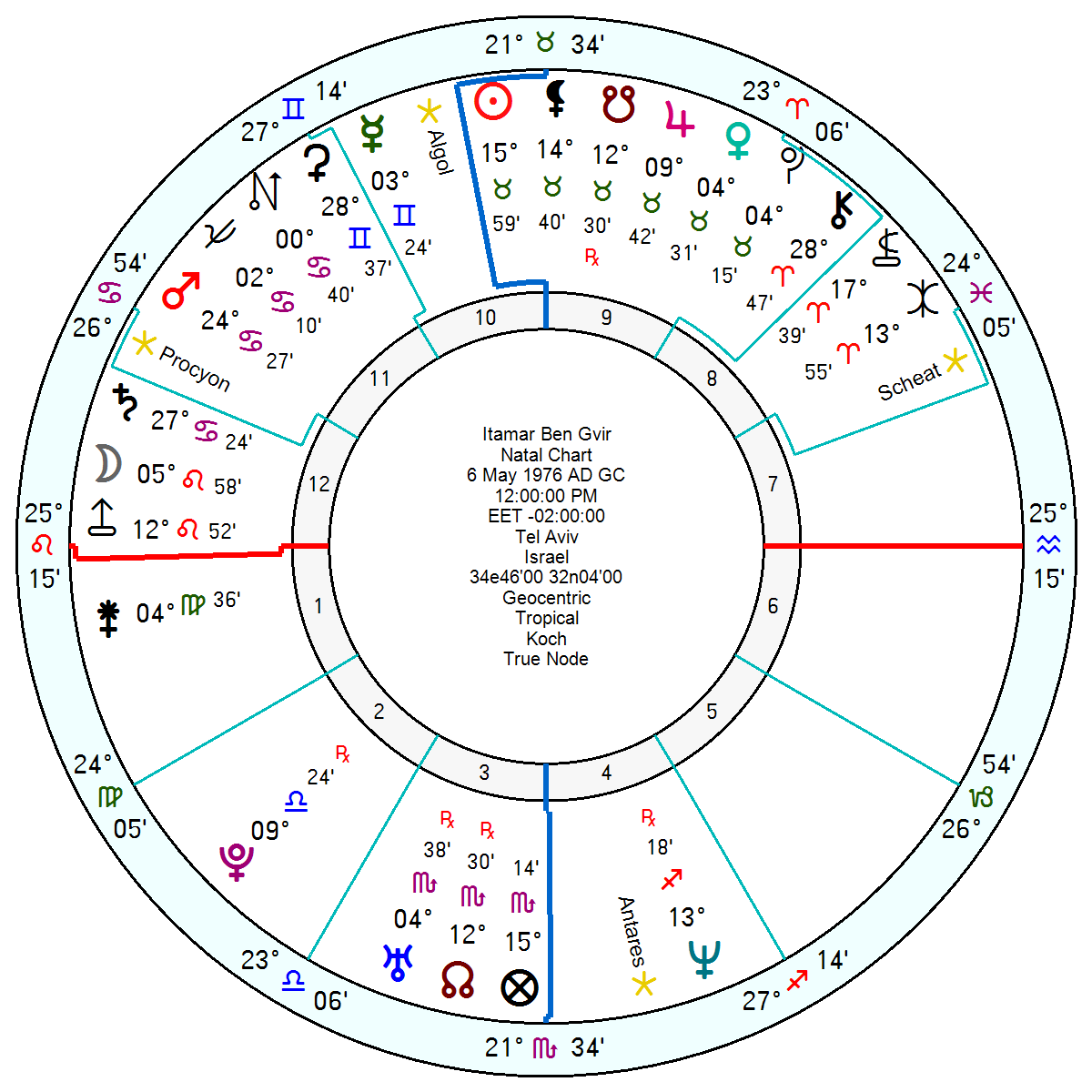
Born 6 May 1976 in Tel Aviv into a moderate household of Iraqi-Kurdish Jewish descent, he was radicalised as a teenager during the first intifada and was unusually exempted from mandatory military service, having been deemed him too dangerous and politically extreme to be trusted with a weapon or uniform. He has at least eight criminal convictions. He draws his support from two main groups: lower-income “Mizrahi” Jews of Middle Eastern or North African descent, who have long felt ignored by Tel Aviv’s secular elite; and Generation Z Israelis, who have grown up knowing only conflict.
‘Ben-Gvir and Smotrich are fascists who are dismantling the judiciary, eroding civil liberties, destroying Israel’s international standing and dragging the country toward an irreversible, apartheid-style single state.’
This is all background to an overlooked side of Uranus, which astrologers tend to laud as one of their own kind but can have an unsavoury negative end to its spectrum.
Ben Gvir is a Sun, South Node, Jupiter and Venus in Taurus so a heavyweight personality; with a can-be-cruel Mars Saturn conjunction in Cancer. He also most significantly has a yod from Neptune sextile Pluto inconjunct Jupiter, South Node and Sun – such a yod tends to over-confidence and egotism, me-and mine to a manic degree. And its reaction point which is highly sensitive to the workings of the yod is Uranus in Scorpio which sits in opposition. When he was brought into Netanyahu’s cabinet in late 2022 tr Uranus was exactly conjunct his Taurus Sun.
His Uranus is being upended throughout this year and 2027 till the end with tr Pluto square, which will be a marker for what comes next, shifting his life onto a different trajectory. Uranus being a trickster planet it is never clear whether that will bring sudden advance or collapse.
2027 could bring failure for him with his Solar Arc Mars square his Neptune; but he could bounce back with a vengeance by 2029 when tr Pluto squares his Jupiter; which is when Israel and the Middle East looks even more stressed.
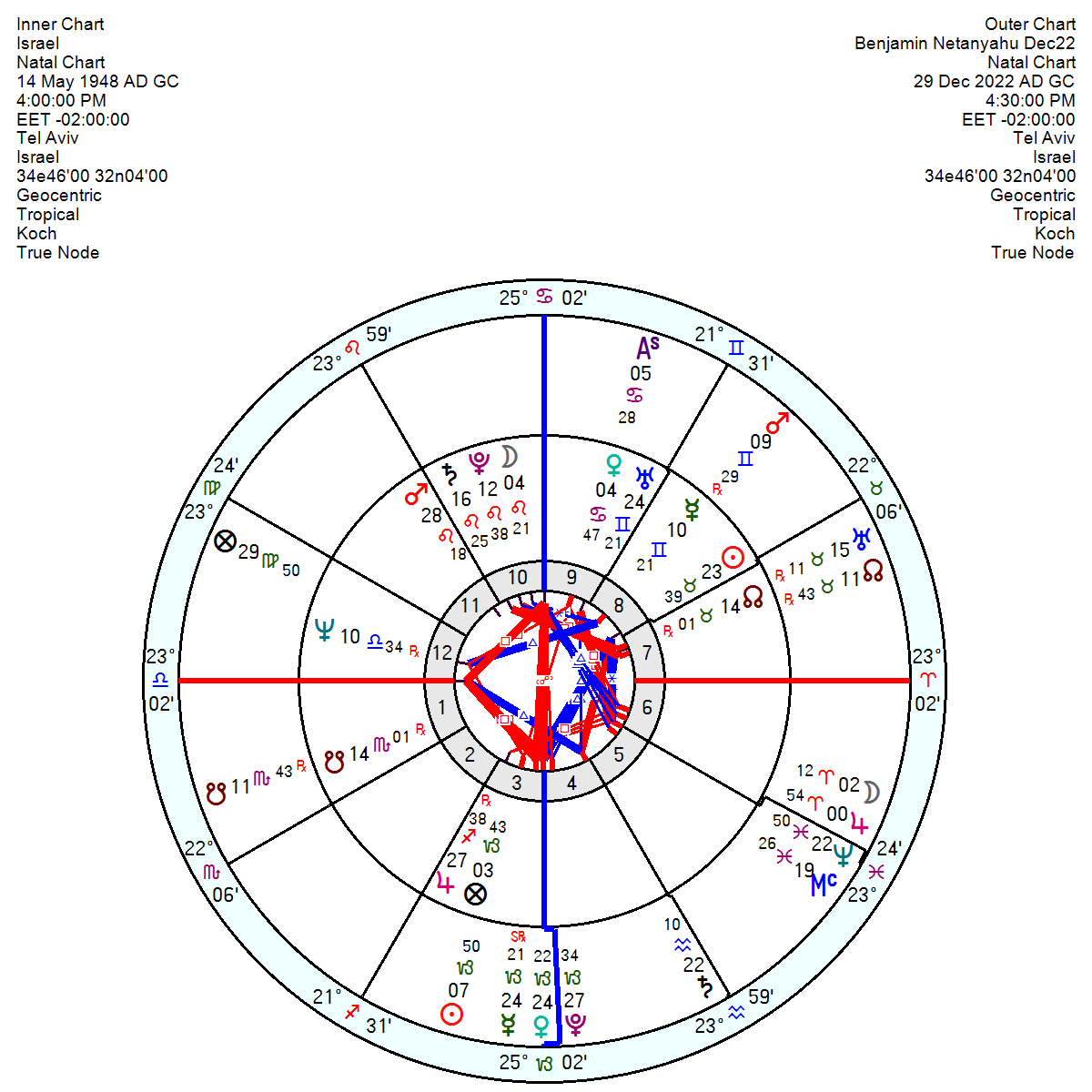
Uranus was also in effect on the Israel chart when he was pulled into the mainstream by Netanyahu’s 2022 election victory. I wrote at the time: Israel – on a dark road backwards 30th December 2022. “Israel facing a historic moment on its path with a Nodal Return and a liberating Uranus (approaching a) conjunction to its Taurus Sun has turned its face against progress and doubled down on the worst of the past. Benjamin Netanyahu, still facing charges of bribery, fraud and breach of trust, was sworn in yesterday as prime minister, heading the most right-wing administration in the country’s history, made up of Jewish ultranationalist and religious parties.”
Uranus, the liberator? North Node, the way to salvation? Or the opposite.
See also : Israel – what went wrong? 22nd April 2026
**
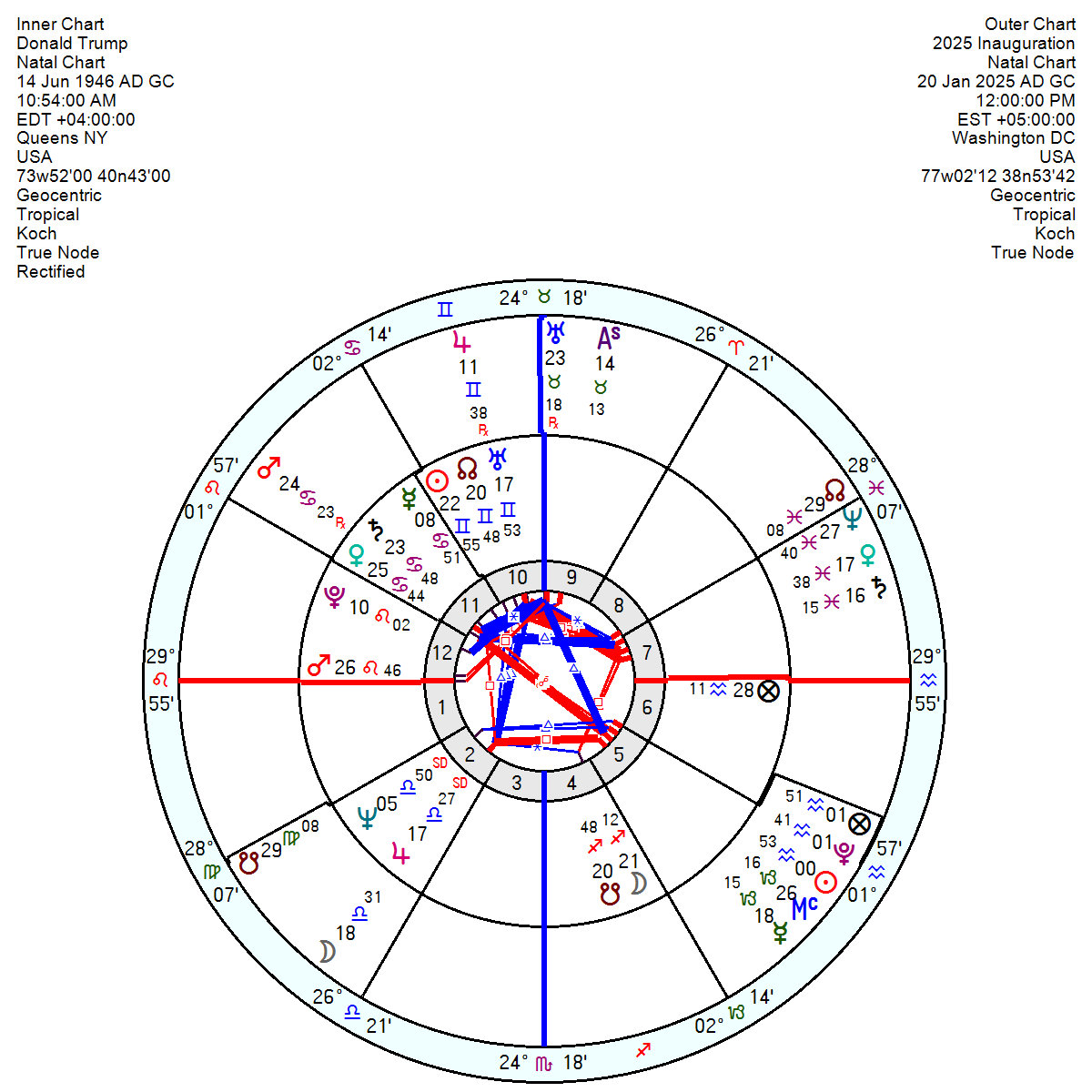
The other Uranus which tends to get overlooked is sprinkled across Donald Trump’s path. A spotlight is usually turned on his Geminian sleight-of-hands or his bombastic Mars in Leo and heartless Mars/Saturn midpoint on his 12th house dirty-dealing-behind-the-scenes Pluto. Yet he has Uranus conjunct his North Node in his 10th and was elected this time round in 2024 with tr Uranus crossing his Midheaven. The previous 2016 election victory occurred, amongst a bounty of Jupiterian aspects, as his Solar Arc Uranus was approaching the conjunction to his Mars and the SA North Node to his Ascendant. His ‘Uranian destiny’ was emerging into the open. This time round, when he has been running even more amok than before, his Inauguration chart has Uranus in the 1st.
The positive outcomes for a Uranian type: social visionary, a lifestyle changer, freedom fighter, trailblazer, crusader for a cause, radical reformer, light bearer for the truth, a mould-breaker.
Negative outcomes: Disruptive, wilfully out of tune with the established order, law-unto-himself, explosive when faced with obstacles, unpredictable, nervy, bluntly outspoken, lawless, socially defiant, wilful, has a tendency to make irrevocable rifts in community, creating chaos for its own sake.
When Aquarius does not display an idealistic humanitarian face the tendency is to blame Saturn its co-ruler. But in reality Uranus the other co-ruler can be just as damaging in a different way.
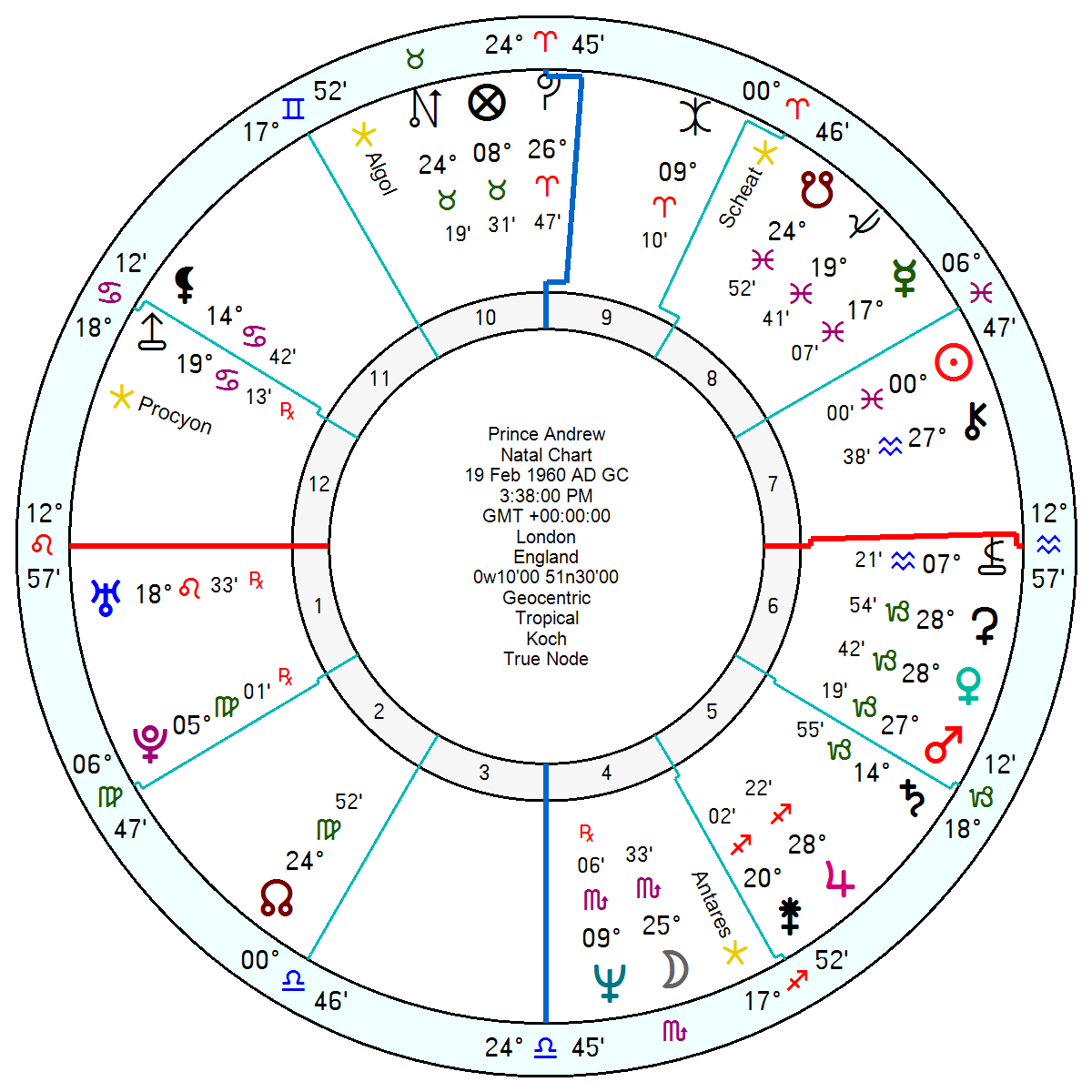
The other Uranus which has always puzzled me is Prince Andrew’s 1st house Uranus in Leo on the apex of a yod inconjunct Mercury sextile Saturn. Contrary, wilful, lawless, rebellious (in terms of personal conduct) – definitely. A trailblazer, original thinker, a catalyst for change – not so much except for the catalyst in that he ‘unwittingly’ caused damage to the monarchy and became weaponised in the fight for victims of Epstein.
Interestingly his life was jolted against his will into a ‘fated’ life change (as is often the way with yods) when Queen Elizabeth 11 died as tr Uranus was square his apex Uranus. In addition to losing a mother, he also lost his sole protector against allegations.
Obviously a chart has many components and Uranus is only one but it can be regressive rather than progressive. Just as revolutions (Uranus Pluto) can on occasion with the best of intentions pull down repressive regimes, they can end up with worse as anarchy takes over.
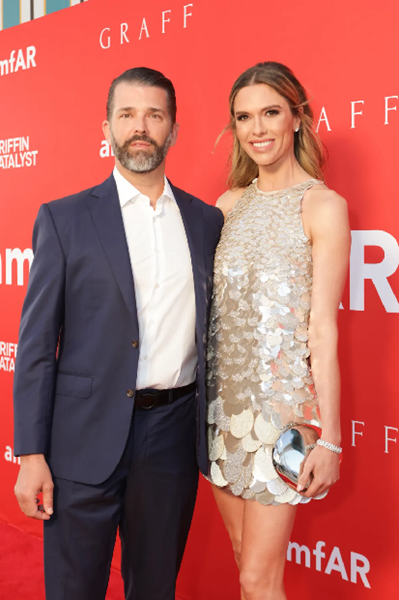
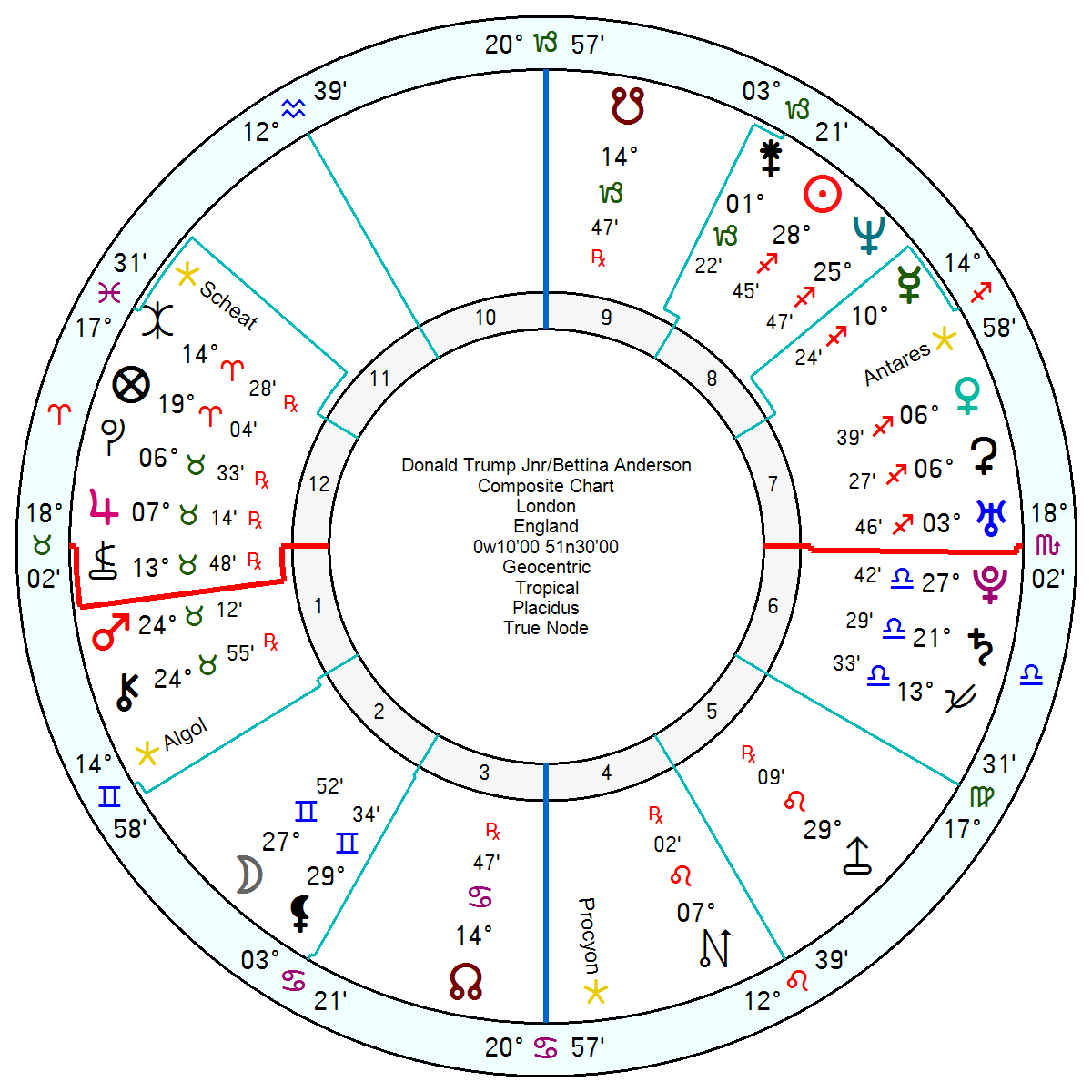
Donald Trump Jnr picked a Sun Uranus conjunction for his second marriage to socialite Bettina Anderson, officially registered on May 21st and celebrating in a party in the Bahamas this weekend, so private even his father will not attend ‘due to security concerns.’
Uranus would not be everyone’s choice for a wedding date since it emphasises freedom and independence but since Don Jr’s birth chart has his Sun/Moon midpoint conjunct Uranus (not always a recipe for settled marriages) it may not be so surprising.
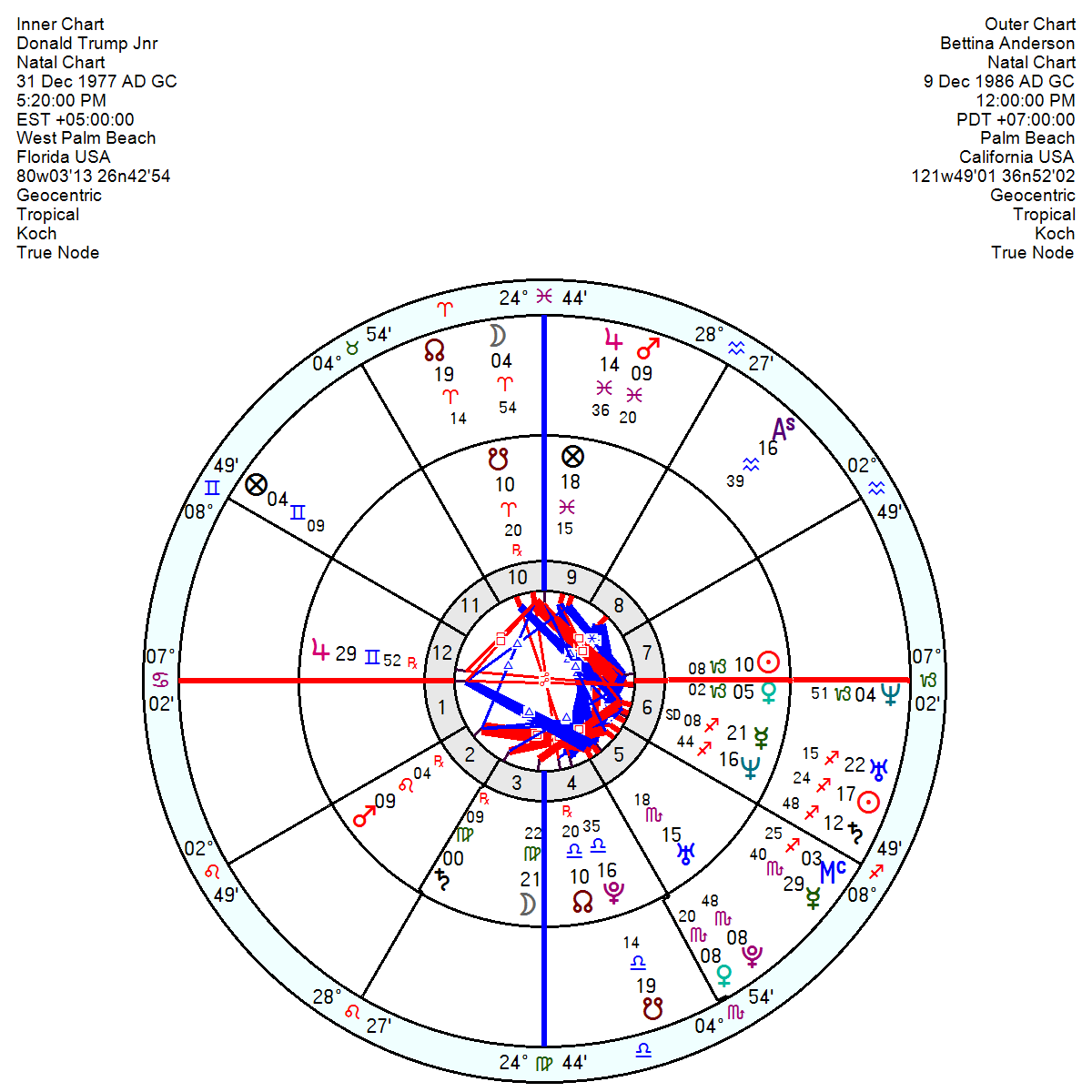
If his birth time of 5.20pm is sound then Bettina’s Uranus is conjunct his Descendant on the cusp of his 7th house of relationships which is equally mystifying.
He was born 31 December 1977 5.20pm (from memory) in West Palm Beach, Florida, and has a charming Sun Venus in Capricorn with his Sun in a controlling square to Pluto in his 4th house of home, family and childhood. He also has a family-connected Virgo Moon on the cusp of his 4th house. Plus an excitable, uncompromising Mars in Leo square Uranus in his romantic 5th house. He was previously married for 13 years and had five children; with a failed engagement thereafter before settling on Bettina.
She was born 9 December 1986 in Palm Beach and is a restless, independent-minded Sun Uranus and Saturn in Sagittarius. Her charismatic Venus Pluto conjunction in Scorpio fall in Don Jr’s 5th for a highly social connection though in square to his Mars and conjunct his Uranus it will make for high-octane moments. Her Mars Jupiter in his 9th will waken up his thinking and his outlook. Her Neptune is conjunct his Venus and Descendant for a starry-eyed connection – initially, though disappointment may follow.
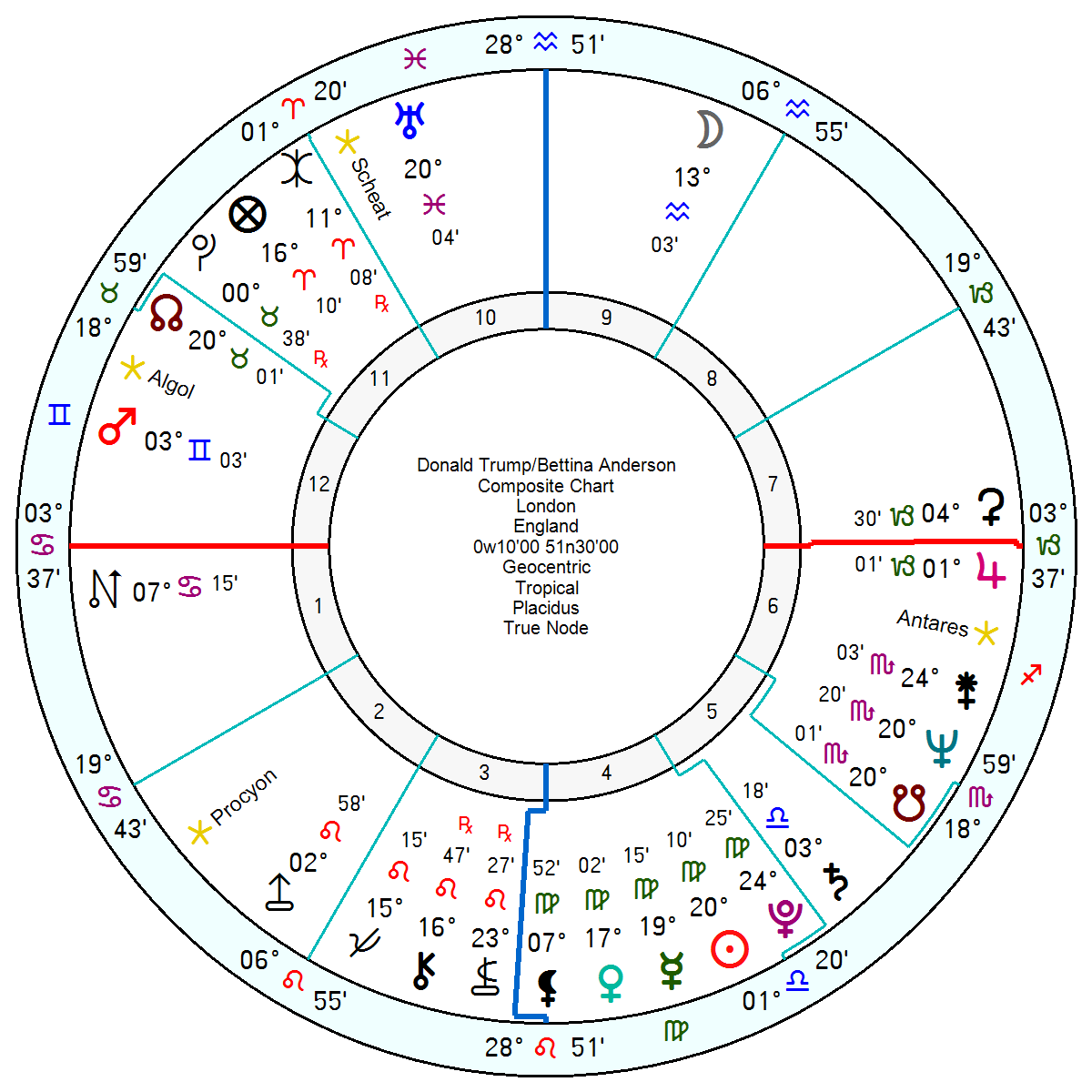
Their relationship chart is eye-curling with a hard-edged, chained-together by circumstances Saturn Pluto conjunction sextile an evasive Sun Neptune conjunction inconjunct Mars. Certainly it will feel fated with a yod and be a driven combination with materialistic Mars in Taurus leading. But it won’t be easy to handle for sure.
There was one media report (not confirmed) that Trump father in law was deliberately ducking the happy event. Her Uranus clashing with his Moon opposition Sun will not make it an entirely compatible relationship. And their relationship chart with a composite Sun Pluto conjunction opposition Uranus will make it a disruptive connection and constantly unsettled.
Vladimir Putin is plagued with a failing economy, a Ukraine invasion not going his way, with Trump not delivering on a Kiev submission and significant discontent internally. Mobile internet has been intermittently disrupted or shut down entirely, causing Russian businesses to lose billions of roubles, with higher taxes and rising inflation, and the cost of groceries and household bills soaring.
According to sources he will not give in over the Ukraine until he has taken Donbas but military analysts say at the current pace of advance, it could take years to fully capture the Donbas, despite what his generals are telling him.
Kyiv has reduced its dependence on Washington, while stepping up its own military production. The unblocking of a €90bn EU loan and deepening military and intelligence sharing ties with European allies have further diminished US leverage over Ukraine.
There is no sense, despite unease at home, that Putin will be toppled imminently; and Russian attacks appear to be stepping up on Ukraine this weekend which fits with the brutal Mars in Taurus square Pluto, exact next Tuesday.
Pin-pointing an exact exit date for any leader is not simple with multiple factors to consider. But 2027 looks most likely.
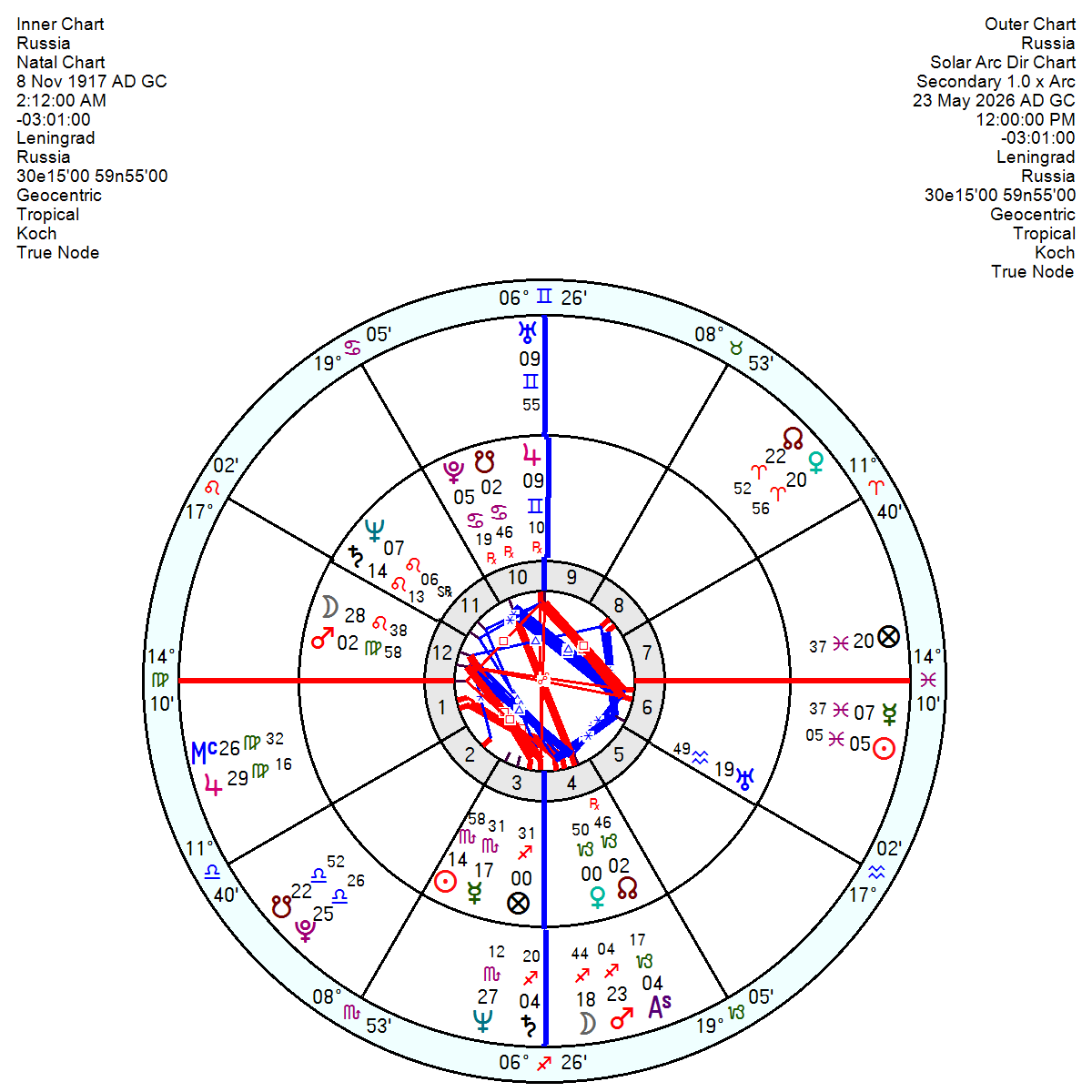
The Russia 8 November 1917 chart has a highly insecure, rattled tr Uranus square the Mars early this June, again over the New Year and in spring 2027. Then in April 2027 is hit with a double whammy of meltdown-confusion tr Pluto opposition the Neptune alongside a power and influence-undermining tr Neptune square the Pluto. Both of which continue on and off into 2028.
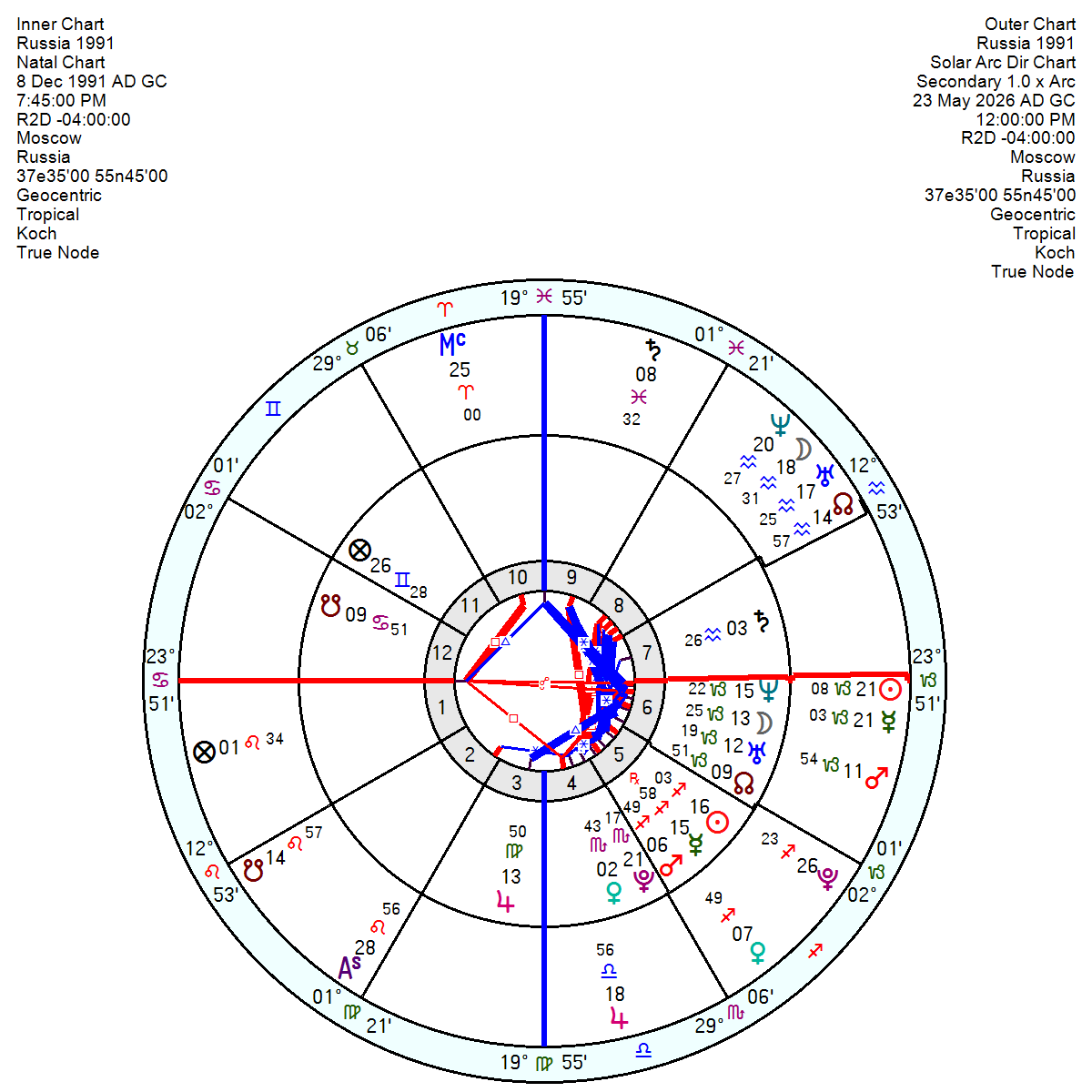
The Russia 8 November 1991 chart is labouring mightily under tr Pluto conjunct the Saturn bringing hardship all this year; with an explosive Solar Arc Mars conjunct the Uranus exact in five months. Again the same sense of confusion and devastation in 2027 as in the other Russia chart with tr Neptune square the Pluto; plus more insecurity from shocks with tr Uranus opposition the Mars in 2027.
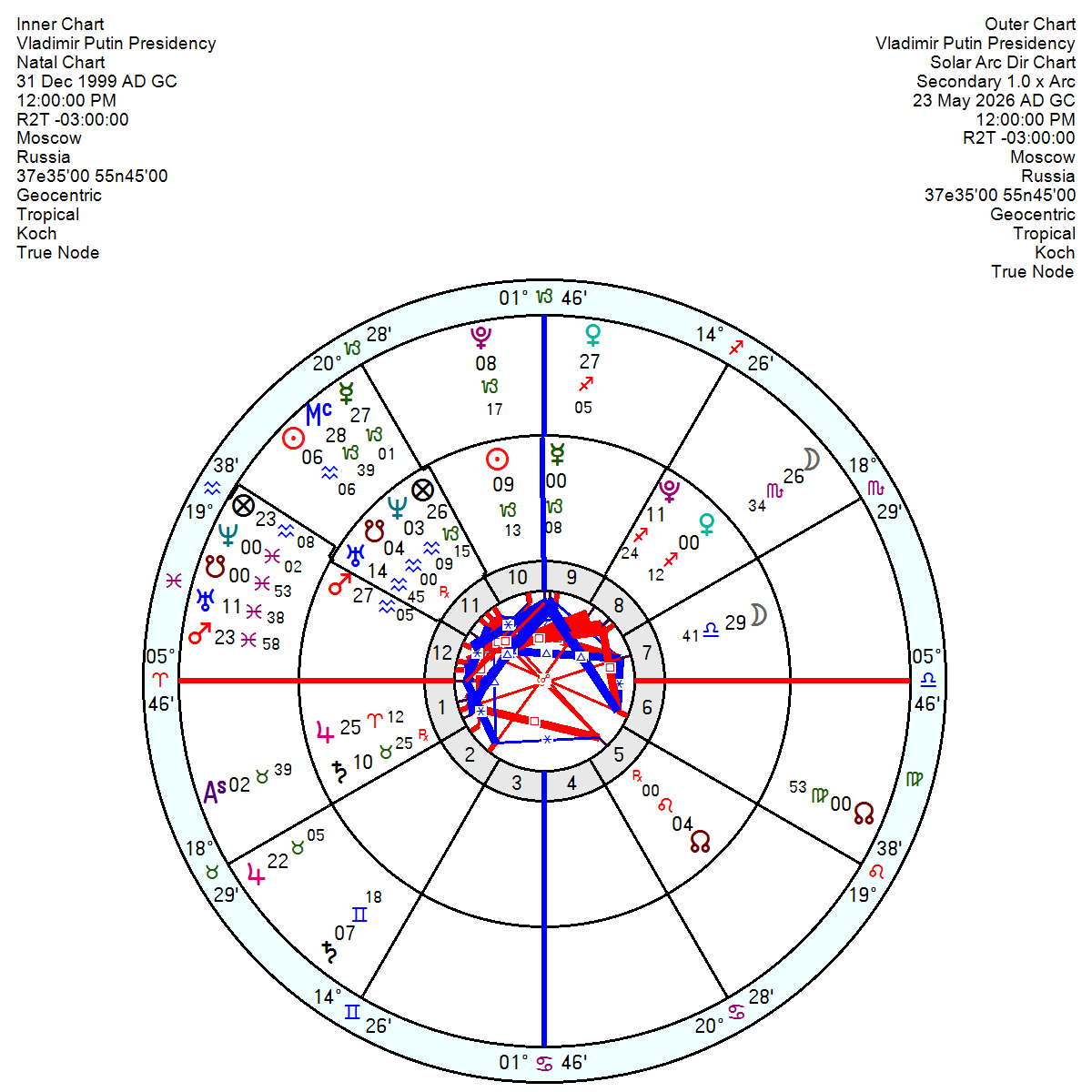
His 5th Term Presidency chart from 7 May 2024 looks to be failing significantly with tr Neptune conjunct the Mars late April to mid May 2027, September 2027 and March 2028.
His initial Presidency chart from 31 December 1999, which would be expected to flag up an exit is floundering this year; and unstable; with tr Pluto conjunct Neptune and Solar Arc Uranus square Pluto; with a blocked SA Pluto conjunct the Sun in 2027.
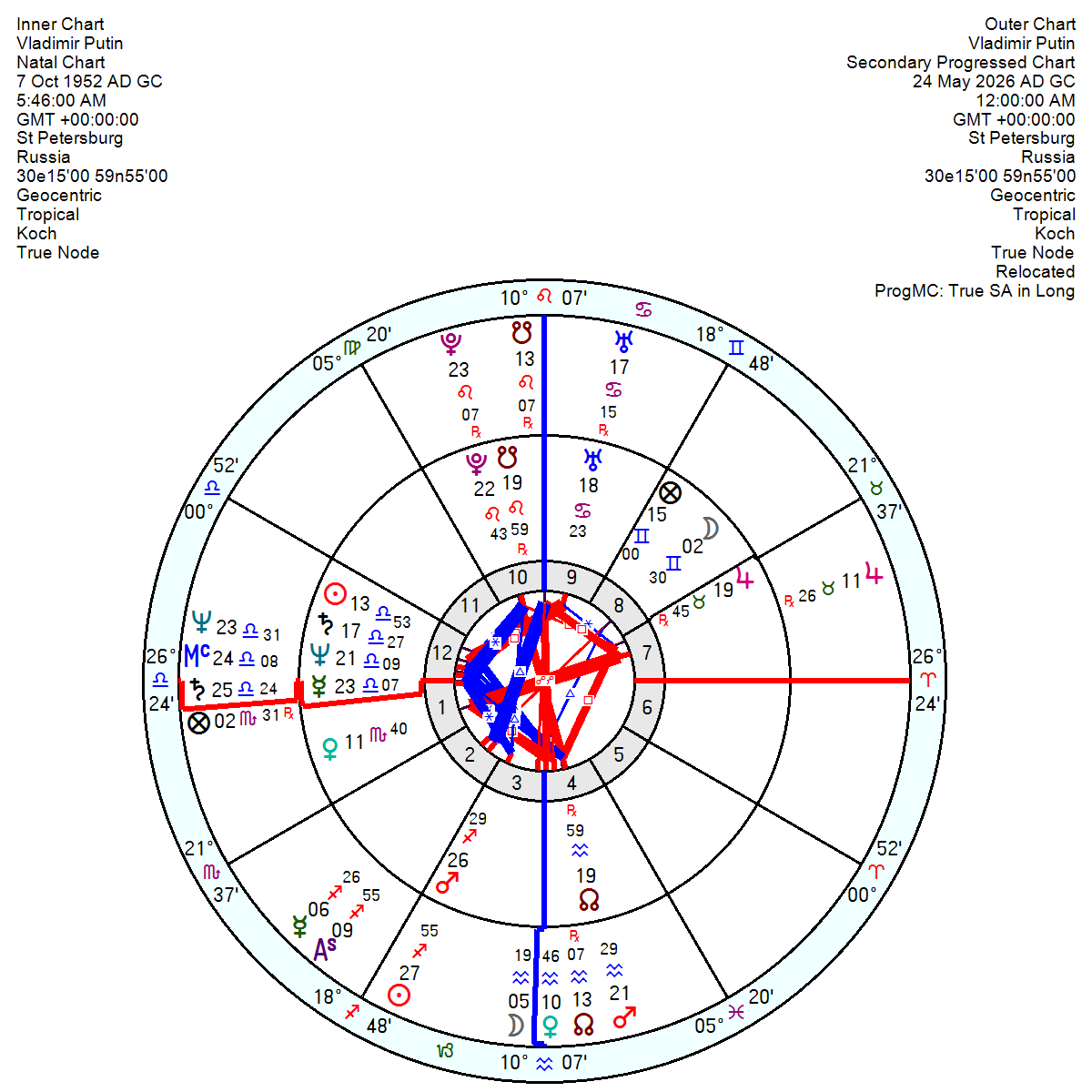
His natal chart, assuming 7 October 1952 is sound, has an ominous Progressed Mars still in orb of being conjunct his Noth Node and aiming to oppose his Pluto in 2027 which will exacerbate his sense of being totally trapped.
His relationship charts with both Russian charts:
Russia 1917 – has been under acute pressure since the Ukraine invasion with tensions erupting through this year and next.
Russia 1991 – discontented with emotional reactions intensifying in 2027.
The winds of change – sidelining Trump and Putin, both hoist by their own miscalculations.
“Numerology is the ancient esoteric belief that numbers carry energetic vibrations and represent a mystical connection between digits and metaphysical phenomena or human life. It is primarily used for self-discovery, understanding your life’s purpose, and mapping out the major cycles of your life.”
Different paths can lead to one goal though it is not always easy or possible to merge one belief system on top of the other. I have known biorhythms even solar flares coincide with astrological aspects so they came to the same conclusion from different routes. But they are separate disciplines.
Where numerology is helpful is with harmonic charts, which are drawn up to make less obvious aspects visible. The creative 5th harmonic of the builder relates to the 360 degree zodiac wheel divided by 5 giving 72 degree aspects. The creative 7th harmonic can be spiritual. Like all astrology there are pluses and minuses. The 9th harmonic can be humanitarian or money-grabbing (Bernie Madoff etc).
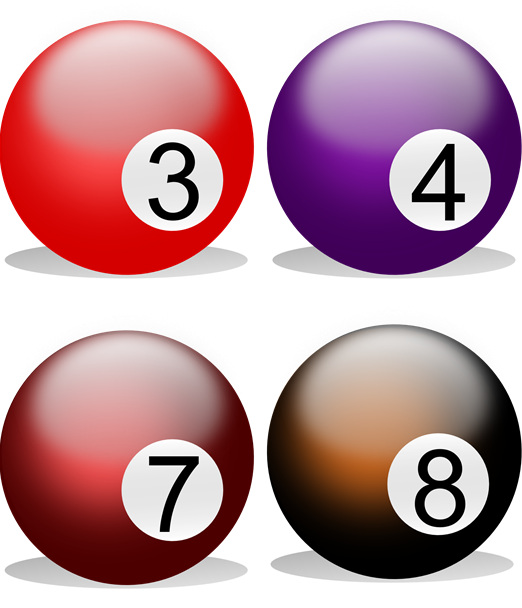
The below is a list that Vendla, a numerologist, gave me years ago which is helpful. Number 12 does fit with Pisces and/or 12th house. Number 8 fits Scorpio. Number 11could describe some Aquarian traits. Number 3 which house is Gemini’s natural home also. But the others not so much in terms of signs’ zodiac order.
The zodiac runs from Number 1 Aries, 2 Taurus, 3 Gemini, 4 Cancer, 5 Leo, 6 Virgo, 7 Libra, 8 Scorpio, 9 Sagittarius, 10 Capricorn, 11 Aquarius, 12 Pisces.
Numerology meanings:
1: The pioneer; Originality, innovation, ambition, determination. Also loneliness, egotistical, vain, dominating. 2: Cooperation, sensitivity, kindness, harmony. An entertainer at heart or at least artistically oriented (painting, music, writing). Also: Irresolute, deceitful, gossiping. 3: Charm, ambition, determination, artistic and verbal skills. Also cold, can be deceitful. 4: A fated number. Forever contradicting and in opposition to authorities. May have to start over and over again. Practical skills, organisation, strength, courage and perseverance. Also: Intolerance, dogmatism, ruthlessness. 5: Always on-the-go. Inventive, freedom-lover, fast-thinking, “sexy”. Also: Lack of concentration, irresponsibility, sensationalistic, self-indulgent, deceitful, “the player”. 6: “The Cancer number”; Sweetness, parenting, protecting home and family. The flipside is conventionality, stubbornness, unyielding, want of domination. 7: Seven is traditionally regarded as a spiritual number, endowed with a different kind of imagination, often artistic skills. Need peace. Perfectionism. A seeking soul. Also: too sceptical, too critical, sarcastic, cold, self-centred, attracted to alcohol/ drugs and occultism. 8: A fated number. “Karmic debt”. Soul wounds, bad luck or loss may follow this number, which also gives an abundance of strength and stubbornness in the face of difficulties. The road to success is often bumpy and hard, and if it comes easy, or at all, it will not necessarily bring happiness. 9: Strength, determination, the humanitarian. A philanthropic or artistic attitude to life is required, because if lacking, the number will “fail” to work constructively and could bring forward aspects such as frivolousness, immorality and irresponsibility. 10: “The wheel of Fortune”. Contains the innovation and creativity of the number 1, but even if 10 stands for prosperity and abundance, it also contains the seed of both rise and fall, of the good and the bad. 11: So called Master Number, which means that it is a difficult number to live up to. The positive aspect of number 11 is idealistic and inspired imagination. The negative aspects are fanatism and also dishonesty, greed, self-indulgency and even perversion. From a different position, 11 warns against hidden trials, disloyalty and betrayal from others. 12: The sacrifice. Being sacrificed or becoming a victim to other persons’ (or entities’) plans, ambitions or intrigues. 12 warns against being a victim of circumstances or dragged into other people’s affairs where you will be the one suffering the consequences. 12 may also make a conscious sacrifice. Also: Creativity, writers.
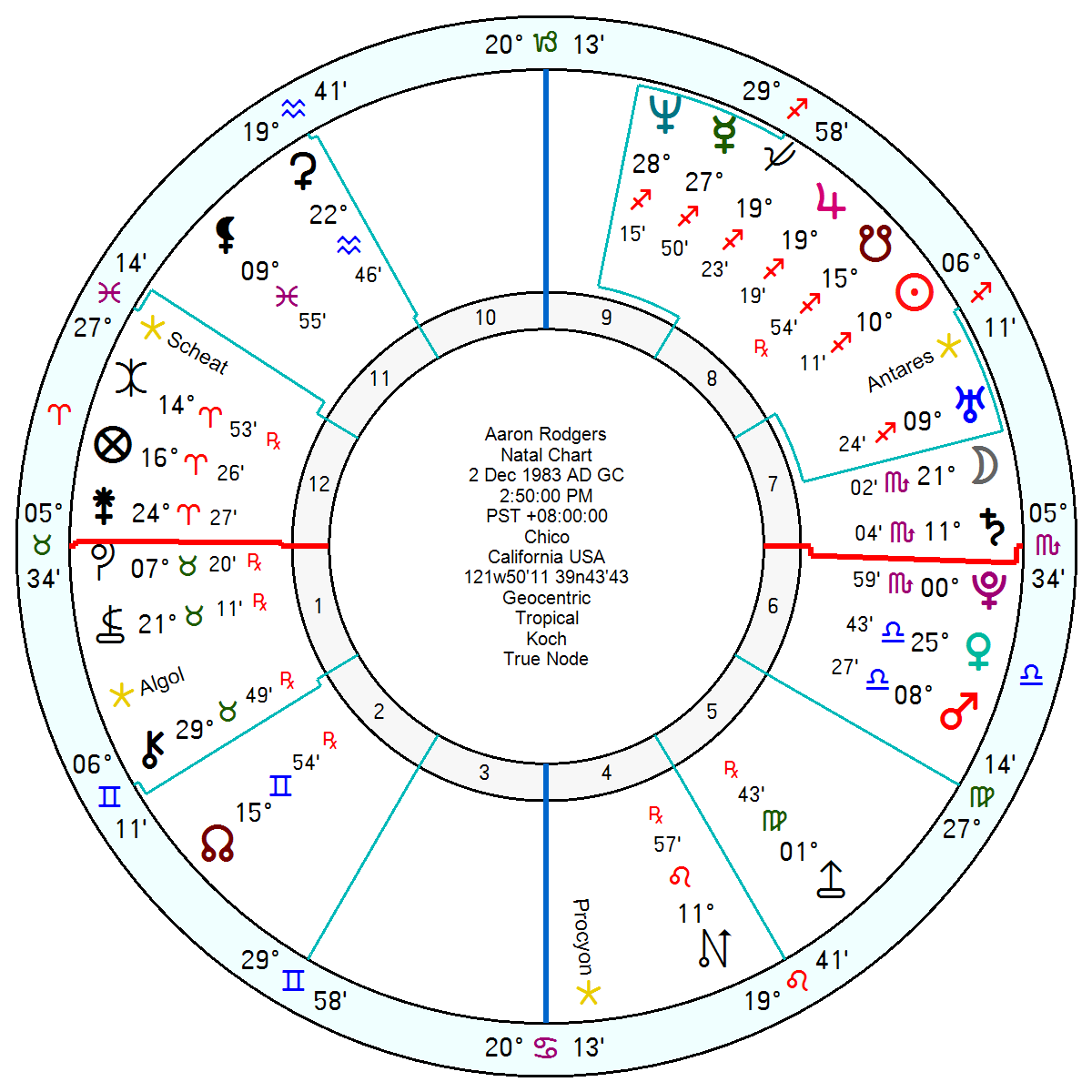
Aaron Rodgers regarded as one of the greatest and most talented US football quarterbacks of all time is to retire after 22 seasons during which he recouped nearly $400 million in fees. He says after he gives up the game he will not go into media work but disappear.
Born 2 December 1983 at 2.50pm Chico, California, he is a supporter of Robert F Kennedy Jnr and a conspiracy theorist. During a February 2024 appearance on the conspiracy-focused Look Into It podcast hosted by Eddie Bravo, he claimed numerous conspiracy theories on medicine, immigration, and John F. Kennedy. Amongst them he claimed that AIDS and COVID were created by the government for the sake of pharmaceutical industry profits.
His Sagittarius Sun conjunct Uranus (and the pugnacious Antares) all fall in his 8th house along with Mercury Neptune in Sagittarius on the cusp of his 9th. His Sun is sextile a hard-working Mars in Libra; with his Venus in Libra in an emotionally intense conjunction with Pluto. His Saturn and Moon in his 7th house in Scorpio are both unaspected. An unintegrated Moon tends to be emotionally disorganized; and an untethered Saturn can be a loner, craving solitude who tends not to have his weaknesses tested and to lack consistent planning in ordering his life.
It does not immediately leap out as a sportsman’s chart but the birth time is recorded as birth certificate. The 8th house as well as his unmoored Moon and Saturn may give rise to his florid conspiracy theories.