
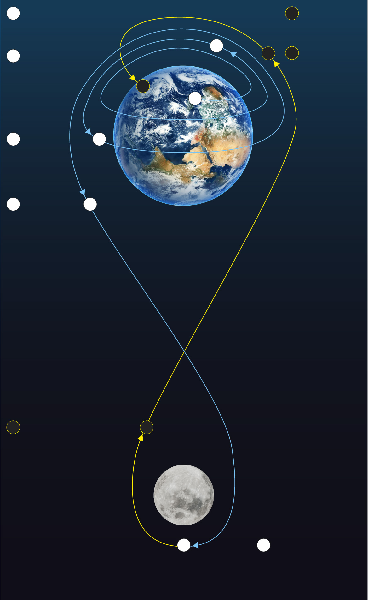
Nasa has launched four astronauts on a 1mn km flight around the Moon and back, the next step in the US space agency’s plans to establish a long-term presence on the lunar surface. The 10-day mission will take humans further into space than ever before, and is designed to test many of the technologies that Nasa will use for Artemis IV, scheduled to land on the Moon in 2028. Last week Nasa laid out a phased programme to build a $20bn Moon base. It will start with occasional human visits to build infrastructure on the lunar surface and then eventually transition over several years to continuous human habitation. This launch marks the first time since the Apollo 17 mission of December 1972 that humans will have left lower Earth orbit.
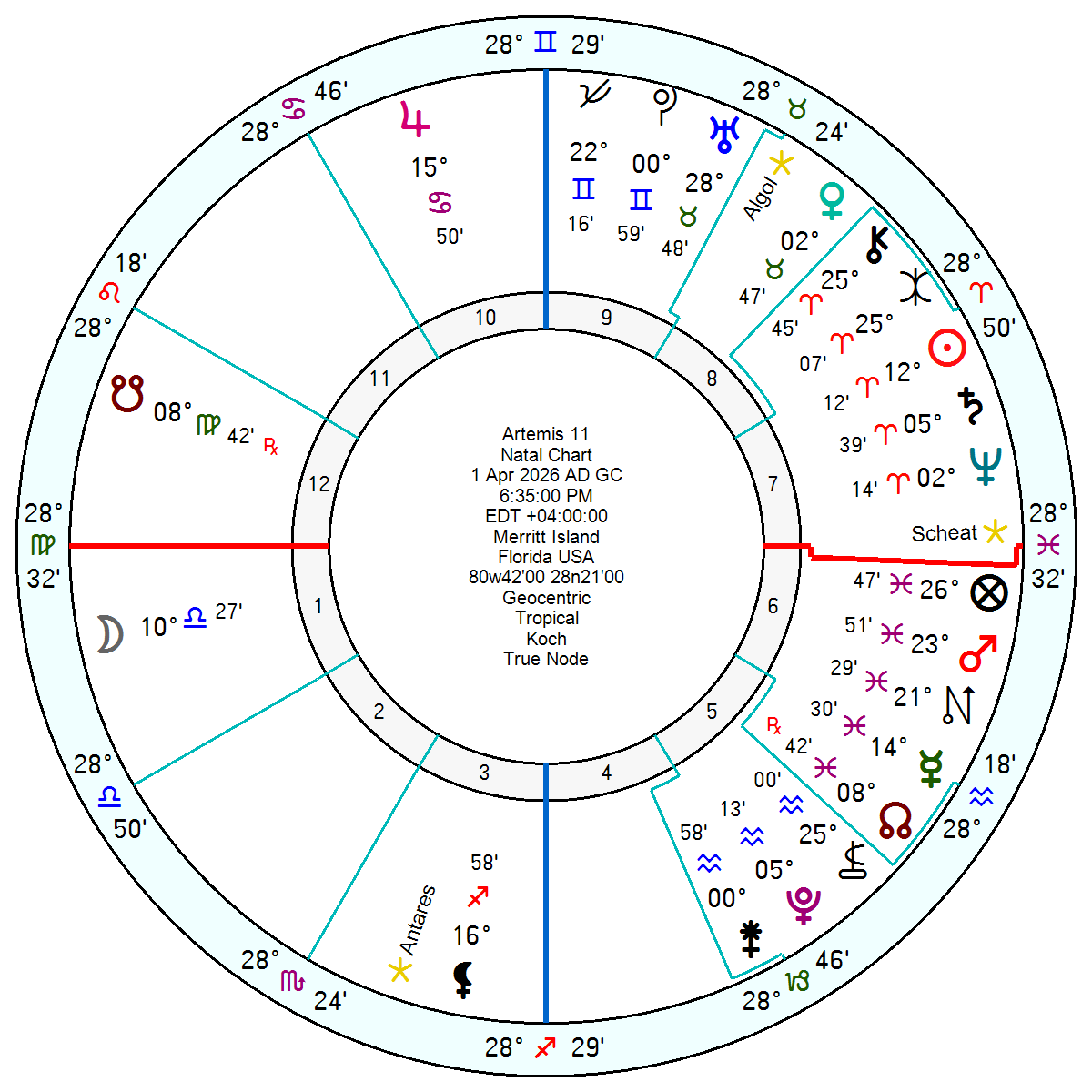
Artemis 11 took off at 6.35pm 1 April 2026 from the Kennedy Space Center on Merritt Island, Florida with a successful Jupiter in the 10th square the Full Moon; Uranus in the far-travelled 9th, a costly Venus in Taurus in the financial 8th, Pluto in the grandstanding 5th and Saturn Neptune together in the 6th fittingly for the first woman and first black man to go into space.
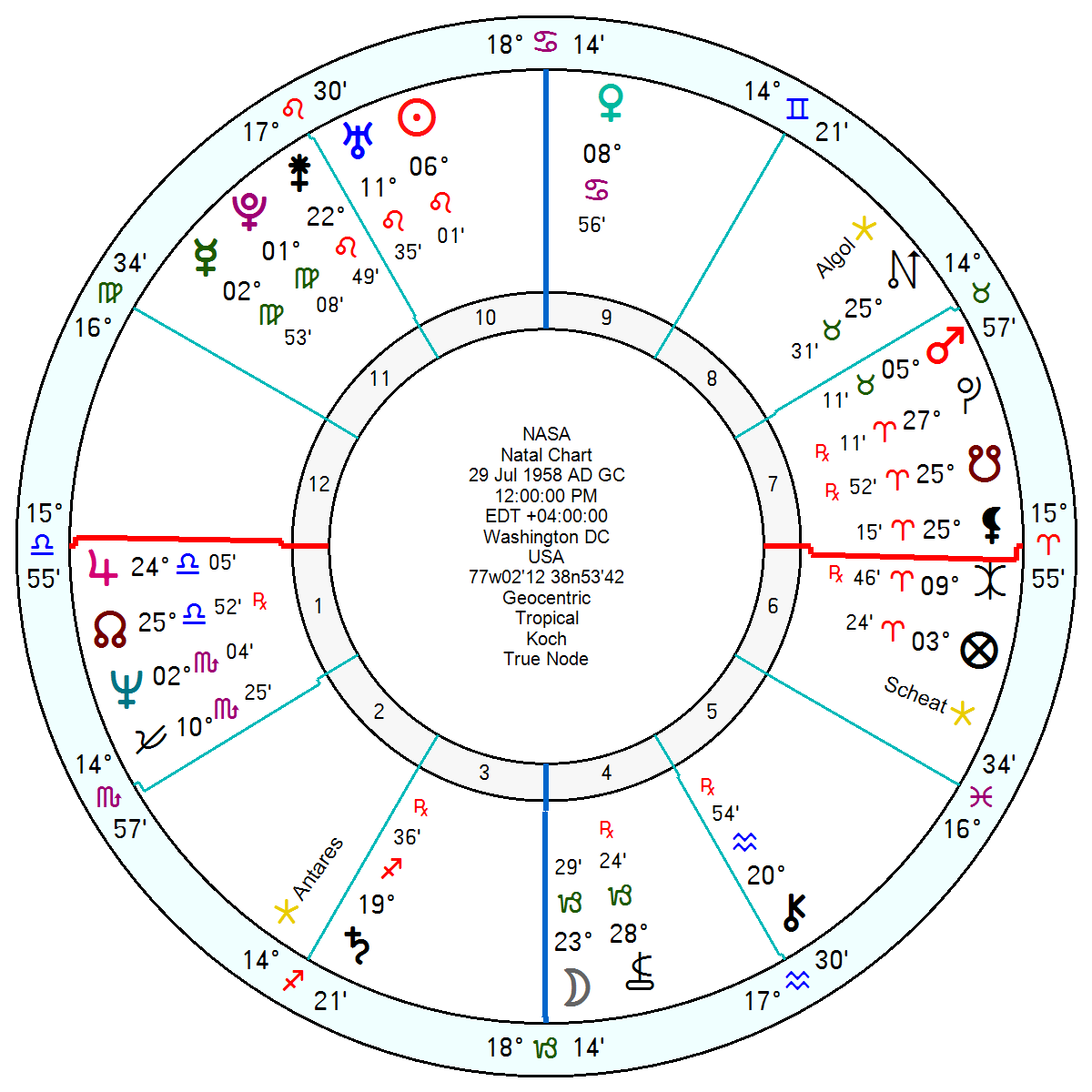
NASA 29 July 1958, will be on tenterhooks and under great pressure with tr Pluto square its Mars exactly now and moving to oppose its Leo Sun in 2027. Tr Uranus will also square its Pluto Mercury from mid May and throughout the rest of the year which will either cause an upset to plans or bring a renewed push with innovative projects. It is certainly facing a challenging year and on as tr Pluto moves to oppose the Sun/Uranus midpoint in 2028/29 and then oppose the Uranus for a major turnaround.
There is nothing like as difficult or calamitous in the NASA’s astrology as there was for the Challenger disaster in 1986 when there was a destructive Solar Arc Mars square Pluto.
Astronauts are beyond brave – or have a different mentality to ordinary folk. Living on the edge.
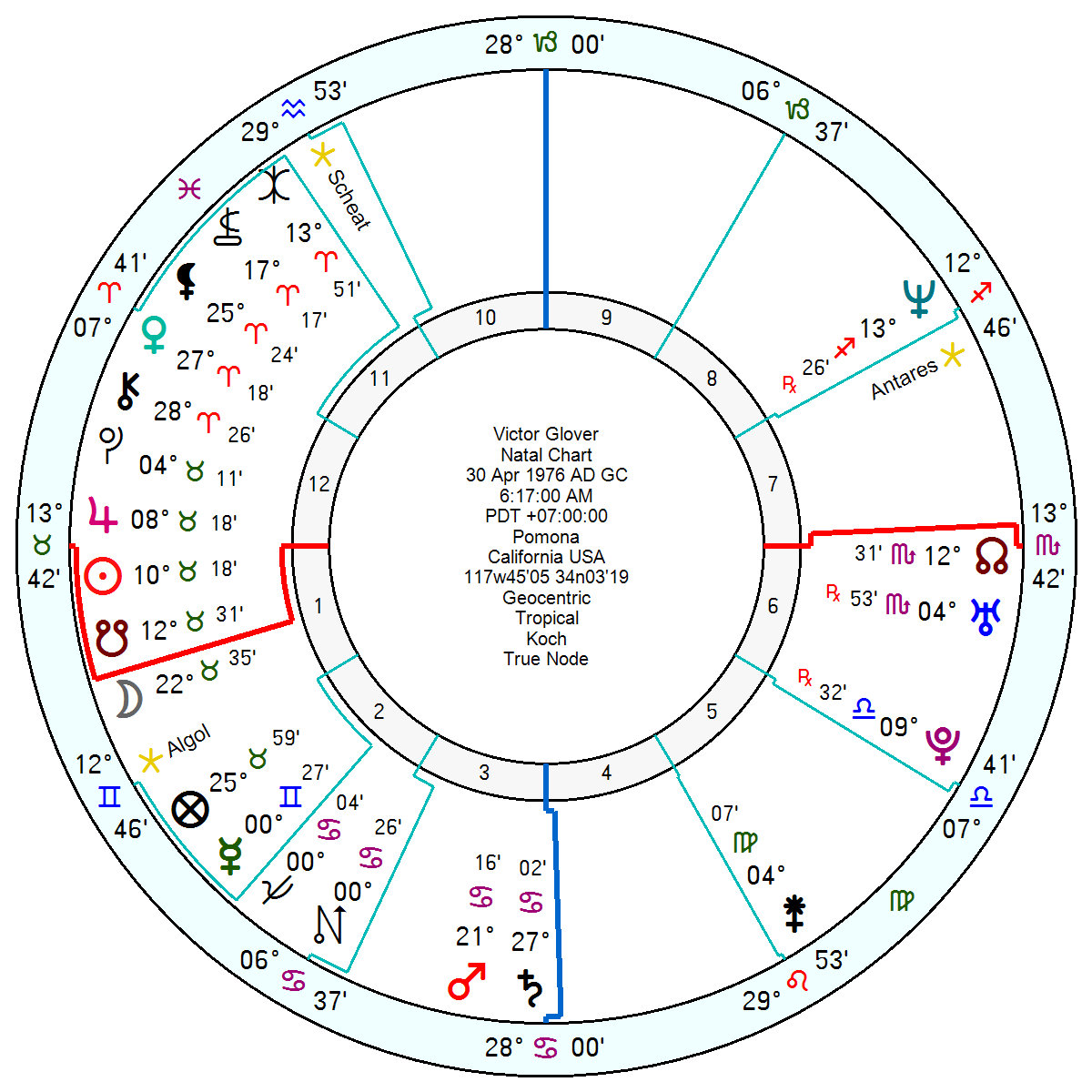
ADD ON: Victor Glover, pilot of Artemis was born 30 April 1976 6.17 am Pomona, California (thanks Astrodienst). He has a Sun Jupiter conjunction in Taurus close to his Ascendant and Moon in Taurus in his 1st – steady, practical, unflappable. His Sun Jupiter South Node oppose Uranus in his 6th and his Descendant North Node, which will suit him for an experimental career. A tough-minded, disciplined Mars Saturn conjunction in his 3rd are square Venus Chiron in Aries. An 8th house Neptune is sextile Pluto for a yod inconjunct Sun Jupiter, designing him for a singular role in life, highlighting his personality and giving him luck though at times a tendency to over-confidence.
He does have a catastrophic tr Uranus square his Mars/Pluto midpoint at the end of April to mid May with more unsettling challenges in June and beyond but overall, assuming a happy re-entry, he has a run of fortunate Pluto transits to his Jupiter/Uranus midpoint and then Jupiter in coming years.
His Taurus heavy chart is similar to Chay Blyth, the Scottish lone round-the-world yachtsman, born 14 May 1940, 4.30am Hawick, Scotland. He was also a Sun Taurus in his case conjunct Uranus with Mercury Saturn also in Taurus, plus Neptune in Virgo in his 6th house with a Taurus Ascendant close to Jupiter and a Capricorn Midheaven.
Charlie Dalin, who won the world’s toughest solo, non-stop, unassisted round-the-world yacht race, rounding the three great capes (Good Hope, Leeuwin, and Cape Horn) is also a Sun Taurus . See post Charlie Dalin, 11th January 2026 which also has Chay Blyth’s chart.
Cosmic or oceanic – earthy Taurus appears to be a surprising asset.
The mission looks in many ways similar to Apollo 8 launched from Merritt Island Florida at 7:15 am 21 December 1968. The Artemis 11 launch chart Saturn sits exactly on the Apollo 8 North Node and the Descendant conjuncts the Apollo 8 Chiron and squares its Sun at 29 Sagittarius. The Artemis 11 MC sits on the Apollo 8 DC and the IC falls on the Apollo 8 AC.
Those extraordinary astronauts are now in their space capsule, Orion, travelling into deep space on the loop around the dark side of the Moon. Gives me the shivers! Looking at the chart for Artemis II here, the MC is 28 Gemini. And there sits the bright fixed alpha star Betelgeuse (Beetlejuice!) in the constellation of Orion, the Mighty Hunter or Giant – once a lover of Artemis in the Greek myths.
Elsbeth Ebertin wrote:
“Placed in the angles, preferment, luck, success and everlasting fame are promised.”
George Noonan wrote:
“The star is indicative of great fortune, martial honors and “kingly” attributes. When rising or culminating the native will be a superior athlete, being endowed with outstanding agility and speed of body.”
The Artemis ascendant aligns with Markeb, a star within the constellation Argo Navis, the Great Ship – just as the enormous rocket, Artemis II is a great ship of space? Robson wrote of Markeb:
“A small star in the Buckler of the Ship. Of the nature of Saturn and Jupiter. It gives piety, a wide knowledge, educational work and voyages.”
Hi Marj, isn’t Saturn-Neptune in the 7th House as opposed to 6th H?
Luna 1 was the first spacecraft to leave the earth’s atmosphere intended to reach the Moon. It was launched on 2nd January 1959 from Tyuratam in Kazakhstan. The Moon was at 15 degrees Libra, close to the Moon in the Artemis chart (10 degrees Libra). The Sun was at 11 degrees Capricorn, exactly square to the Artemis Sun in Aries. Jupiter was in the 3rd house with Neptune on the cusp of the 3rd, but Mars was in the 9th, square to Uranus in the 11th. It passed by the Moon by almost 6K km due to a navigation error, and went on to orbit the Sun, which it is still doing.
What a breath of fresh air, something good for the USA.
@Charlene, for all the mankind! I was born in 1976, so I missed the Apollo mission, but was old enough to see Challenger explosion. I watched the launch live yesterday, despite it was in the middle of the night in Europe, and had a *good* cry, because the last months have been personally very trying for me, and there has not been much to be hopeful for overall. For the reference, I am a Libra Sun/Pluto, and this Full Moon hit those directly.
It’s very moving watching the astronauts’ react to the sight of the Earth from space, apparently it is a profound experience:
‘They described it as “overwhelming,” “breathtaking,” and “indescribable” experience that brought them to tears and stopped them in their tracks. Viewing the entire globe “from pole to pole” and as a “shimmering, fragile outpost of life” left them searching for words, calling it “surreal” and “absolutely spectacular’.
I remember watching the Apollo moon landing as a child, my baby sitter pointing at the moon and telling me, “If you look closely, you can see the men moving about up there”.