
On the threshold of the new era with Uranus poised to be the final piece of the jigsaw to fall into place in late April as it moves into Gemini, there are several minor planet conjunctions to help or hinder the way ahead.
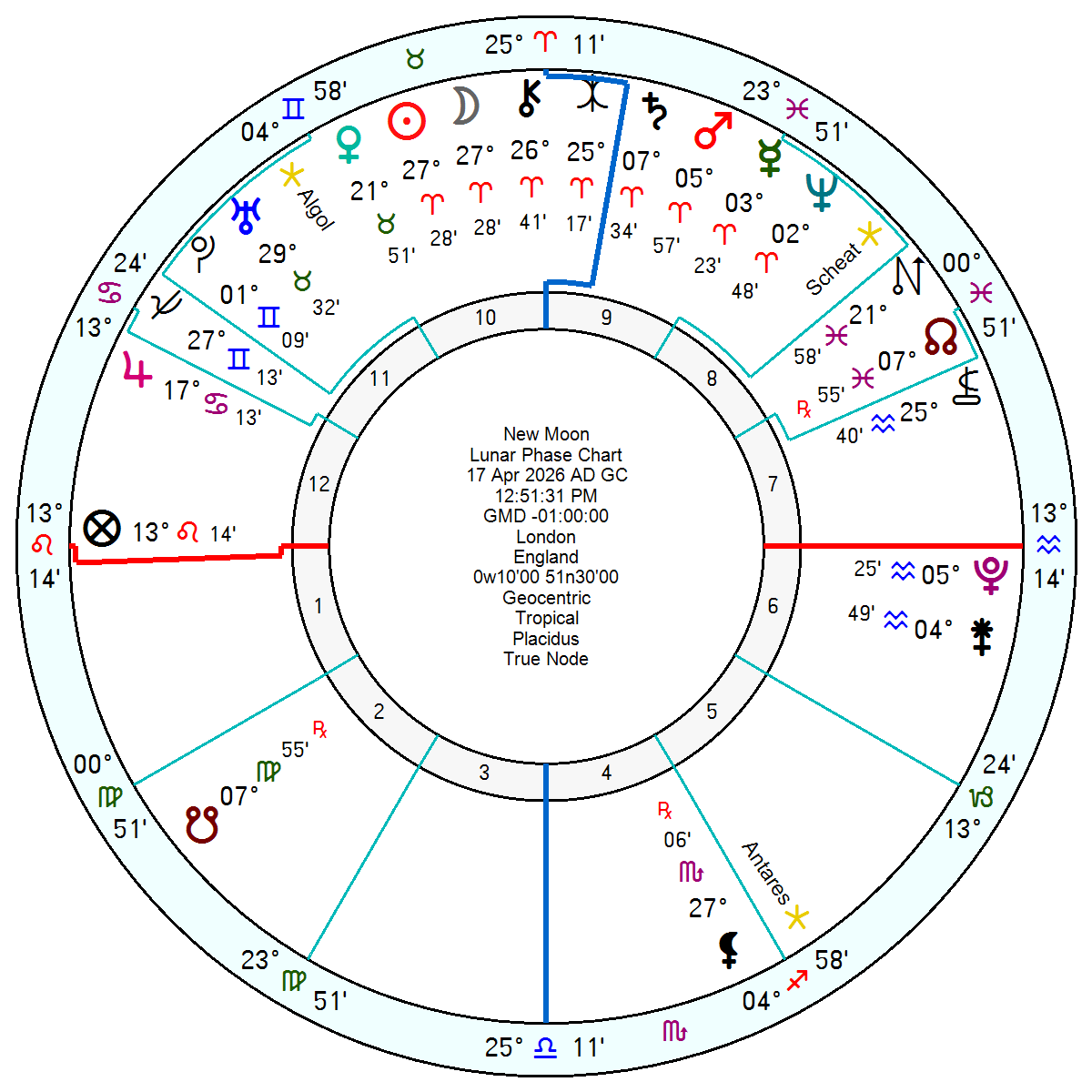
Mercury in Pisces will conjunct Nessus on April 9th. Usually associated with deceit Nessus has a positive role, making us better equipped to deal with risks and cons. It might suggest the ‘negotiations’ in the Middle East and elsewhere are hindered by treachery and insincerity. Nessus is also linked with ancestral and collective trauma – unresolved issues passed down through family lines or cultural groups which like the Shirt of Nessus slowly poisons or wounds. On the upside it encourages individuals to stand up against injustice and toxic patterns to ensure the past does not repeat itself, demanding that these hidden wounds be given voice and visibility. Which certainly sounds accurate for the ancient blood feuds of the Middle East.
On the 9th Mars in Pisces is conjunct the Fixed Star Scheat, which generally is regarded as unfortunate, likely to occur with accidents, natural disasters and in this case because of combative actions.
On the 15th the Aries Sun is conjunct Eris, the dwarf planet, recognized for its similarities to Pluto. Although thought to be a force that disrupts, provokes and shatters illusions, it can also be a potent force for personal evolution. Both conflict and catalyst, it highlights fractures that already exist. It calls for a stand against falsehoods and prompts a confrontation with uncomfortable truths. With awareness it brings a moment where it is crucial to challenge distortions and say ‘No More’.
On the 16th the Aries Sun is conjunct the centaur asteroid Chiron which suggests that progress will not be made on the basis of pride, ego or ‘winning’. Healing can only come from a place of selflessness – which in a fight between alpha males, fuelled by ancient blood feuds and egged on by a rampant narcissist, may give the fates pause for thought.
The Aries New Moon on the 17th pulls together with the Eris Chiron conjunction – with all four tied in a bow. At best it could point to new beginnings where there are enough voices saying ‘no more’ and healing of collective and generational trauma can begin. But that does seem to be a gigantic ask and a Pollyanna delusion.
For all that there is a message coming from the universe at the moment with the Chiron Eris conjunction which I cannot articulate but seems crucially significant. It has been in place since 2023 and moves out of orb before mid 2027. Perhaps part of it is about negative events having to reach crisis point before real change takes place – e.g. the Middle East saying enough is enough to Iran and Israel since this latest conflict had its beginnings in 2023 with the Hamas attack. And somewhat later, Trump going on a despotic rampage in the US since his election.
To finish off April, Uranus as it moves into Gemini on the 26th will conjunct the dwarf planet Sedna. In mythology Sedna was betrayed by her angry, cruel father but survives her abandonment to become a mighty sea goddess and ruler of the monsters of the deep.
The myth of Sedna revolves around betrayal, abandonment, resilience, and the transformation of victimization into spiritual empowerment. It prompts a confrontation with harsh truths to uncover inner strength. Key Themes: The Survivor and Resilience: Sedna energy comes into play during extreme stress or situations where self-preservation is vital. It represents the ability to dive into deep, uncomfortable emotional waters and survive, turning hardship into a “backbone”.
Quite what effect Uranus will have on Sedna remains to be seen – but one possibility is the innovative side of Uranus will come into play to ‘rescue’ a situation of hardship.
Interesting month.
I’ve always wondered – how did these minor planets get their names and characteristic associations? Was the name given because we had an inkling of their impact /effect or was it the other way round? Also – they all seem to be from different mythological roots: many seem to be Greek but then you get ones like Haumea which is I believe Hawaiian. ( I hope this question makes sense!!!)
I often wonder the same thing. No idea. I assume it is the astronomer who discovered them or a committee? But how would they know what meaning to assign to them? Someone else might know.
AI says:
“Dwarf planets are formally named by the International Astronomical Union (IAU) primarily after mythological deities or figures, particularly those related to creation, fertility, or the underworld. While early discoveries like Ceres and Pluto followed Roman/Greek traditions, newer discoveries, such as Haumea (Hawaiian) and Makemake (Rapa Nui), reflect diverse, often indigenous, cultural mythologies to acknowledge the location of telescopes.
(The Planetary Society)
And:
Cultural Focus: For Trans-Neptunian objects (objects beyond Neptune), the IAU requires names to be associated with mythology, often looking beyond just Greek and Roman, such as the Inuit goddess Sedna or Chinese god Gonggong.”
I think there’s more than a dash of synchronicity in the mix somewhere too. Then astrologers have to observe effects over time, so I’m not sure how they/we define and refine meanings. Works in progress? Catalysts certainly, at least that’s what I tend to think anyway.