
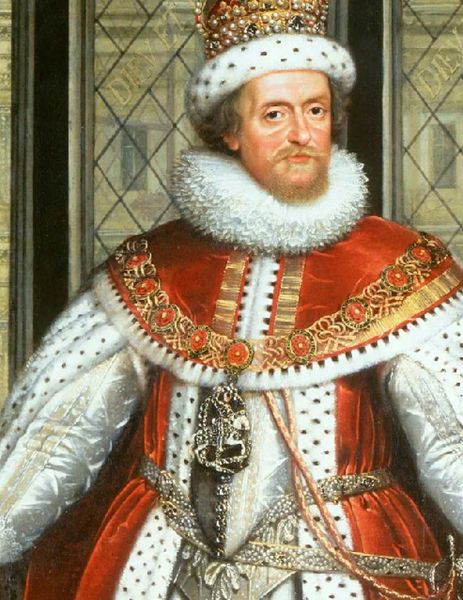
James I of England, the first Stuart king of England, and James VI of Scotland, has had a less than glowing reputation, deemed as odd and effeminate and has been underplayed in comparison to Elizabeth 1 and Charles I. A new biography paints a different picture of an assured intellectual who promoted peace in Europe and colonial expansion in America.
He was born in 1566 to Mary, Queen of Scots, great-grandson of Henry VIII’s elder sister, Margaret Tudor, and crowned in 1567, a “cradle king” at only 13 months old, after the murder of his father, Lord Darnley, and the forced abdication of his mother, whom he never saw again. Three of his four regents died in office and a 1582 coup, saw the powerful Earl of Gowrie kidnap the 16-year-old king during a hunting trip and hold him captive for 10 months.
Despite his homosexual inclinations, he dutifully married Anne of Denmark and had seven children, three of whom reached adulthood, with his second son, Charles I, as heir. James succeeded to the English throne as King James I of England on the death of Queen Elizabeth I in 1603.
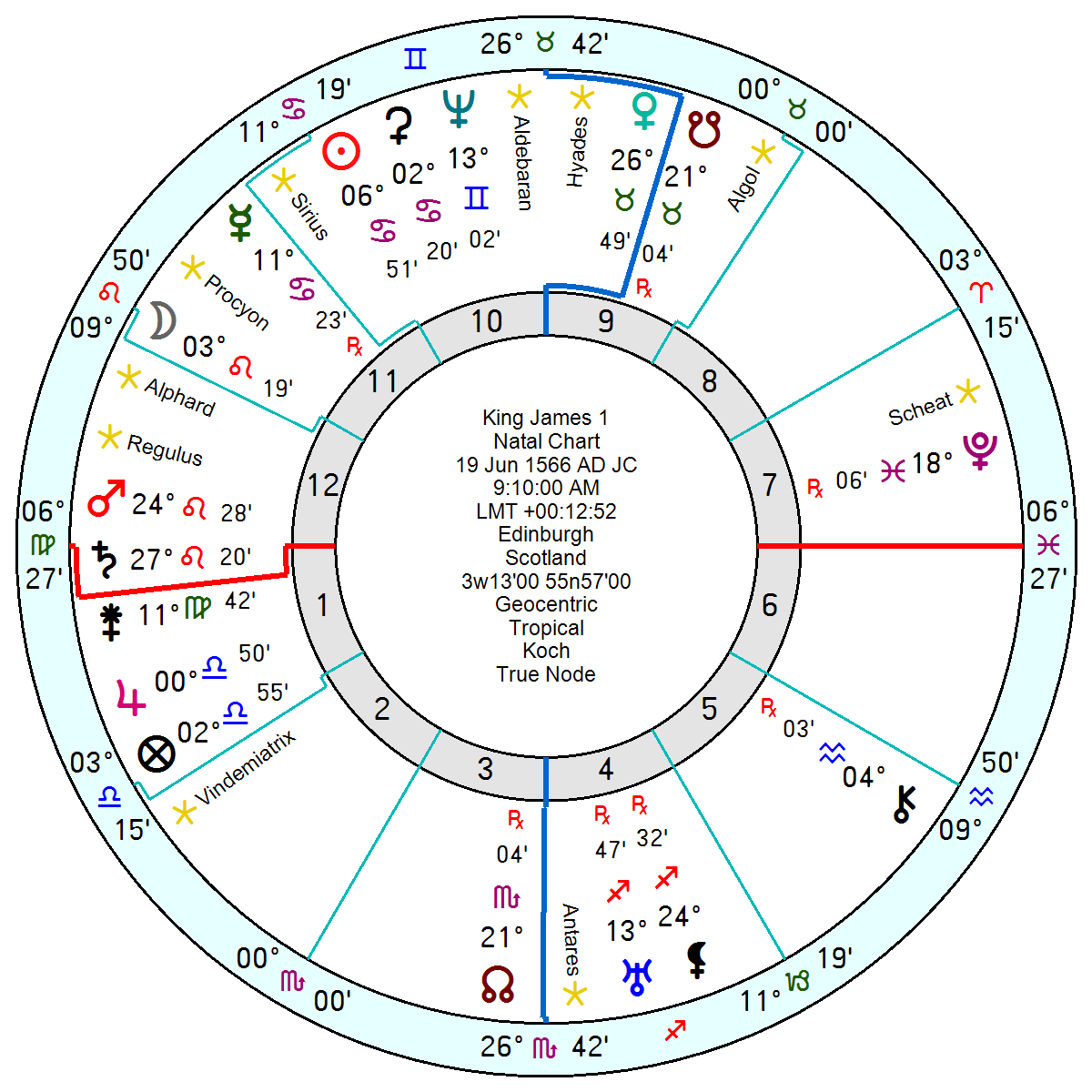
He had a 10th house Cancer Sun square a 1st house Jupiter – creative, caring and confident. He also had an inventive, though nervy 10th house Neptune opposition Uranus in the 4th which latter points to a turbulent childhood. His Neptune Uranus opposition squared onto a 7th house Pluto in Pisces which would mark him out potentially as a radical thinker, though one whose ideas would often be before their time. And that Pluto may well be the reason for the hostility he raised in critics after his death who tarred his image. It would also have made him highly-strung and mentally stressed.
He also had a hard-edged Mars Saturn conjunction in Leo in his 12th square Venus South Node in Taurus, a pointer to his damaging and fearful childhood.
In his later years, he suffered from arthritis, gout and kidney stones, lost his teeth and drank heavily. He died during a bout of malaria which brought on a stroke and a violent attack of dysentery.
He was widely mourned, having retained the affection of his people, who had enjoyed uninterrupted peace and comparatively low taxation during his era. He was succeeded by his son Charles 1 who was beheaded 24 years later aged 49 after losing the English Civil War.
Tough times then for a monarch – and on the medical front.
Henry VIII will stated that if his children died without issue then he wanted the crown to go to the descendants of his younger sister Mary, Duchess of Suffolk rather than his older sister Margaret who had married the King of Scotland. Had that request been followed then Ann Stanley would have become monarch after Elizabeth 1 death in 1603 not James 1.
It doesn’t really matter what Henry viii thought, because once you are dead, it becomes the succeeding monarch’s problem. But Lady Jane Grey was the granddaughter of Mary, the sister that wasn’t the Queen of Scotland. And she had a very tragic end. And I doubt very much that she ever wanted to be Queen. But that decision was down to Edward vi who didn’t want either of his sisters to rule. One because she was a fervent Catholic. And he didn’t want Elizabeth, I suspect because her legitimacy was in doubt or because both their mothers were arch enemies. But the legitimacy issue would throw his own legitimacy into question. Which is why he chose Lady Jane Grey. And that nearly caused a civil war.
King James I is of course the King of the King James Bible, aka the Authorised Version, which celebrated its four hundredth year in 2011, and which is very beloved by some fundamentalist evangelical denominations in the US.
His personal motto was Beati Pacifici, “blessed are the peacemakers” and there is a statue of him with that motto in one of the quads of the Bodleian library in Oxford.
I believe that he was quite well-versed in the Bible himself. And he did, via his Bible, try to reconcile the various factions of the Churches of England and Scotland, the latter was of which explicitly Presbyterian and hostile towards him. Thence that motto above.
The thing that jumped out to me in his chart was the Venus almost exactly conjunct his MC (as mentioned by Martha below) being almost exactly square to his Mars-Saturn conjunction. I’m tempted to read that as his being either bisexual or straight but being aware of male beauty (i.e. not going all the way with his male favourites), with the Saturn indicating an element of struggling with his sexuality. It is worth remembering that one of the sects of the then Anglicanism were literally the Puritans, and the Church/Kirk of Scotland, his other realm, were quite strict in their faith and severe in their outlook on sexuality.
I am not sure whether to include angles in yods, but there appears to be a yod between his Ascendant sextile Sun inconjunct Chiron. Not sure how to interpret it though. Could that be the astrological cause of the dislike of witches (Chiron as the healer, possibly also witches, under fire from both the Ascendant and Sun, both of them reflecting personalities of the monarch) ?
Shakespeare’s Macbeth, set in Scotland and famously including three witches, was published towards the end of King James’s reign.
His eldest son, Henry Frederick, was born on 19 February 1594 at Stirling Castle, Scotland and died 6 November 1612, aged 18. Perhaps had he lived, English and British history would have been very different, with no Civil War.
For a long time, James I and Sigismund III Vasa, have for me, seemed to be interesting time twins. Born the 19 and 20 of june respectively, 1566, they were both, more or less, heirs to two kingdoms. James to Scotland and England, and Sigismund to Sweden and Poland. Both of them did assume the double throne. But only James was able to keep his gain for the rest of his life.
Sadly, I do not have the time of birth for Sigismund. But it would be interesting to compare natal charts.
5am
Or, perhaps, he was responsible for killing the potential healers?
Twelfth house, self-undoing
Hit reply to Jane’s comment, sorry for out of context…
I think the profound trauma of being separated from his mother as a 1 year old, never to see her again played a not insignificant part in his misogyny and fear of women. His 12th house Mars/Saturn conjunction, which is also a marker for the assassination of his mother’s secretary and suspected lover, Rizzio when she was 6 months pregnant with James. Mary’s next marriage to Bothwell made her unpopular since he was suspected of involvement in the murder of her 1st husband, Lord Darnley. The struggle for power and control behind the scenes is rooted in that conjunction. At one year old, he was taken from his mother’s care after she was arrested by Protestant rebels, imprisoned in Lochleven Castle and made to abdicate in favour of her infant son. Mary’s Catholicism made her an enemy of the Protestant cause. Again we see typical 12th house themes repeating here.
The boy King’s tutor, George Buchanan gave him a staunch, Protestant education and drummed into him the importance of learning and literature, but was also passionately anti-Mary despite having taught her when she was a child. A part of his remit was to demonise Mary to her son. Therefore it is unsurprising that James developed the paranoid views he did about the potential in women to be evil. He must have felt so many mixed emotions – grief at her disappearance from his life as an infant, anger at her for abandoning him, mistrust of women in general. Also, let us not forget that he was a potential target for assassination himself, long after the Gunpowder Plot as well prior to his coronation. When the arrival of his wife-to-be Anne of Denmark was delayed due to terrible sea storms, James was becoming increasingly interested in the witch trials taking place in Trier, Germany, plus he suspected that the storms had been summoned deliberately by witchcraft. Eventually this led to the famous Berwick Witch Trials where over a 100 individuals were arrested and subjected to extreme torture. We know that the witchcraft in Shakespeare’s ‘Macbeth’ was informed by these events. And James’s outer planet T-Square on Pluto in Pisces in the 7th may well have contributed to his dark fantasies and tendency for projection.
An interesting footnote to this in Wiki:
‘In March 2022 Nicola Sturgeon, the first minister of Scotland, apologized for the persecution of alleged witches during the 16th, 17th, and 18th centuries. The Scottish government had not apologized previously.’
I agree the abrupt separation from his mother, his scary childhood and his homosexuality could be used as an argument for his attack on witches/women. But it is just as likely that his religiosity magnified the historical Biblical obsession with Eve being the sinner by being tempted by the snake in Paradise which kicked off the story of humanity.
Christianity had always wrestled with the split between spirit and flesh – women being identified with the latter since their bodies were central to reproduction. The old Gnostic Christian belief was that (and I paraphrase wildly) God ruled the soul and Lucifer the flesh.
These were also superstitious times and anything that hinted of magic would be a) attractive to the peasantry and b) suspect to those who wished to hold the power i.e. the clergy, the rulers and basically men.
Yes, Marjorie I take your point – to medieval society and even in the early modern period, everyday life was imbued with religiosity. Religion informed their lives with ritual, liturgy, the saints, even the animals and beasts are there to teach them divine truths (as the bestiaries inform us) and belief in the devil and his evil, seductive ways was deeply rooted as was the general belief that women were the weaker vessel and more susceptible to temptation. Plus the Church was the lifeblood of communities and the centre of everything, the welfare state of its day, caring for the poor and healing the sick. The ‘Maleus Maleficarum’ when it was published in 1495 strengthened the popular belief in witchcraft.
I remember reading a book by Patrick Harpur called ‘The Philosophers’ Secret Fire: A History of the Imagination’ (iirc) in which the author explores amongst other ideas, the eternal conflict between the flesh and the spirit, heaven and earth, gods of the sky and gods of the earth and underworld and argues that humankind uses the arts, literature, poetry, philosophy and the imagination to make sense of the world. Alchemy he argues is the process by which the philosophers of the time attempted to bring these elements together in order to transform the polarities into a unified whole, the spiritual gold.
These were such pivotal times. In some ways it’s interesting that the period
..the period, steeped in so much religiosity, eventually leads to the enlightenment
Possibly another candidate for family patterns?
James’ mother, Mary, had her Sagittarian Sun 26 degrees, trine Black Moon Lilith 26 Aries, South Node 24 Leo, Uranus 29 Leo. They aspect her Jupiter in legal and religious Libra, 25. Quite a powder keg! So then there’s James’ own striking Mars 24 Leo and Saturn 27 Leo trine BML 24 Sagittarius bringing his mother’s own Catholicism with him, amongst other inheritances in his emotional, physical, and even spiritual DNA? Mary also had Mars in Aquarius conjunct Pluto, square Saturn – a potentially dark and challenging theme there reflected in her son’s Saturn-Mars conjunction. Mary’s symbolic presence in her son’s life and choices may reside in the hidden 12th to some extent? The 12th could also act like a channel for the prevailing zeitgeist, with its obsession for witchhunting across Europe?
James’ son, the troubled and doomed Charles 1st, was another Sagittarian. His Venus, 23 Sagittarius was conjunct Mars, 25 Sagittarius, trine Pluto 22 Aries, and Chiron, 19 Leo. Further fiery links between the generations. Charles own BML 14 Scorpio is conjunct Mary Queen of Scots’ intense Scorpio Saturn square Pluto in Aquarius. Charles II, on the surface a pleasure loving Gemini, carries Mars in Leo, 18, square Pluto, 21 Taurus.
Thank you Jane. You prompted me to look at the Stuart line in general. As you point out, there are some remarkable planetary patterns which repeat down the generations and that Mars/Saturn inheritance is strong. For example, Charles II, who was instrumental in promoting the high tech of his day and also founded the royal observatory has Mars 18 Leo in the 12th which squares Moon 19 and Pluto 21 of Taurus. His successor, the deposed James II has Mars 24 Leo in the 1st square Pluto 24 Taurus and Saturn 8 Sagittarius – in the 5th – his children did not inherit the throne.
If we look at his son, James Francis Edward Stuart (the so-called ‘Old Pretender’) born June 10th 1688 we see Mars 17 Cancer conjunct Pluto 22 square Saturn 18 Libra. And then we arrive at the ill-fated Bonnie Prince Charlie, Charles Edward Stuart, the ‘Young Pretender’ born 31/12/1720 who unsurprisingly, given his ancestral burden has BML conjunct his pars fortuna in the 12th, while Mars/Saturn at 2 and 3 of Sagittarius make a minor aspect to Pluto 21 Virgo. He ends the dynasty with that marker in Fire, just as it was begun in James I’s astrology.
The Stuarts are an interesting dynasty, perhaps a little tragic, bridging as they do the age of magic and belief in witchcraft and the Age of Enlightenment.
Thanks for this VF. I am fascinated with family patterns, and as we’ve seen before, royal dynasties tend to offer a long line of natal data, unlike most ordinary families.
Re the Stuart line, Princess Diana has some royal Stuart ancestry, although not descended directly from the Stuart kings. Her Venus in Taurus aligns with James 1st’s natal Venus. Her Uranus aligns with his Mars in Leo. William’s Taurus Venus conjunct Chiron continues the theme.
The late Sagittarian Sun of Mary, Queen of Scots, and the BML of James 1st then appears with Harry’s 26 Sagittarius Neptune (square Virgo Sun), and William’s 27 Sagittarius ascendant and 25 Sagittarius Neptune. He also has Mars 9 Libra, conjunct Saturn 15 Libra.
Thanks, Jane. I have overlooked Mary and Anne, daughters of James II who in fact did inherit the throne. Anne was the last Stuart monarch. Anne in particular suffered from terrible health conditions, miscarried at least 12 times and lost every one of her remaining 5 children.
King James 1 was obsessed by witchcraft and published a work called Daemonologie in 1597. And was responsible for an Act Against Witchcraft allowing torture to extract confessions from suspect witches in 1604. I wonder what astrological significators can be seen in his chart? The Mars and Saturn in regal Leo in the twelfth could indicate deep and violent fears, but what other indicators are there that reveal such hatred?
“Daemonologie laid out information such as how to identify a witch and how to punish them. One way to seek out a witch was in their use of charms and herbs: ‘By curing the Worme, by stemming of blood, by healing of Horse-crookes, by turning of the riddle, or doing of such like innumerable things by wordes, without applying anie thing, meete to the part offended, as Mediciners doe’. Women known as healers and midwives often came under suspicion because of their skills. Another way to identify a witch was to find the mark of the devil hidden somewhere on their bodies – James referenced Agnes Sampson’s trial directly, describing how they shaved her head in an attempt to find her mark, eventually finding it on ‘her privities’.” phillipagregory.com
I noticed that the Saturn/Mars is square Venus and the South Node, as Marjorie writes. Black Moon Lilith, perhaps symbolising the hidden feminine archetype in some way, is trine Saturn/Mars and inconjunct the Venus and S Node. James’ “feminine” Venus and BML are at odds with one another, earthy security needs vying with subconscious Sagittarian freedoms maybe? Saturn and Mars together can be cruel, and implacable – a way of constraining both sensuous Venus and what could be a wild, fiery, even witchy BML?
James, along with many all over Europe, was obsessed with witches for quite a while, although it faded eventually. Meanwhile, much misery and damage resulted and thousands of lives were destroyed. His Leo Moon opposite Chiron, if the Moon’s degree is accurate, could also be an indicator – many so-called witches were talented midwives and herbalists, much needed in their communities.
I think the illnesses that afflicted him in later life seem to reflect both Saturn – arthritis, kidney stones, teeth – and Mars – malarial fever, and a stroke, perhaps indicative of Mars in Leo?
Agree Saturn Mars conjunction is cruel and does more damage to those who marry into clan and those who don’t oppose it in the clan. Saturn as ancestral as in Hinduism ,is found in family charts where descendants have it with Mars aspect.
Mars in Leo and leo being heart sign so agree to stroke and Saturn ,bones and calcium body parts-even with strong and auspicious these two, these diseases arrive as one ages.
Witch burning is still on in rural India as a way to usurp land and assets from widows and women who have no family to protect them with males in them. Religion and magic is usually used to legitimise sins.
A Quick Look at his Mars/Mercury midpoint appears to place it on his Moon. A timely written book, as Pluto is coming up to oppose this midpoint and his Moon. Also it would gives him strong views as a leader. He would ensure his people knew his authority with a Mars/Saturn conjunction in Leo. Also a need for power? As Saturn’s domain is Capricorn and ruler of the 5th house, is void of any planets. A sense of impotence as.a King, needing to find a way Sun in Cancer of ruling the people in a convincing way?
Mars Saturn can be sadistic and a focal point Pluto will also have its moments of wanting to crush what it fears. But you have to remember he was a man of his time and despite having succeeded his cousin Elizabeth 1, it was hardly a pro-woman era not for another almost three hundred years and then some.
It is always enlightening to compare the charts of historical figures with one’s own when appropriate. My Neptune in the 10th would also qualify as nervy since it is closely square a Jupiter-Uranus conjunction in the 8th. My Pluto-Moon conjunction is however sextile Neptune, which is square my Sun in a cardinal T-square. Astrology is marvelous. I believe, unlike some astrologers, it does have moral intent because it shows us the way forward but inflicts pain if we do not heed. We are really mice in a Pavlovian labyrinth who cannot find a way out but can move forward to spiritual sustenance. This suits my innate mysticism perfectly.
I am currently reading Gareth Jones excellent biography of James 1. The first version of the Union Flag was designed by James who actually wanted to merge all his crowns into a single Kingdom of Britain over a century before the 1707 Act of Union. Ironically it was the English Parliament who rejected the plan because they feared a loss of English identity. James main weakness was his penchant for elevating male favourites to positions of influence and his inability to control royal spending. Nonetheless he was a cautious and shrewd political operator. Unfortunately, his son, Charles, inherited none of James skills as a statesman so lost both his throne and his head.
Apologies that should be Gareth Russell’s biography of James 1
Which is ironic, because for many years the English haven’t really been allowed their own identity. Unlike the Scot, the Welsh and the Irish.
I take it his Venus, angular, at the MC would make a male effeminate.
Are there any other alignments in a charrt that would also create this tendency?
Uranus, mercury also r known for such and gemini to aquarius as signs. Pisces,the confused opposing fishes