
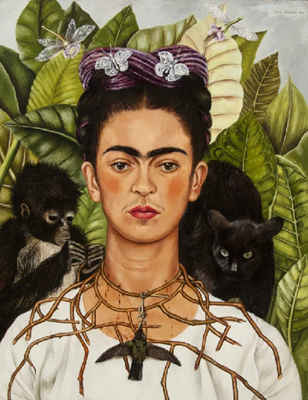
Frida Kahlo, the artist, who has achieved cult status in the last two decades is the focus of an exhibition at the Tate Modern: The Making of an Icon for the next six months. Art critics are scathing about the ‘piggybacking or the deadening drumbeat of identity politics’ in the exposition but inevitable given that Kahlo represented many of the modern preoccupations of sexuality, gender, class, status, race and disability.
Her own macabre, mesmerising and seductively weird paintings are the centrepiece of the show with the curator saying the intention is to “trace how Frida has become this global icon.” Her stamp can be seen nowadays on Christmas decorations, fashion collections, socks, skateboards, clutch bags and feminist children’s books.
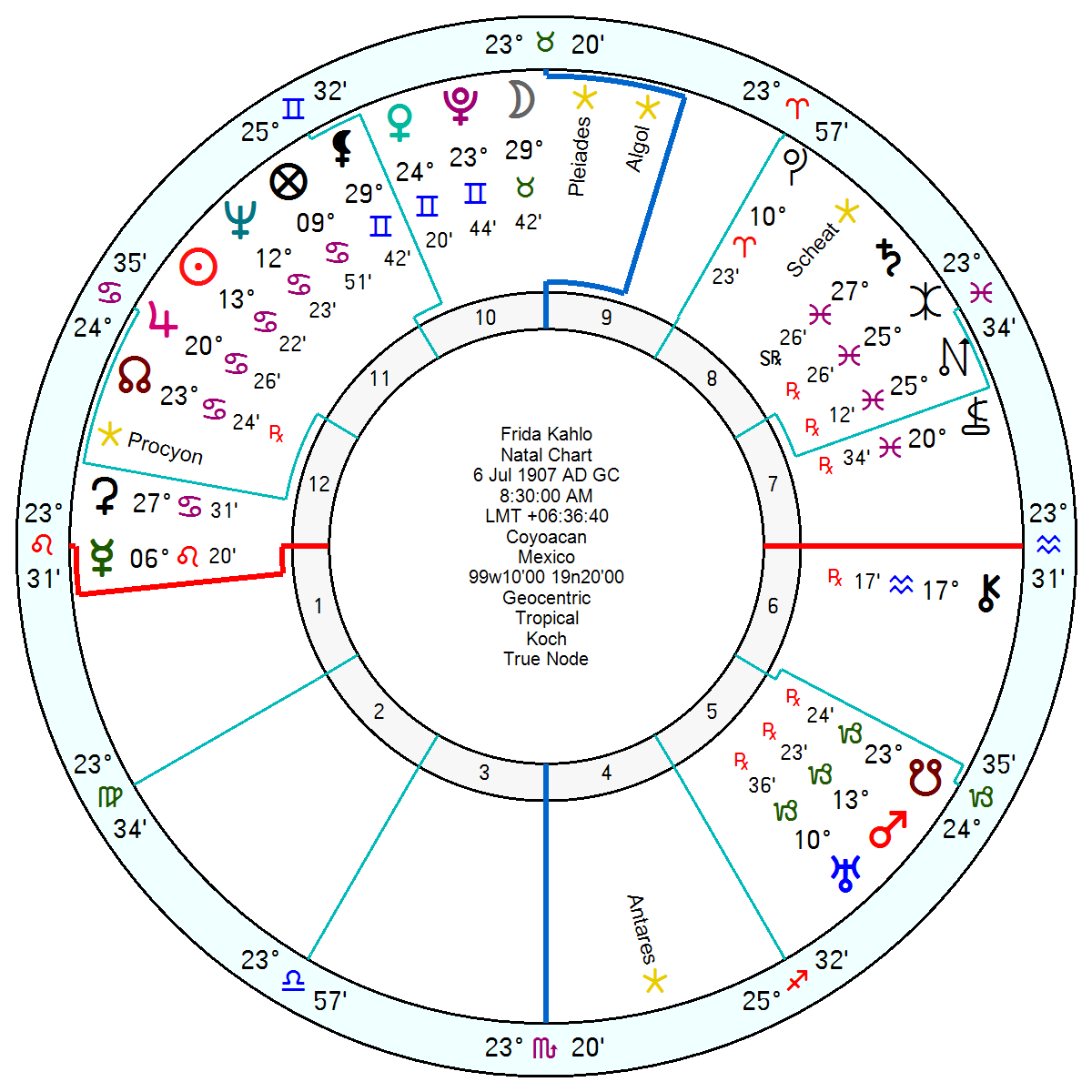
She was born 6 July 1907 8.30am Coyoacan, Mexico, to a German father, who suffered from epilepsy and a Spanish/indigenous Mexican mother of delicate health. A bout of polio aged six permanently damaged one leg. But she suffered a worse blow aged 18 when a calamitous traffic accident left her with lifelong injuries and in constant pain.
She was devoted to her Mexican identity and fought for the working class becoming respected for having a strong female voice. Through her life she had affairs with women and men, experimented with masculine clothing and remained proud of her lustrous black moustache — prominent in her self-portraits. She was also the first artist to represent female experience in terms of miscarriage and birth.
Her devotees tend to selectively pick what suits their cause from her life ignoring her strong communist beliefs and her (unfeminist) dedication to her husband, another Mexican painter Diego Rivera, a prolific philanderer, who even had an affair with her sister. He was 20 years older and obese.
She had a visionary, idealistic and optimistic Sun Neptune Jupiter in Cancer opposition a volatile, explosive, highly strung a 5th house Uranus Mars in Capricorn. She would have initiative to spare but would be constantly pulled in opposite directions. Her sombre 8th house Saturn in Pisces was trine a Cancer North Node and Jupiter, sextile Moon MC in Taurus, so she would resist intimacy and channel her obsessions with death and what lay in the darkness into her career. Her Taurus Moon in the 10th would suit her for a public career; and Venus Pluto in Gemini also in the 10th would make her influential with a creative streak from Venus and the Taurus Moon.
Her Saturn which is in a bleak square to Pluto Venus rules her 6th house of health. Chiron in Aquarius is the only entity there which Melanie Rhinehart suggests can lead to a lifelong search for ways to connect the spirit and the flesh. In Aquarius it would make her a crusader for a cause.
Her 10th house Moon in Taurus would be the saving of her, bringing a public career that involved a tactile medium and involved a love of all things botanical. Her Venus close to Pluto and square Saturn suggests an emotional life both passionate and cold. She had affairs with everyone from Josephine Baker to Leon Trotsky.
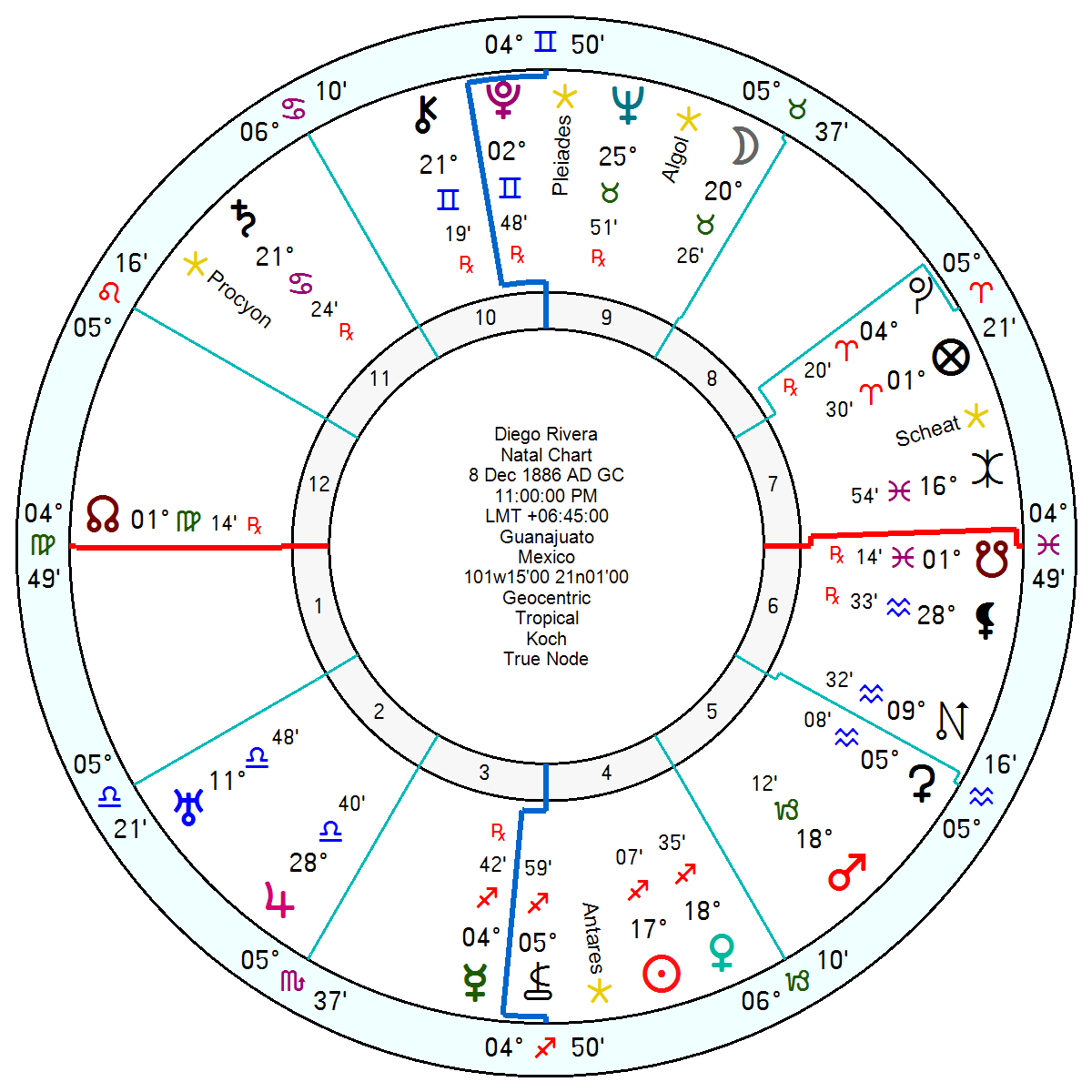
Her husband Diego Rivera, born 8 Dec 1886 11pm Guanajuato, Mexico, had a 4th house Sun Venus in Sagittarius. He shared a Taurus Moon and 5th house Mars in Capricorn with her, so both liked to go their own way. His Moon Neptune Pluto fell on her MC and into her 10th so he’d be a driving force and controlling in her career and life’s direction. Though he’d also squash her exuberance at times since his Saturn was conjunct her Jupiter; and his Uranus was square her Sun Neptune and Mars Uranus – not an easy or harmonious match.
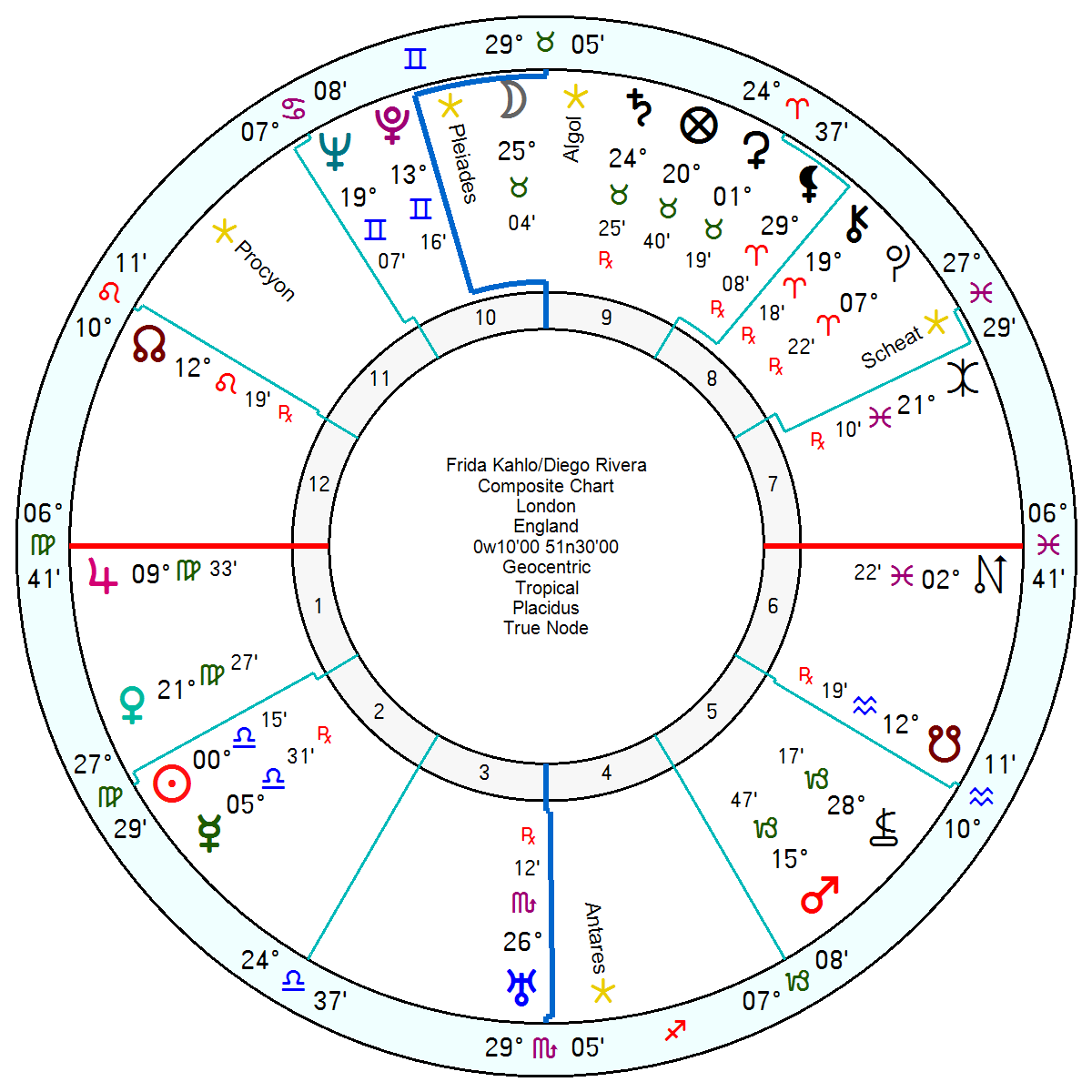
Their relationship chart had a cool composite Moon Saturn in a tension-erupting opposition to Uranus. But the Moon Saturn was also trine Mars and trine Venus so there would be mix liveliness and creativity with emotional blockages. The composite Venus was square Neptune Pluto so passionate and idealised, driving them both unbalanced at times. Plus a yod onto a focal point Mars for angry flare ups.
She died aged 47, perhaps of an accidental overdose though she was in worsening health having had a leg amputated. She wasn’t well known outside art circles until the 1980s.
“One must still have chaos in oneself to be able to give birth to a dancing star.”
Friedrich Nietzsche