
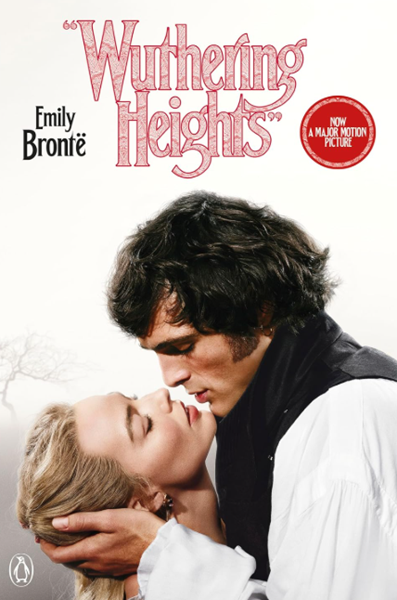
Wuthering Heights, Emily Bronte’s classic novel has been given a ‘hyper-sexualised’ makeover in a new Jacob Elordi/Margot Robbie film. The provocative scenes in question are erotic, with much moaning and writhing though they are not explicit. One reviewer pointed out the passionate Heathcliff Cathy love affair had been interpreted in different ways at different times, which say more about the era in which they were produced — its expectations, prejudices, and neuroses — than about the work itself.
The devoted lover. The toxic narcissist. The sex symbol. The chaste beloved. The perverted necrophile. The proto‑Marxist rebel. The idealistic lunatic. The unscrupulous psychopath. The victim of the powerful.
The story is about Heathcliff, a street boy taken in by a rural landowner and brought into his home, where he becomes part of the family, hated by son Hindley, and adored by Cathy. He eventually leaves the family, and Cathy marries a neighbouring landowner, Edgar Linton. Heathcliffe returns as a wealthy man, consumed by resentment, determined to corrupt and destroy the family, while still trapped by his indestructible love for Cathy. She dies in childbirth and he dies much later, being buried beside her decomposing corpse in her coffin.
Despite its reputation as a story about soaring passion, in reality as another reviewer pointed out is a novel about violence, powered by rage, alcohol and fear with much child beating, temper tantrums and blood. Undoubtedly it was a reflection of Emily Bronte’s curate father who was prone to violent rages, as was Emily. In her biography of Charlotte Brontë, the novelist Elizabeth Gaskell describes how Emily once lost her temper with her bulldog, Keeper, and repeatedly punched it in the face with her “bare clenched fist” until its eyes were swollen and “half blind”.
Its publication in 1847 met a muted response, unlike her sister Charlotte’s Jane Eyre and only became a success well into the 20th century, thanks to champions like Virginia Woolf and to the impact it had on the Surrealists.
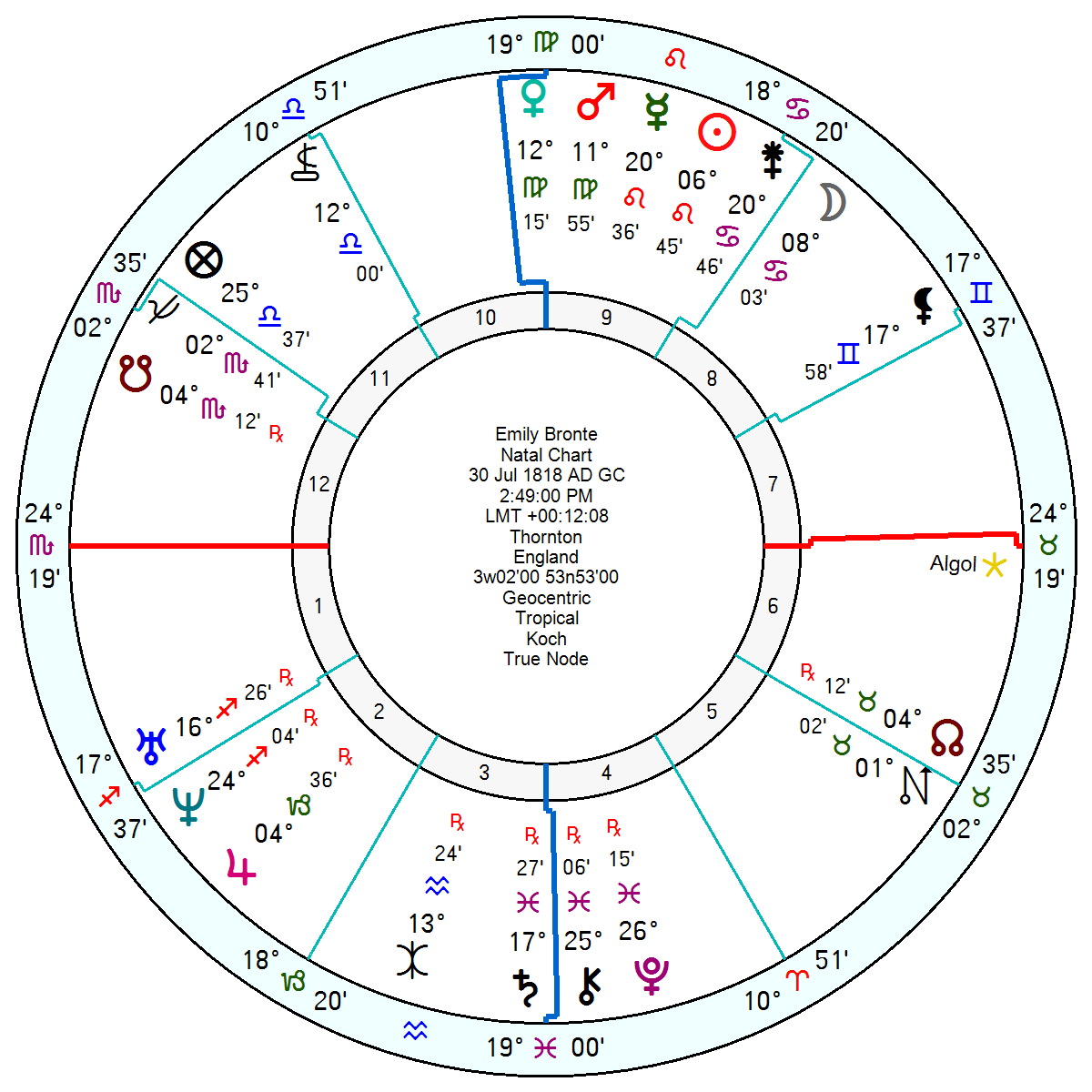
Emily Bronte, born 30 July 1818 2.49pm Thornton, England, had a Leo Sun and Mercury in the 9th house of communication and writing and a Cancer Moon deeply buried in the 8th. But what marked out her subject matter was a volatile, Mutable T square of a passionate Venus Mars conjunction in Virgo in the 9th opposition a regretful Saturn in Pisces square Uranus in Sagittarius. Venus Mars can give an inclination to strong sexual yearnings. Mars Saturn can be cruel. Mars Venus square Uranus – a need for constant excitement without ties. It is quite a perverse chart. She had the destructive Fixed Star Algol conjunct her Descendant. A controlling Pluto in her 4th hinted at a tricky father and dark undercurrents running through the family home. There are some theories that she was autistic. She died a year after publication of her novel, on her First Saturn Return, possibly from tuberculosis, never having married.
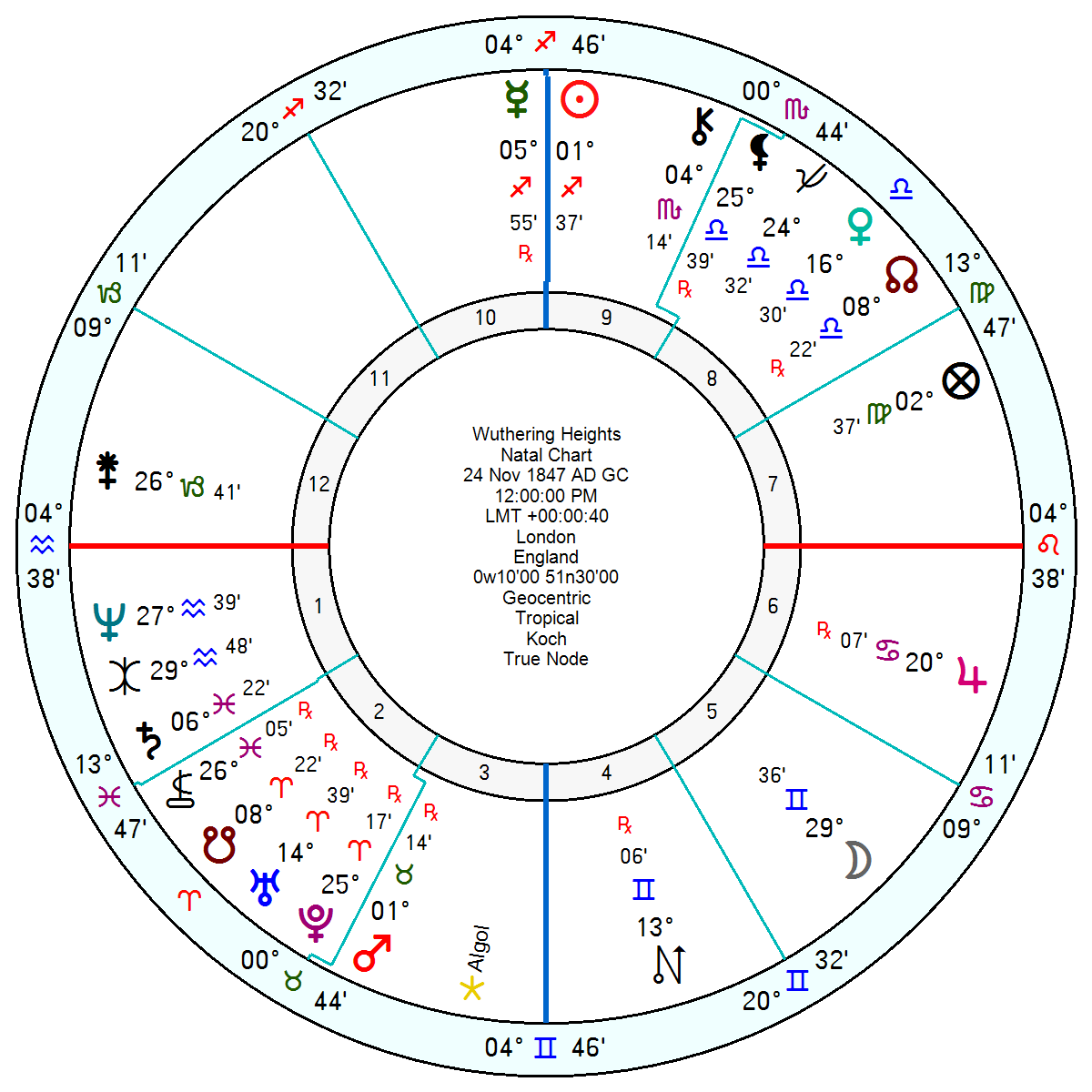
The novel was published on 24 November 1847 with a rage-filled and frustrated Sun inconjunct Mars Pluto; and maybe on the point of a yod with Mars Pluto sextile a late Gemini/Cancer Moon which would make sense of the content.
I am eternally fascinated by what catches the mood of the moment and in some cases continues to do so over decades and centuries.
Emily Bronte’s Wuthering Heights is the archetype which has generated countless soap opera plot lines. In a similar fashion her sister Charlottes Jane Eyre became the template for huge numbers of modern Romantic novels. I don’t particularly enjoy reading either of these books but there is no doubting their influence.
I read the Bronte book when I was a young teen, and found the story irresistible and passionate. I read the book 50 years later and was repulsed by the unhealthy compulsive relationships. My reaction: these were some sick people. I realize it was written in a different time and culture, however, for young readers it may set a standard of what relationships should be, and not in a good way.
I never liked the novel, and think I’ll give this film a wide berth. It’s getting some awful reviews.
Apparently, the cemetery adjacent to the parsonage contaminated the home’s water supply and thus adversely impacted everyone’s physical health. I wonder if that could have affected one’s mental health, as well.
I read “The Brontes” by Juliet Barker, a well-received tome if a bit tedious. It didn’t reveal much re life at the parsonage in terms of psychological inner-workings, etc. but an interesting read nonetheless–brimming with minutiae. Thanks for this enlightening post, Marjorie. What I love about astrology is how it cuts to the heart of the matter, exposing the true story.
Thanks Marjorie. Very interesting to read what you wrote about Heathcliff and Cathy:
“The devoted lover. The toxic narcissist. The sex symbol. The chaste beloved. The perverted necrophile. The proto‑Marxist rebel. The idealistic lunatic. The unscrupulous psychopath. The victim of the powerful.”
This list chimes with the enduring emotional and erotic allure of Dracula, and other vampire character inventions over the century or so since ‘Dracula’ was published in May 1897. Curiously, author Bram Stoker was born just two weeks before the publication of ‘Wuthering Heights’ on 8th November, 1847. He has a yod of Saturn sextile Mars in Taurus, inconjunct Venus in Libra.
When ‘Dracula’ was published, 26th May 1897, Saturn and Uranus were conjunct at 26 Scorpio, square Stoker’s natal Neptune 27 Aquarius and inconjunct his natal Pluto 25 Aries. Mercury was 27 Taurus. Interesting to see that ‘Wuthering’ and Stoker Neptune, emphasised by the current Uranus transit and approaching Solar Eclipse in Aquarius. The black vampire horror movie, ‘Sinners’, has been nominated for multiple Oscars this year. Uranus will be 28 Taurus on Oscars night in March.
I read Wuthering Heights as a teenager and thought it rather wild. I tried to reread the book a few years ago and found it difficult and abandoned it after a few chapters. I found it, on re-reading rather unfocused and a bit of a mess. This is rather like Emily Brontë’s chart which apart from Mars Venus conjunction opposite Saturn looks rather messy.The Brontë home in Haworth (now a museum) is worth visiting. The home which is small and must have been claustrophobic for everyone. One can imagine nerves being frayed, especially if you have the energy shown by a prominent Mars.
The director, Emerald Fennell has Mars conjunct Venus in Virgo square Uranus in Sag at very similar degrees to Emily Bronte.
How interesting, Louise!
Thank you