
The Eurovision Song Contest is brewing up for a turbulent winter as Ireland, Spain, the Netherlands and Slovenia have already indicated they will boycott it after Israel was cleared to compete. Ireland’s RTÉ said it felt that its “participation remains unconscionable given the appalling loss of lives in Gaza and the humanitarian crisis there which continues to put the lives of so many civilians at risk.” There were also allegations of unfair voting practices.
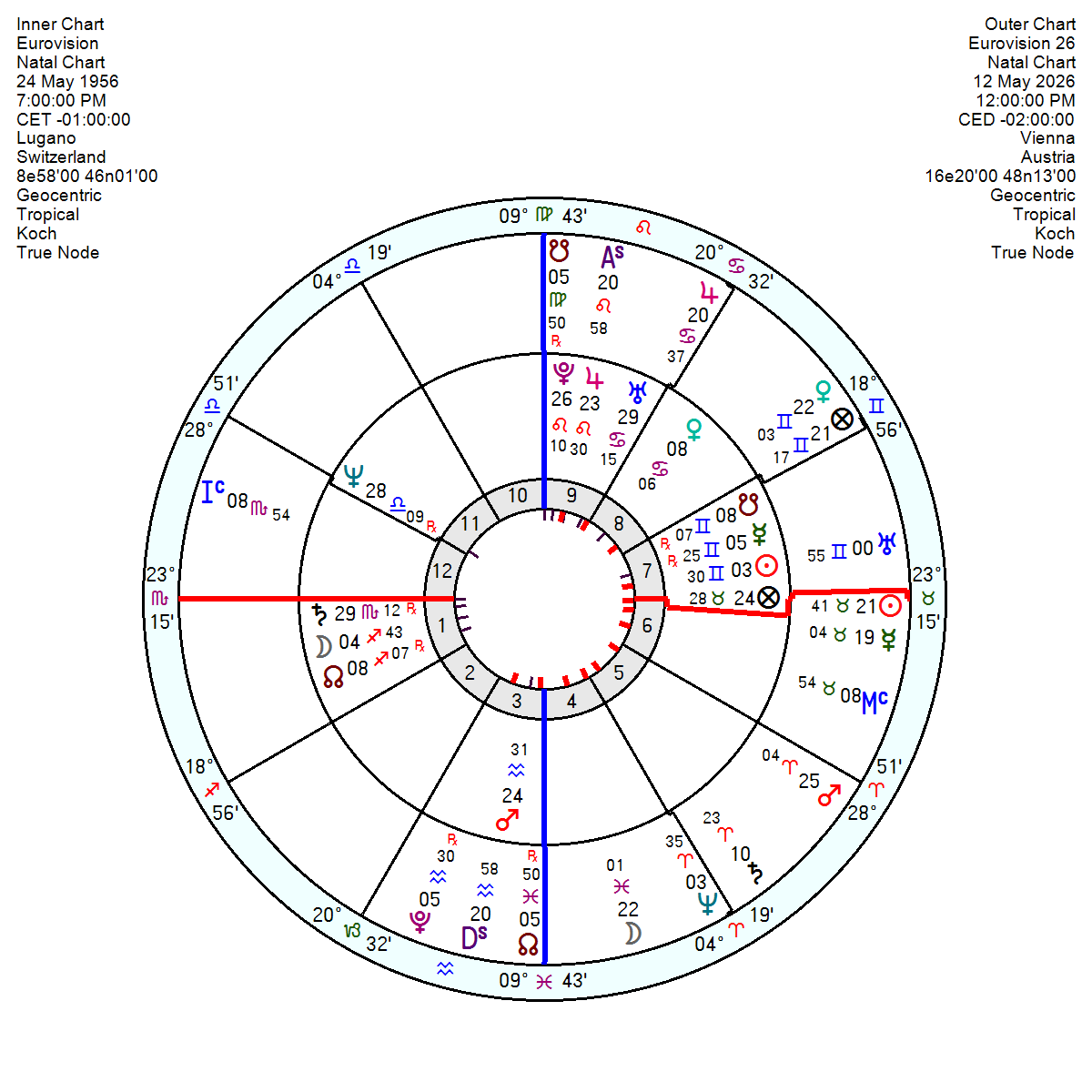
The first Eurovision, 24 May 1956 in Switzerland 7pm, started on a Full Moon with the Gemini Sun opposition the Sagittarius Moon. There was also a super-confident Jupiter Pluto conjunction in Leo in an enduring and stubborn Fixed T Square opposition Mars in Aquarius square Saturn in Scorpio. Unbudgeable normally – except that tr Uranus which opposed the Saturn last month will return for the same in April 2026, one month before the competition which runs 12 to 16 May 2026.
The Taurus Sun for the first semi final on May 12th 2026 will move cross the square to the 1956 Jupiter and Mars before ending up just short of being square the Pluto at the final four days later. The mood will be heightened and there may be repercussions in the aftermath with tr Uranus moving to hard aspect the 1956 Full Moon from mid June 2026 onwards into 2027.