
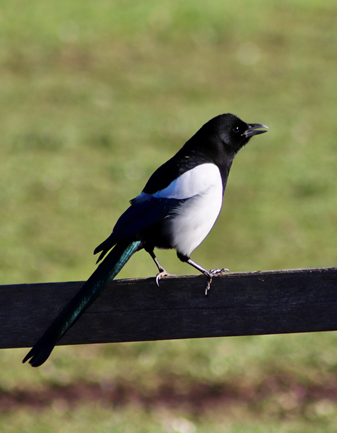
Magpies were a common sight in my childhood garden hopping round the lawn and were never given a second thought. Only in my twenties did a superstitious friend start to make me wary. One day the unusual sight of a magpie sitting on the back of a sheep (like a tick bird on a rhino) was followed by news of the death of a pet sheep I had hand-reared. Thereafter I became alert to sightings.
Riding exercise on a friend’s horse one morning I caught sight of a magpie sitting on a tree above the track looking directly at me and later passed a dead cow carcass on the road (not unusual in faming country since they are left out to be uplifted.) The horse a couple of days later fell on the road with its owner riding, caught cattle gangrene from its injuries and died. The vet said he hadn’t seen a horse with that in thirty years. That focussed my interest on a parallel universe.
Not that magpies are always unlucky though in years following, a magpie flying across the road usually meant delays or accidents ahead.
The old magpie rhyme – one for sorrow, two for joy, five for silver, six for gold – flitted through my head when I was selling my first flat. On Hampstead Heath as I was dog walking, a congregation (mischief) of magpies was gathered, all six of them. Hmm, I thought and hey presto the sale went through at a much better price than expected. Gold indeed.
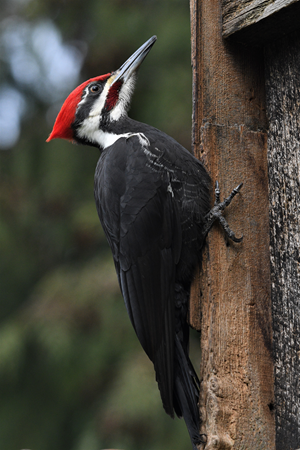
On the good news front as well, my first ever sighting of a Pileated Woodpecker, a sparkling red, white and black dandy, coincided the same day an exceptional career opportunity came in.
Having become focused on bird meanings I drooped when I saw Green Finches (= illness), beamed with enthusiasm when I saw Herons (= new beginnings) and Hawks (= fly highest so blessings from above, except if you are a rabbit of course).
Three trips to St Kilda one year, the furthest north-west of Scotland’s islands, next stop North America, would have defeated even Asbolus. Tens of thousands of gannets, fulmars, guillemots, kittiwakes and puffins did not stir up any messages from beyond though I did wonder about the meaning behind being attacked by an enormous Great Skua (known as pirates of the sea) as I crossed its breeding ground.
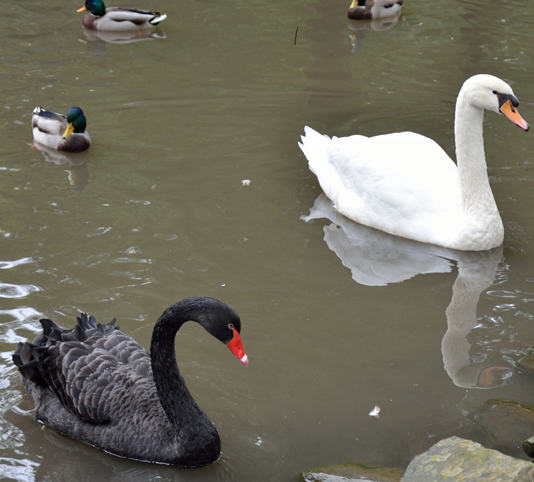
Back on the mainland, I embarked on a new relationship. The first Scilly Isles holiday together was blighted by the devastation from a recent storm of hurricane proportions. The second in France was littered with roadkill (I joke not). The roads were awash with squashed badgers, foxes, hedgehogs and rabbits. Passing a pond whereon swam a white swan and a black one I decided that was it – an incompatible if not downright unlucky association.
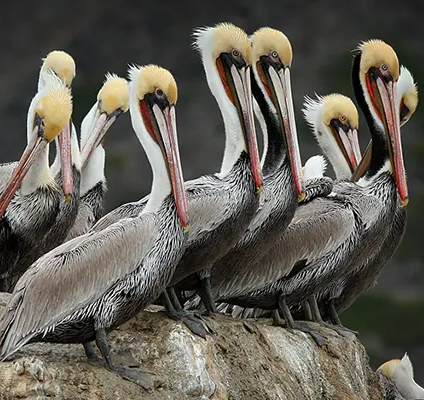
Retreating to an alternative healing spa in Big Sur, California to recover my balance, Pelicans were a welcoming sight on the way down. Known as Spirit Animals they represent overcoming heavy emotional burdens. Which about covered that.
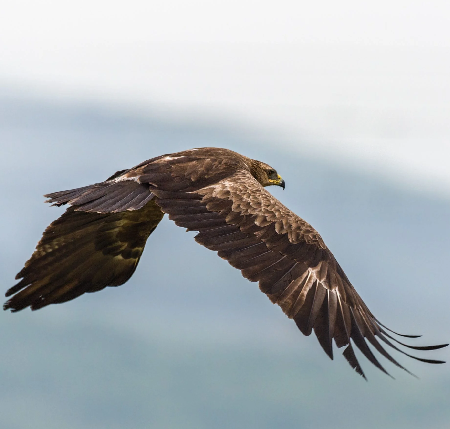
In recent years there have not been many ornithological incidents of note apart from a wonderful velvet brown eagle which flew low across in front of my car the day I bought a house in the South of France.
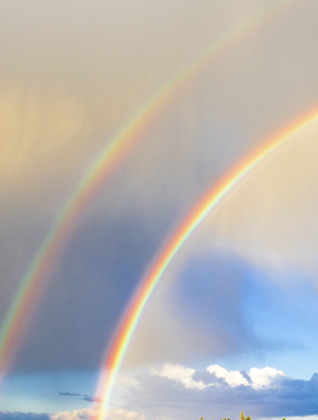
Though there was one meaningful happening from nature. A friend dying of cancer wanted to chase a magnificent, luminous double rainbow up in the mountains so she could see both ends disappearing into the earth. I drove her up and it was a breathtaking sight. She died soon after. It came to mind a year or so later when I caught sight of another double rainbow. News of the death of a Hawaiian friend was delivered shortly after. His wife later told me in their culture the rainbow bridge was the journey to a happier life on the other side.
At present I have an office window which looks out onto bird feeders and a garden with a gaggle of magpies, crows, jays, myriad small birds and the occasional red kite flying over. And the odd roe deer ambling around. Nothing untoward or other worldly.
Sceptics will point to coincidence or even hallucinations in the above stories. But most people if they are honest will admit to happenings in their lives which they could not explain but seemed deeply meaningful.
In a way I don’t care what the explanation is beyond accepting that the world is an odder place than science would have us believe.
“Science is still only a candle glimmering in a great pitch-dark cavern.” Mario Vargas Llosa
“Theory is all very well, but it doesn’t prevent things from existing.” Freud
“The rise of modern science has brought with it increasing acceptance among intellectual elites of a picture of reality that conflicts sharply both with everyday human experience and with beliefs widely shared among the world’s great cultures.” Edward F Kelly: Beyond Physicalism.
“Each science has a sort of attic into which things are almost automatically pushed that cannot be used at the moment, that do not quite fit …We are constantly putting aside, unused, a wealth of valuable material [which leads to] blocking of scientific progress.” Kohler:
I found this article to be very mind opening, it made a huge impression on me. Thank you!!
Lovely post, thank you. I once heard an old saying that when you see a magpie you ‘spit and count one hundred’, so that is what I do.
Marjorie, I so enjoyed your post and reading the comments here. The subject sparked a google search yielding a new term to me, ornithomancy – https://en.wikipedia.org/wiki/Ornithomancy
And, astrologically, I immediately thought of Bernadette Brady’s good use of the Eagle and the Lark to symbolize our approach to chart synthesis in her Predictive Astrology.
Thank you for this inspiring post, Marjorie.Like Susy robins are significant to my son and I.
Once when we were out visiting a rather beautiful garden we had a memorable encounter with a robin.
We were sitting down on a bench when it hopped over and seemed to want to communicate. It didn’t want to be fed and it was standing very still and appeared to be ‘staring’ at us. We couldn’t understand its behaviour and it stayed like that for a long time for a bird. It just seemed to want us to ‘get’ something. We started jokingly speculating it was my mother who had died some months before and wouldn’t want to be left out especially if my son was around. And really that seemed to fit. It seemed once we took this onboard and had a ‘chat’ with it the robin was satisfied and hopped away. Every time either of us now see a robin we assume it’s my mother – my son’s quirky nan.
What’s special about this sort of connection and your post, Marjorie, is that it puts you in touch with a different sort of energy – more the sort children are more naturally in touch with where time seems more elastic. Maybe this links to what is being explored in quantum physics?
When I was a child, I remember being told if a bird flew in the house, someone was going to die. I told that to a co-worker and a bird happened to fly in the warehouse area of the building, where he worked in. The next week he went to Oklahoma for a funeral.
Right now I have a duck who has built her nest in the same area of our front yard as last year. We also have a nest of Cooper’s hawks in the same tree as last year. I haven’t heard what either bird might protent.
Enchanting post Marjorie.
Birds are often seen as spiritual guides or omens. The way they swirl through the sky at night in collective synchronicity, is a thing of beauty.
Just before finding this article i was watching a couple of jackdaws on the fence watching a couple of squirrels…theres a few jackdaws and magpies live in my neighbours chimney.
Many years ago I was driving near Stanford in the morning, once in awhile a blue heron will cross my way. I remember thinking that it represents something . Don’t remember what.. but I have a feeling it has connection with ancient ancestors . Later I have learned that a native Americans village was found there .
Fascinating Marjorie. My brother died six weeks ago and I keep seeing hummingbirds. He played the trumpet and this morning I realized I have a bunch of red trumpet shaped perennials blooming outside and I stood and watched two hummingbirds flit back and forth, sticking their long, pointy beaks into each flower. So many times they flit off if they see an approaching human, but they put on quite a show this morning. I like to think it was a message from him saying he’s okay.
Thanks Marjorie.
Sometimes even in my suburban garden one just stops and listens to the sound of bird life. It is a connection to the natural world and a moment of pleasure.
As I understand it the Romans viewed birds and their migratory routes as aids to divination.
We are governed by various cycles. Astrology looks to the relatively certain and pure cycles that we see in the heavens.
Wildlife and birds also display cycles but there is natural interference from the everything else but the cycles are there.
In my family (originally from rural Herefordshire) we think robins are a sign that a deceased loved one is near.
I chat to robins as if I’m talking to my grandfather. My mum does the same.
Thank you Marjorie for a very interesting and thought provoking article. I too was slapped on the side of the head by a Great Skua whose nest I must have been near on St. Kilda. My birdwatching magazine waiting for me at home featured them as “Bird of the Month”! My cat, at different times, sat beside two visitors to my home with his front paws on their lap. Both were currently having a difficult time. He never adopted that position with me in the seven years I had him. As usual, Shakespeare has the right words….commenting on his friend’s reaction to the appearance of his father’s ghost Hamlet says “There are more things in heaven and earth, Horatio, than are dreamt of in your philosophy”.
The Romans took the behaviour of animals very seriously. There was a whole official priestly group of Augurs whose job was to interpret them. Often decisions were delayed or wars/battles either fought or avoided as a result of the reading of these omens.
I recall seeing an uncommonly high number of Cardinals during Covid. There is a saying something to the effect of: cardinals appear when angels are near.
I didn’t know till my father told me when l came home for a visit before taking up a job abroad in my early 20s that there is an equivalent rhyme about magpies in Scotland “One’s love, two’s grief, three’s a marriage, four’s a deeth”(death). A couple of days later l saw four magpies on moorland. When l left l told my father that someone would die when l went abroad and l wasn’t sure how l would cope.
Ten days into my new job in Switzerland my father died suddenly of a heart attack.
What CherS says of magpies in Australia is similar to seagulls in north-east Scotland. They are now protected species and frequently attack people with shopping etc. At least one village primary school does not allow young pupils into the playground at lunchtime/break owing to seagull attacks.
Where l live in England l see many crows, magpies and red kite but fewer small birds such as sparrows than years before – not enough cover in gardens to keep them safe – a parallel with ‘strong man’ leaders in the world today?
In Australia during the Spring (August-November) which coincides with the magpie breeding season, we have magpie alerts, physical signs placed in areas where a magpie is nesting nearby as it is not uncommon for magpies to swoop on passers-by as a defence mechanism to protect their young. We’re encouraged to wear sunglasses, broad-brimmed hats, or carry an umbrella as we pass through. It can be particularly risky for cyclists who often thread zip ties through the air vents on their helmets which gives a mohawk appearance to deter the swooping birds, or alternatively cyclists paint an angry face on the back of their helmets. Magpies cause hundreds of injuries every year in Australia, particularly in the Eastern states. I’m not a fan.
Bird omens (and animal messages) started following me about 10 years ago. A beautiful butterfly showed up in my living room just before I moved house to another part of the country. I moved to a small village, and lived there for about 9 years in what turned out to be a personal exile. Not by my own choice, I tried to seek out new connections but the universe decided otherwise. During those years I went through loneliness and personal hardship, and experienced what you might call a spiritual transformation. When I moved there, Saturn crossed my Ascendant. Solar Arc Mercury was buried in my 12th House for years on end, corresponding exactly with my exile. In those years I often went on long treks on my bike, where I was followed and attacked multiple times by a buzzard. (it couldn’t penetrate my helmet!) In my backyard stood an apple tree, when suddenly a large group of long eared owls came there to roost. In that same year, during an intense meditation a golden eagle came to me. In my new house moths appeared, for years in a row. About 3 months before the COVID epidemic started, I had a dream about people being locked up in their houses due to a zombie virus outbreak. Nowadays I live in a small scenic town and work as a counsellor and social worker.
As a boy my father had a magpie, he had found wounded, as a pet. When he died in 2019 a large single magpie came and perched on the table out side my parents’ back door for several days.
On sight of a magpie (each individual one) during my day, I always salute them. A superstition I’ve carried through life.
There’s also the lore that if they fly into your garden from the right it’s good news, but if they fly from the left it’s bad.
That caveat I’ve not heard!
What a lovely article! I remember the time we were staying in a remote cottage in Wales. My brother had died the previous year and it was the day of his first birthday since his death. I woke up to the sound of tap-tapping from somewhere. On and on it went, so I crept downstairs and there at the kitchen window was a Magpie tapping its beak against the window repeatedly, as if to say, ‘hello, I’m here.’ Such synchronous happenings feel so personal when one is grieving, like a direct message from the loved one.
What a lovely piece. The title struck me immediately as on Thursday I saw two dead magpies under a tree and another one today, a few roads away. I mentioned it to someone over lunch. Sadly, likely human interference.
I regularly experience minor “coincidences” or some sort of pre-cognition. They are never massively significant, but I take them as a nod I am in the right place and as such, I find them reassuring. Something more major is that every house I have lived in has had multiple connections to someone that I have known or come to know in my time there, always without me being aware initially. Hard to explain but I have a sense now that I will live where I am meant to and I need not worry too much about it. Perhaps the ancients could make more astrological connections than I am able to that explain some of the fateful elements of our lives.
There is considerable variation in the lyrics used. A common modern version is:
One for sorrow,
Two for joy,
Three for a girl,
Four for a boy,
Five for silver,
Six for gold,
Seven for a secret never to be told.[1]
A longer version of the rhyme recorded in Lancashire continues:
Eight for a wish,
Nine for a kiss,
Ten a surprise you should be careful not to miss,
Eleven for health,
Twelve for wealth,
Thirteen beware it’s the devil himself.[2]
<333
There was a childrens TV programme in the 70s with that theme tune
The rhyme “One for sorrow, two for joy” is a traditional nursery rhyme originating from British folklore, often associated with magpies. It is believed that the number of magpies seen predicts the weather or one’s luck. For example, one magpie is said to bring bad luck, while two magpies are considered a sign of good fortune. The rhyme has various versions, with some extending to include additional verses predicting different outcomes based on the number of magpies seen.
Wikipedia
+3
Wikipedia
Magpies: Counters of Fortune
Few birds are surrounded by as many counting rhymes and superstitions as the magpie, particularly in British folklore. The most famous rhyme—”One for sorrow, two for joy”—continues with different numbers predicting everything from marriages to journeys to secrets. The superstition is so ingrained that people still instinctively salute a lone magpie or look for its mate to avoid the foretold sorrow. In Korean culture, magpies represent good fortune and happy news, with their chattering believed to herald the arrival of guests or good tidings. Chinese tradition similarly views magpies positively, considering them birds of joy and good fortune, particularly when they appear in pairs. These divergent interpretations demonstrate how the same bird can develop entirely different symbolic meanings across cultures, though all recognize the magpie’s distinctive appearance and behavior as somehow meaningful and worthy of human attention and interpretation.
Birds have long been seen as messengers of the divine, carrying messages from the heavens to the earth. Their behaviors and appearances are often interpreted as omens, which can guide individuals in making decisions or understanding the future. Here are some common interpretations of bird omens and their potential real-life implications:
Black Crow: Often associated with change or transformation, a black crow may indicate a need to prepare for upcoming changes in your life.
1
Owl: Known for its wisdom, an owl sighting may suggest that it’s time to trust your intuition and embrace the unknown.
1
Hummingbird: Embodying joy and love, a hummingbird may indicate that positive changes are on the horizon.
1
Eagle: In some cultures, eagles are revered as powerful spiritual guides, symbolizing victory and imperial power.
1
Raven: In Norse mythology, ravens are known for their intelligence and ability to carry messages, often seen as harbingers of death or bad luck.
1
These interpretations are subjective and can vary based on personal beliefs and the context of the observation. It’s important to consider the specific bird species, its behavior, and the circumstances surrounding its sighting to gain a deeper understanding of its potential meaning.
1
Crows at house top indicate a guest on the way, in indian culture. Usually came true but with apartments, difficult to know if its neighbours part or ones own 🙂
Beautiful posting! Touches on the magic of nature. You had a charmed up bringing.
I used to live in the middle of a lot of acreage. We could tell when the weather was going to change based on bird behavior.
Your response to Marjorie’s writing is spot on.
I love what you experienced.
Thank you for sharing
Hello, Marjorie. My mother had a stroke years ago and experienced a number of other serious health problems before she died 4 years later. I remember my father and I noticing that for a few weeks around the time of the stroke, every inch of the overhead power line that connected my family’s house to the utility pole was covered by cooing mourning doves. That never happened again in all the years my dad lived in that house, give or take the random one or two we subsequently saw.