
Once the dust and hysterical predictions of political earthquakes dies down, it is worth noting that Reform’s projected vote in a General Election based on this result would be 26%, way short of a Commons majority. A win usually needs close to 40% (Keir Starmer got in with 33.7%). And local elections are often an opportunity for a protest vote which evaporates when faced with a parliamentary election. The rest of the vote was bunched in a 16 to 19 per cent band between Labour, the Conservatives, Greens and Lib Dems.
The SNP’s national share of the vote, at 38.3%, was its lowest since 2007, suggesting voters had drifted away; and leaves FM Swinney short of winning the overall SNP majority he argued would be a mandate for holding a second independence referendum.
Plaid is now the largest party in Wales with 43 of the 96 seats. Under Wales’s new representative electoral system, at least 49 seats are needed for a majority. These results mean Plaid Cymru can comfortably form a minority government.
A Westminster coalition government ahead is not regarded with enthusiasm and as Andrew Neil points out would not allow for “tough-love welfare reform, massive rearmament, scrapping the Net Zero lunacies and prioritising policies that produce cheap, secure energy.”
It was an election undoubtedly driven by the unpopularity of Keir Starmer but with an electorate not exactly enchanted with the possible replacements.
Robert Shrimsley in the FT suggests it is likely in this flux that a broad left-right political balance will still hold in future with reach party taking in their close rivals. “The question is whether this moment marks a permanent shift to fragmented politics or simply a transition to two new but still similar power blocs. Is this the end of the duopoly or merely the end of the duopoly we are used to?”
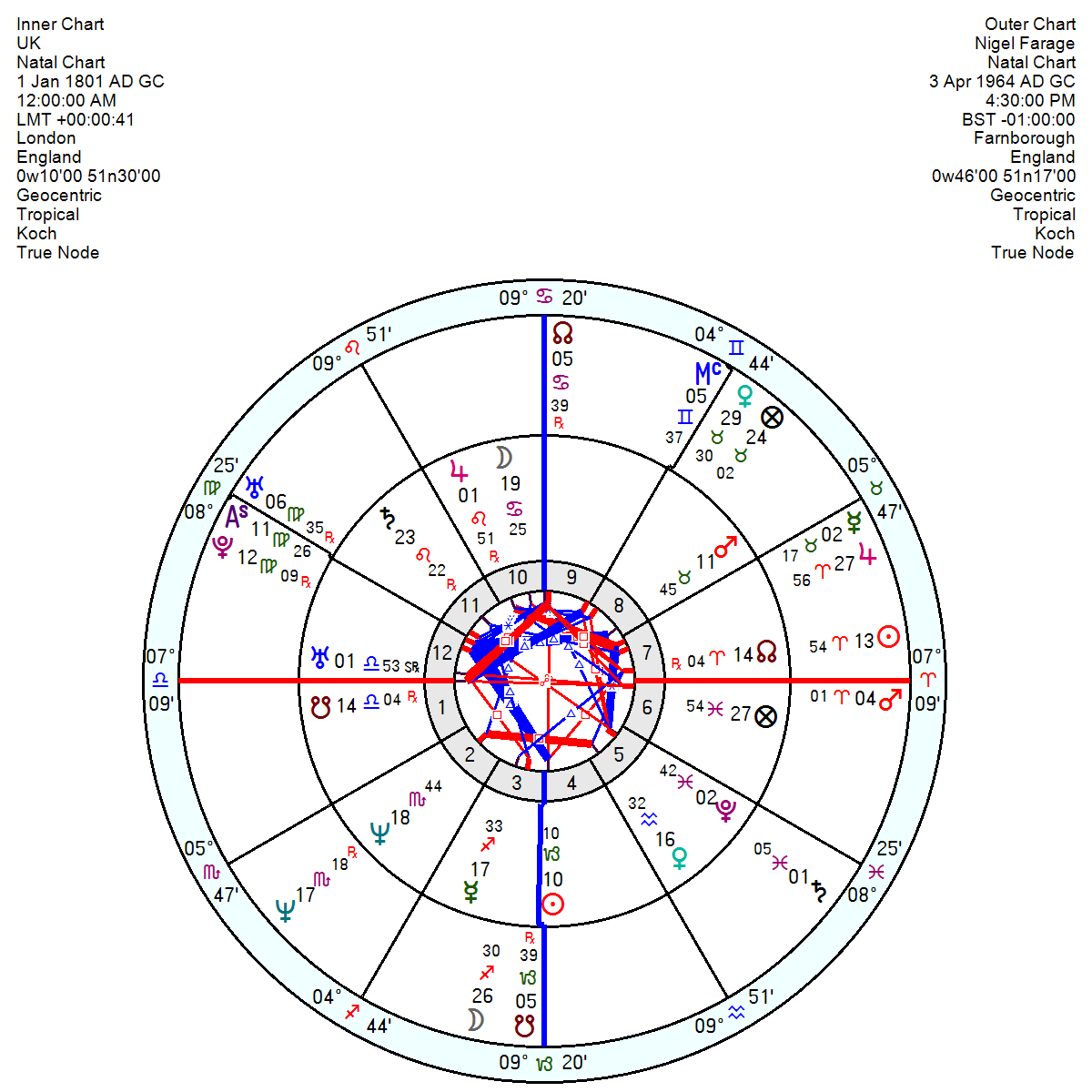
Having absorbed all of the above it is still true that Farage has a talent for acting as an agent of change firstly in Brexit and now this. With his 8th house Aries Sun conjunct the UK’s 7th house (= close partnerships) North Node he clearly serves a purpose in wakening up the UK and forcing it to develop. Not that he himself is a beacon of light given his capacity for in-fighting, lack of staying power and more. He helicopters in for a reason, does the needful and disappears – a trickster. His Sun is conjunct Eris, the dwarf planet known as a conflict bringer and catalyst.
His Saturn in Pisces sits on the UK’s Pluto, both due for a shake-up, in his case mid to end of this month, and the UK in June onwards. It will be interesting to see what transpires, especially with the UK since that will rattle its yod hinting at a significant change in the UK’s destiny. Farage has tr Neptune conjunct his Mars late May to mid August and again on and off till early 2028 which is usually associated with failure. Tr Uranus crossing his Midheaven August to October this year and again in 2027 does suggest a radical change of direction in his life and career. His midpoints with one exception this month are less than upbeat for a couple of years ahead.
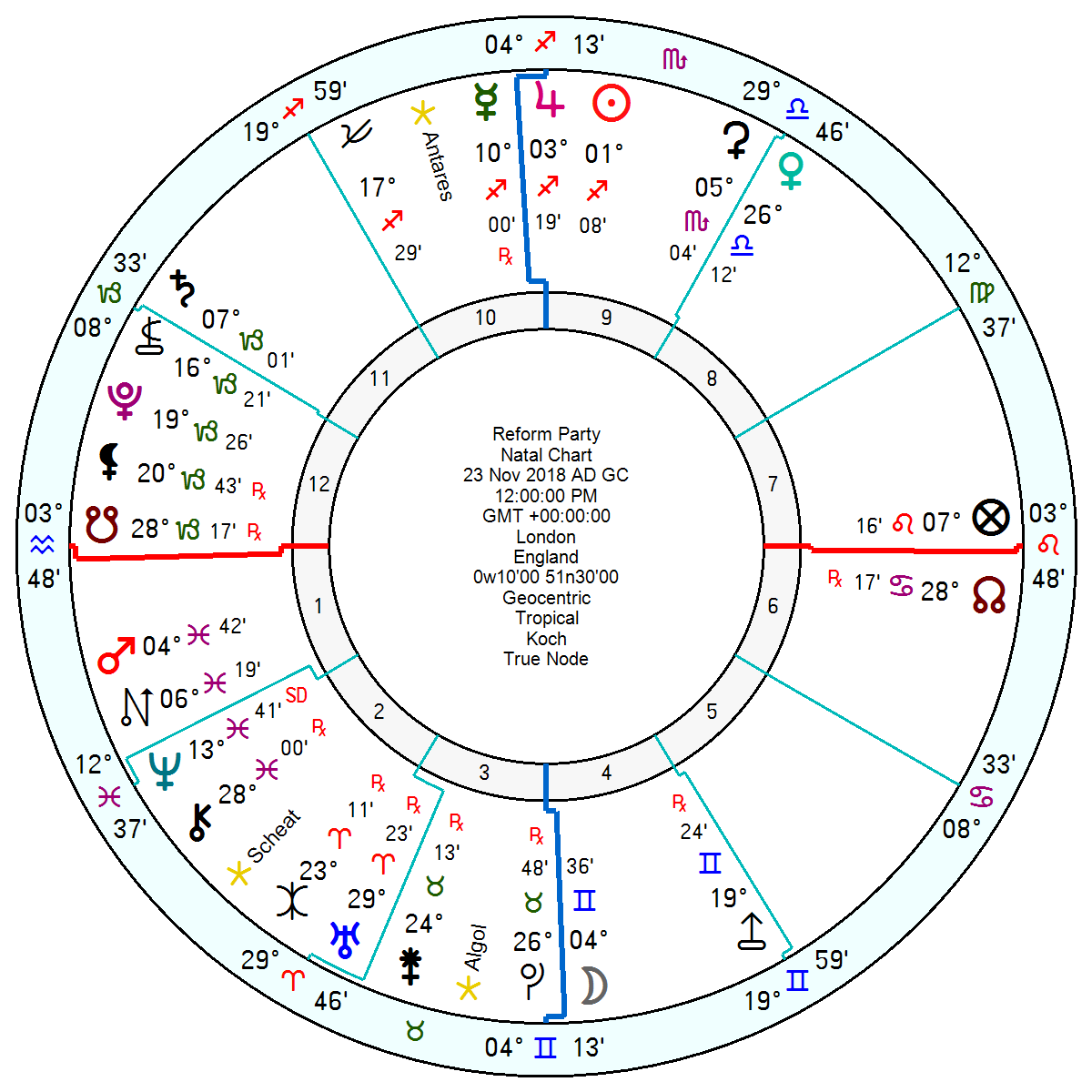
The Reform Party, 23 November 2018 has an adventurous Sun Jupiter in Sagittarius getting buoyed up by tr Uranus in opposition at the moment but it moves on to square Mars in Pisces which will start to get rattled from this July onwards. Very up and down, unstable, racketing around from highs to over-reaches and backfires. 2028 looks highly uncertain and confused.
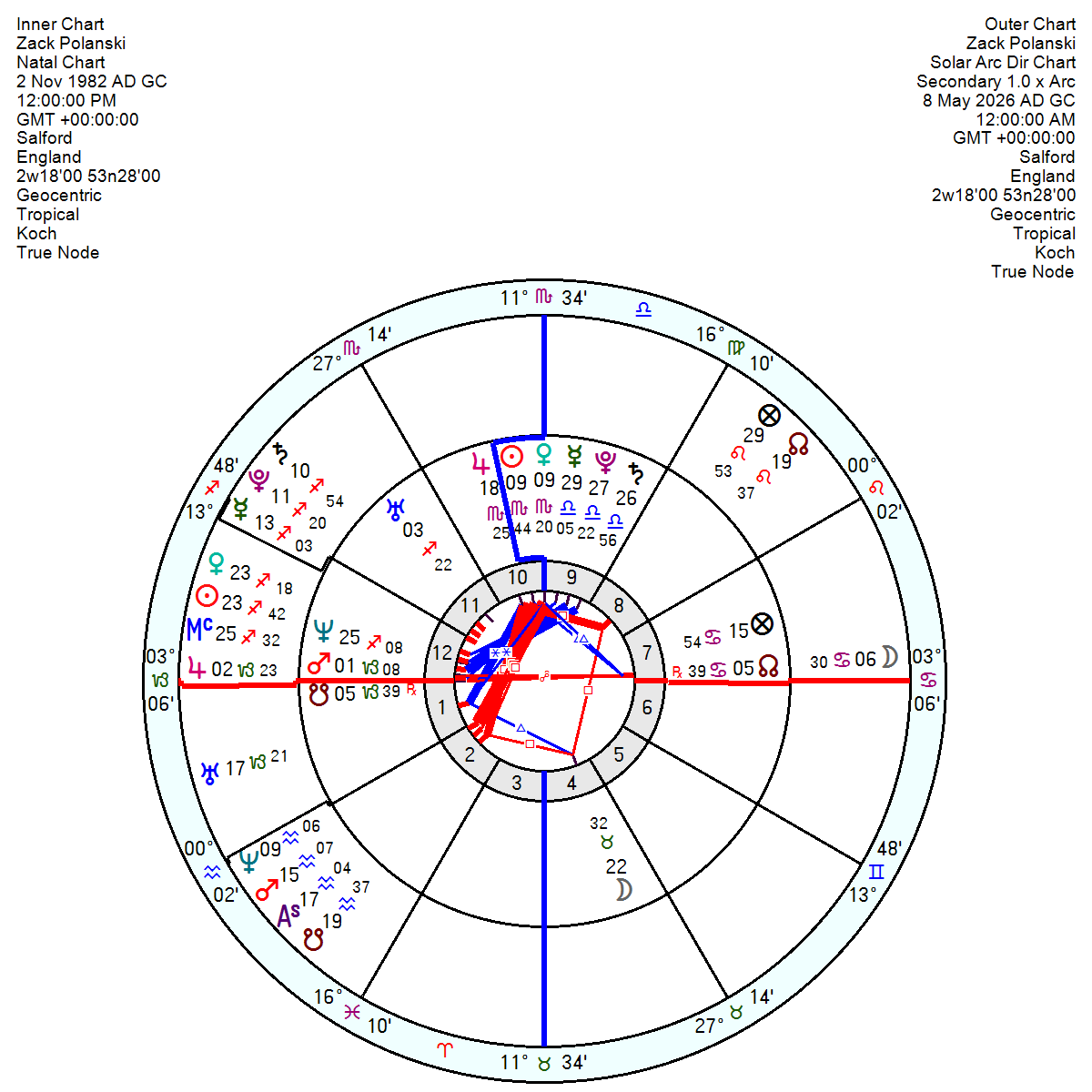
Zack Polanski, 2 November 1983, Salford, England, a superficially charming and determined Sun, Venus and Jupiter in Scorpio with a publicity-attracting Neptune Mars conjunction may well have peaked with his Solar Arc Jupiter conjunct Mars keeping him afloat early this year. Ahead he faces an undermining Solar Arc Neptune square his Sun now and a Solar Arc Sun conjunct his Neptune in the next year or so.
His leadership from 2 September 2025 is upbeat at the moment though less so this autumn and on a sharp downhill slide later this decade.
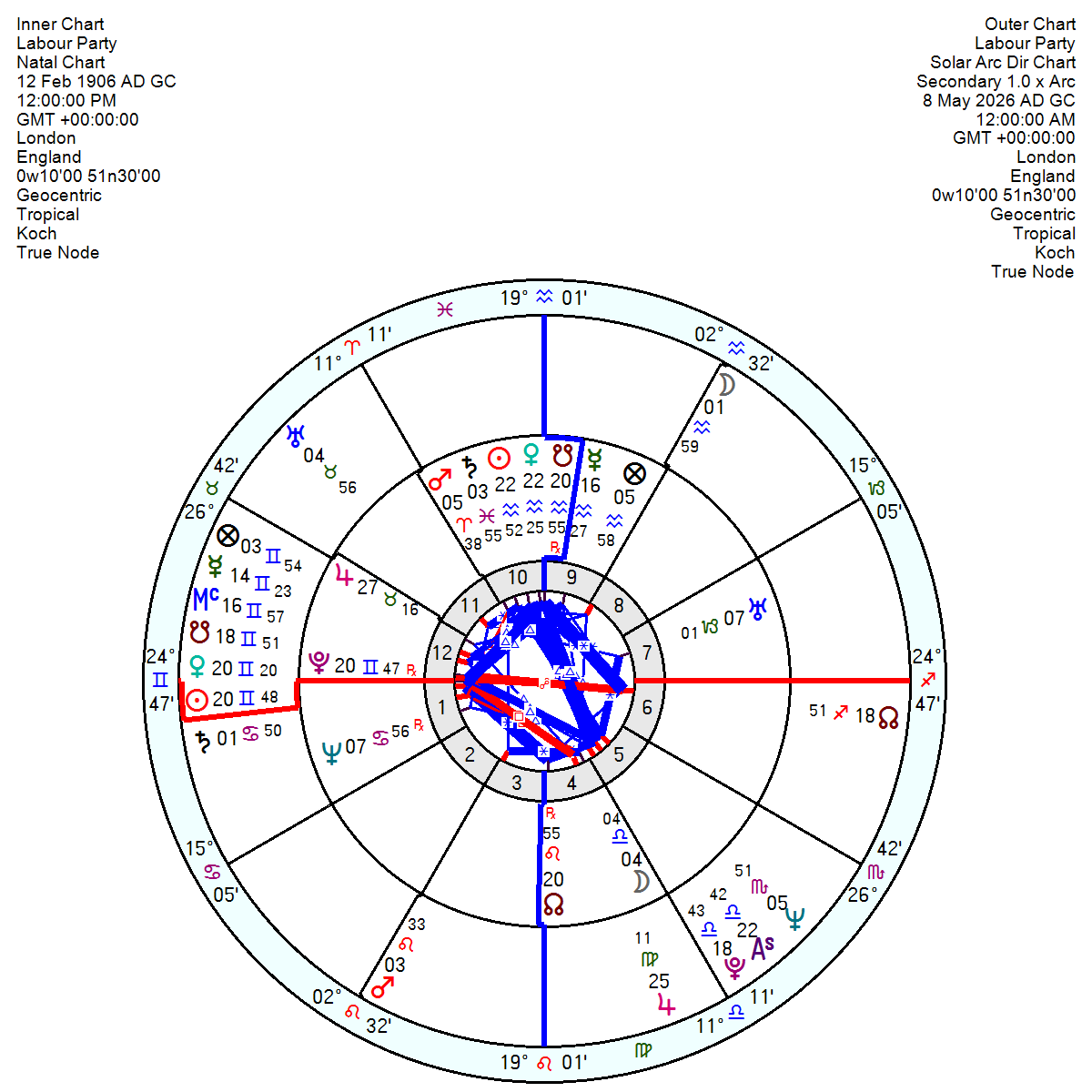
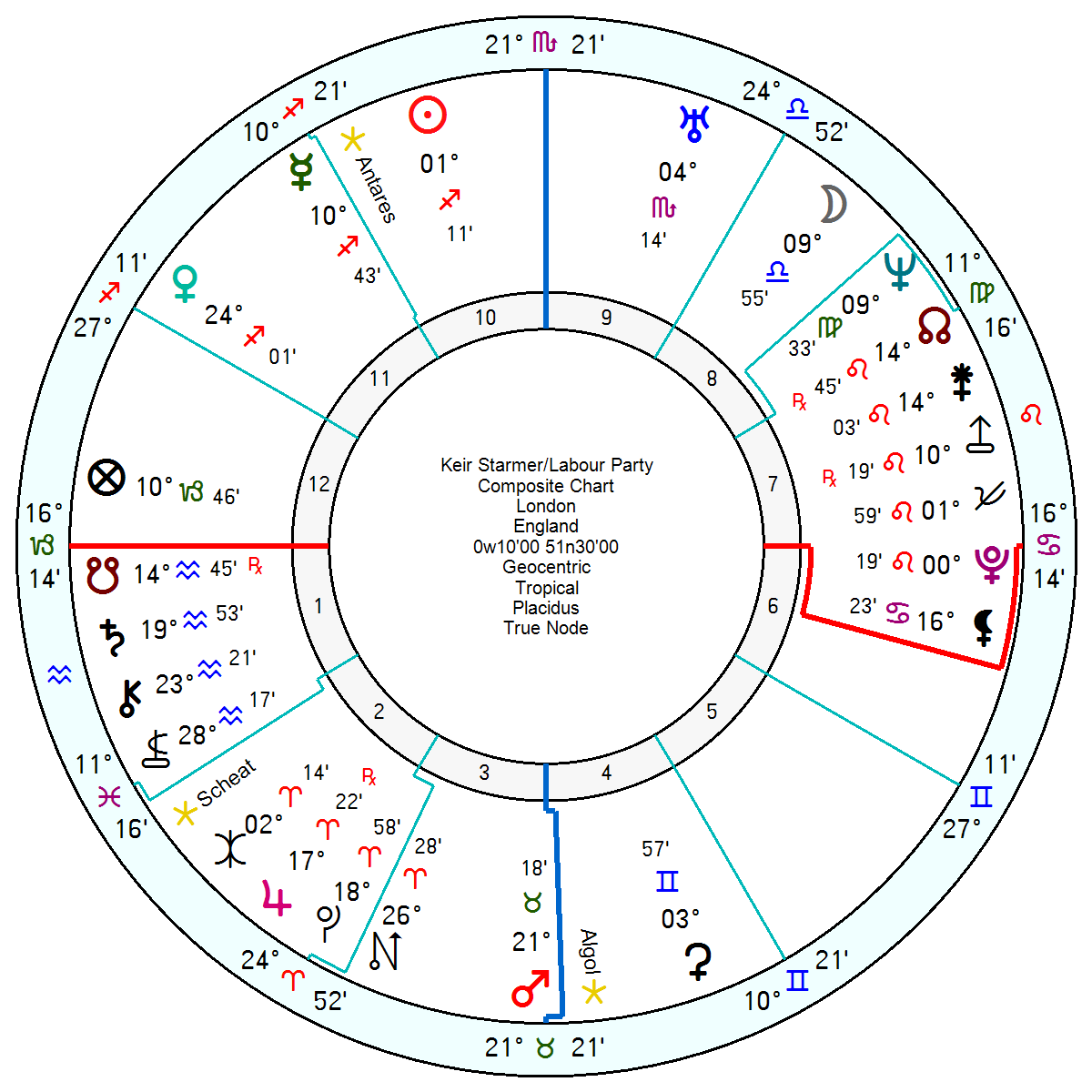
The Labour Party, 12 February 1906 chart is descriptive of the mood of the moment with its Solar Arc Sun conjunct Pluto for a total blockage; and worse to come through 2027 to 2029. Keir Starmer’s relationship with this chart is rattled at the moment and threatening to split asunder with tr Uranus opposition the composite Sun later this month and again early in 2027.
Though the fear for Labour would be that a leadership change would not bring any better fortunes.
The Conservatives are still wrestling with old demons and attempting to rebrand their image for at least another year before they haul their feet out of the past.
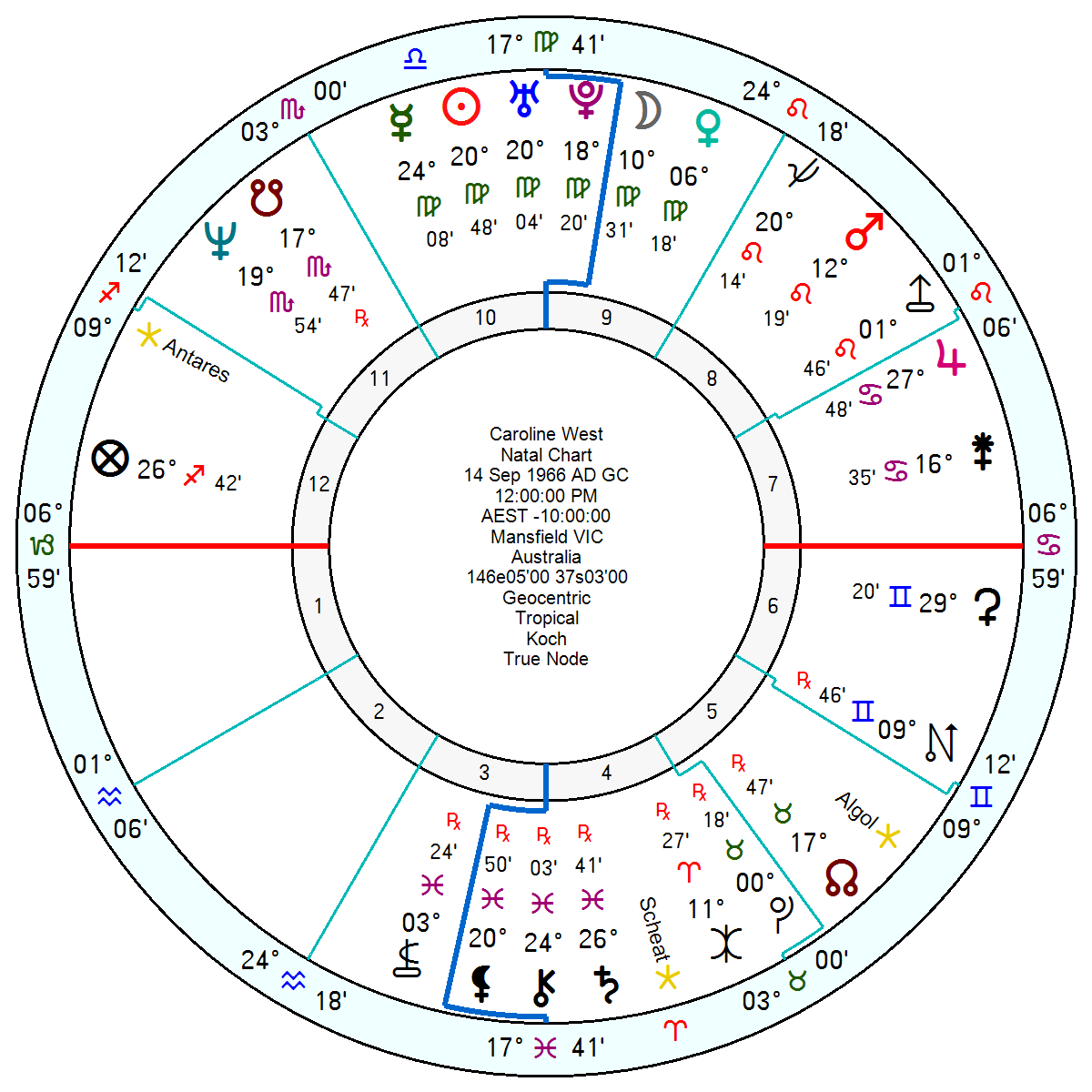
ADD ON: Caroline West MP, an Australian-born UK MP, has called for a Cabinet Minister to challenge Starmer, saying she will put herself forward in the absence of anyone else. Born 14 September 1966, she is a Corbynite and pro-Europe. She has six planets in Virgo ranging from Venus and Moon to Pluto, Uranus, Sun, Mercury conjunct opposition Saturn – definitely a rebel. She also has an amped up Mars in Leo on the focal point of a Fixed T Square to Neptune opposition a Scorpio North Node.
Not a lady who does things by halves clearly.
She looks a touch over confident at the moment with tr Pluto opposition her impulsive Mars/Jupiter midpoint and will run into all manner of arguments and aggravations in coming months.
Some rumours that Labour MP Al Carns might throw his hat into a leadership contest. Could you look at his chart?
He is certainly ambitious enough with Mars conjunct a leadership Leo North Node conjunct Jupiter. Being born in Scotland there must ne a birth time somewhere. I think not just yet. Disappointed in 2027 and his moment comes in 5 years time.
Pluto went stationary on May 6th at 5 degrees Aquarius. The 6th was the day before the local elections. Starmer’s Saturn is at 5 Aquarius. I’m not sure he’ll go but this is a pretty brutal hint from the stars.
Farage’s chart shows change of direction from this July. It makes me wonder if while we are distracted with Starmer we are missing the serious allegations that are coming in against Farage at the moment.
The upcoming Pluto square Mars sits on Starters nodal axis and SaturnR – feels like a crunch. Transiting Uranus trine Starmer’s Saturn joker in the pack. As far Labour – new labour experiment is due for total transformation and change in direction with solar arc sun conj Pluto
In September 2025 Marjorie wrote about Shabana Mahmood. Bearing in mind her intervention in the current government circus, it is spot on:
“The Home Office is a thankless job and no surprises she is running into sinkholes and setbacks in 2026 and worse in 2027. Her Saturn in final degree Virgo is also seriously rattled this month by the eclipse and across the winter by tr Neptune Saturn in opposition.
Her relationship with Starmer is nerve stretched and high-tension now and through 2026 with tr Uranus opposition the composite Neptune Saturn. And tr Saturn Neptune opposition the composite Pluto.
Musical chairs at the top won’t make much difference to a government that increasingly looks unable to cope.”
Thanks GD – yes, interesting about Saturn and Tony Blair – a time of great Saturnian responsibility for him (and even the personal responsibility of another, late, child), plus considering how ‘belligerent’ he could be, interesting that his Saturn years began with Saturn in pugnacious Aries.
Perhaps I’m resisting the idea that Farage could ever be PM. If we have a GE in 2028 or 2029 (last chance saloon) then I’m hoping Reform will have faded somewhat. Yes, they’ll gain seats, but not enough to gain power. Maybe I’m pinning my hopes on Saturn in sensible, cautious Taurus and the Nodes in Capricorn to damp down airy, fiery impulses!
Of the possible outcomes from these local elections, I agree with your comment the other day that Reform winning councils gives them a chance to show that they aren’t any more effective than the rest. I’m not a fan of Farage because he is pure self-interest and hypocrisy (EU passport and house in France I believe) and it is appalling that people can’t see that he is just a mini-me version of Trump who would wreak havoc. But then you wouldn’t really expect anything much else from an Aries/Taurus with almost no placements in the societal signs.
Overall politics is between a rock and a hard place. As terrible as Starmer is, if he steps down then we just end up with 2-3 yrs of the media calling for an election and going on about how his successor has no GE mandate. Just as happened when Truss / Sunak took over from Boris. Don’t want him to stay / don’t want him to step down.
The only glimmer of hope is the astrology Marjorie posted a week or two back about how the UK’s chart seems to be on the up soon. Maybe that will be Starmer being replaced. It’s hard to think how else it could brighten.
reply to UnmM – yes, for the House of Commons I look at January 20th, 1265 (JC). It’s a kind of experiment I began messing about with when I noticed that 1066 Mars, 8 Aquarius, opposed the HoC Leo Neptune, 1066 Venus was conjunct HoC Nodes, Hoc Pluto in Sagittarius was square 1066 Virgo/Pisces Nodes, and 1066 Neptune in Taurus was conjunct HoC’s Saturn and Mars in Taurus square its Moon in Aquarius.
Nick Campion gives a 10th June 1983 chart for ‘Thatcherism’, when the Conservatives achieved a majority in the General Election. He argues that this chart ‘contains clear signatures of the beliefs and behaviour’ of Thatcherism, and represents a key moment. Interesting to see that Neptune, 28 Sagittarius in 1983, was conjunct the 1066 Uranus in Sagittarius and square it’s hidden Pisces Moon (the public). Saturn and Pluto in Libra put pressure on that Moon, and were sextile philosophical, sometimes fanatical 1066 Uranus in Sagittarius. In many ways, what happened during those Thatcher years still affects us today.
Thank you for the response, Jane.
Re the issue with being unable to reply directly to others within this site (presumably because of missing a Reply link), have you tried a different browser (such as Edge, Chrome or Firefox)?
Firefox uses a different engine from Edge or Chrome (both of which use the same engine under the hood) and may be worth trying.
And of course, if you have a Mac, use Safari, which has its own engine.
Using a completely different browser to your usual one may solve the issue with being unable to reply to others on this site, even if it is a hassle to use a different browser just for this one site.
(The advice is courtesy of my brother, who is heavily into IT…automated house lighting, that kind of thing. I have summarised it as best as I could understand it).
Thank you so much UnM! I’d tried two different browsers, to no avail – I also have a family member who is an uber-geek. So, here I am posting a reply having done the old fashioned thing of switching everything off at the wall in frustration…..and it has worked. No doubt other quirks await since computers have a mind of their own. Just spooky that the first time I decided to try again here was in reply to you!
Mysterious movements in the ether…:)
I wonder whether Farage will be beset with health, rather than politiccal issues, going forward.
Reply to GD: You’re right to say that Farage has a trickster’s knack for reading the zeitgeist, for now at least. But I think it’s worth considering the Saturn in Taurus square Pluto in Aquarius theme in 2028-9. Quite a tough, testing moment. Plus the tr Nodes enter Capricorn/Cancer in 2028. Curiously, the UK House of Commons has an Aquarian stellium, Jupiter, Saturn and Mars in Taurus, and Moon’s Nodes in Capricorn/Cancer. Chiron moves into Taurus next May. So perhaps the bumper fire and air mood is tempered a bit by all that?
I notice that there’s certainly a summer bonfire of a fire and air fest in July this year, with Jupiter newly in Leo (UK Jupiter Return), and later the Nodes into Aquarius.
Jane, what date do you use for the UK House of Commons? Do you use a different date for the Lords and/or Parliament as a whole?
As an aside, if one takes the 1265 Model Parliament as the start of the Commons, it is interesting that its Pluto Return was 2009, with the Expenses scandal.
Couldn’t find anything interesting parliament-wise in 1761 or thereabouts (apart from George III ascending the Throne), but 1512/13, the previous Pluto Return, saw the start of parliamentary privilege of free speech, with Strode’s Case.
Good God, history has a strange way of echoing.
Re Plaid Cmyru winning the largest number of seats in Welsh Seneed, almost exactly three Pluto returns ago was the end of Welsh Independence, between 1282 and 1284, when the last Welsh Prince of Wales became the first person to be hanged, drawn and quartered in the British Isles (according to Wikipedia) and the Statute of Rhuddlan extended English law into Wales.
The King of England at the time was Edward I, Edward Longshanks, who was also called Malleus Scotorum, the Hammer of the Scots. Some echo of history there too.
History is fascinating.
I wasn’t really looking at how Farage actually expresses his chart; moreso just an objective look at which politician’s might have a chart suited to the era in terms of it being predominantly fire-air. Don’t forget we also had the 2020 Jupiter-Saturn conjunction in Aquarius which sets the theme for the next twenty years.
You’re right though about Saturn transiting through Taurus (as well Aries) where it is going to challenge Farage. But then Blair had Venus at 15Aries which was hit by transiting Saturn as he was first elected in 1997 and then it passed on over his Aries Mercury, Taurus Sun / Jupiter, Gemini Mars and finished up on his Ascendant as he was re-elected in 2001.
To be clear all this is sort of just a theory, I’m having a hard time mentally separating the general themes of people’s charts from the details of how transits will affect them. And of course almost everyone has some kind of mix of the elements etc.
I said before 2024 that I didn’t feel Starmer’s birthchart was the right fit for this era – too much hesitancy. Likewise I don’t think Badenoch’s chart which as I recall is Cap-heavy with Cancer Moon and Saturn in Virgo is right for a fire and air era. The chart which seems to fit it best is that of Farage with his Aries planets, Sag moon and Gemini MC. Among the Labour possibles Angela Rayner with her Aries Sun, Leo Mars and Libra planets especially if her moon is in Leo but she is otherwise a bit Virgo heavy. This doesn’t mean to say that finding an air-fire person is going to turn everything around – after all Donald Trump’s chart fits the era perfectly.
I wonder if we have to wait until a 2034 GE for things to really start turning around – that’s when the late 90s Pluto in Sag, Uranus-Neptune in Aqua will be in their mid-late 30s – perhaps one of them will step into the limelight.
Interesting – given that Trump’s chart fits this era energy wise, why did he first come to prominence in the previous era?
It’s a good question – the fact he didn’t get re-elected in 2020 suggests maybe he wasn’t the ‘right chart’ for the era.
That said, he does have Saturn-Venus conjunct in late Cancer as well as Mercury placed in there which would complement the concerns of Pluto in Capricorn.
Plus the Uranus in Aries era was 2010-18 which would complement his fire-air.
When he was elected in 2016 the mutable signs were emphasised with Jupiter in Virgo, Neptune in Pisces, Saturn in Sag. The latter squares was quite prominent in creating the refugee migration crisis that took place that year and he was able to capitalise on it with “building a wall” – cancer/capricorn protectionism.
Uranus in early Cancer (with Saturn for the first half) in 2034 will change the energy again, I’d think.
Indeed, everything will roll on. I’d say both Saturn and Uranus will tamp down the emotional / subjective of Cancer and therefore maybe that will assist the Pluto in Aquarius objectivity.
Tony Blair is the poster child for the chart matching the era with his Gemini Asc with Jupiter/Mercury on it and a Aquarius moon as well as the Leo Pluto and Saturn/Neptune in Libra (even though he was a Taurus Sun). Yet his legacy began to unravel when Uranus moved into Pisces in 2003 when he supported the invasion of Iraq but he still won another election in 2005.
am increasing noticing that reacting time to events are literally within less than a day. Any longer deliberation you will miss the deal, eg stock markets).
This might explain why UK seems to not run to Trump’s aid as fast as they should like what happened in Boris time.
80s kids have Pluto in Libra sextile Neptune in Sagittarius. Add in the Leo factors to want to run for elections plus a gift of gab, one should find a air fire politicians. But the astrology weather will changed again when election time come.
Saturn will conjoin Farage’s Sun three times between June and March 2027.
Sun/Saturn transits can be both times of restriction and challenges or rewards for due diligence. Farage’s Sun at 13 Aries sits very close to the UK 1801 North Node at 14 Aries near the point where Saturn turns retrograde in July. Interesting to note that Starmer’s speech on Monday 10 May 2026 took place when Saturn was conjunct his own government’s 5 July 2024 North Node at 10 Aries. That degree will be crossed again twice by Saturn. The first will be a retrograde pass in early October 2026 which significantly will be just after the Labour Party annual conference. The second will be in late January and early February 2027 when Saturn is direct again.
Thank god Kemi is not in power, we would have been embroiled in an illegal war along with Trump. Same goes for Farage, I really question their principles and decision making.
Not sure what you mean by ’embroiled’ but I believe Kemi said where British bases were being attacked, more should be done to stop that.
As far as I’m aware, Kemi is not on record as saying the UK should join US and Israel in the war on Iran.
Of all the political leader Badenoch’s natal chart has the best fit with the U.K. 1801 chart. Her problem is that the Conservatives Party sold its soul to neo liberal economics in the Thatcher era and is now paying for that decision at the ballot box. Sadly, yesterday’s results did her no favours.
Pleased Kemi’s astrology aligns well with the UK chart Hugh. I think she’s great, and just what Britain needs.
I really hope the party sticks with her for the next General Election despite those results
Thank you Marjorie for this and adding in a look at Polanskis leadership chart.
What a mess we are in. The loveless landslide that gave us Starmer and now these elections.
After local election results I had a quick dig into the Green Party’s early history. It was originally named as the People’s Party and normally dates its inception to a meeting held in Coventry on the evening of 24 February 1973. Comparing is natal chart to the Labour Party 1906 chart is quite intriguing as the Green’s Mars at 8 Capricorn sits very close to the Labour Party Uranus at 7 Capricorn opposition Neptune at 7 Cancer. The Green’s natal Pluto at 3 Libra opposes the Labour 1906 Mars at 5 Aries.
The Green Party’s Saturn at 13 Gemini is conjunct the Labour 1900 Pluto at 14 Gemini. The Green Party’s Uranus at 22 Libra opposes the Labour Government 5 July 2024 Chiron at 23 Aries and its Mars at 8 Aries opposes the Labour government Moon at 7 Cancer.
The Green’s own Chiron at 14 Aries sits on the UK 1801 North Node. That latter degree is where Saturn begins its retrograde on 27 July 2026 which last until December 2026. Saturn returns to 14 Aries until March 2027.
It should be noted that following a split in July 1990 the Green Parties in Scotland and Northern Ireland became completely separate entities from the Green Party in England & Wales with their own organisations and leadership.
I think the idea that Reform only picking up 26% of the vote will stop them winning a General Election is a little optimistic as it rather depends on how the other parties vote splits. In the local election on 7th March 2026 their 4 nearest rivals polled 20%, 15%,14% and 14% respectively. Under the UK First Past The Post system that would be enough to win a majority in the House of Commons if it was replicated in enough seats. In fact the Labour landslide in 2024 with just 34% of the popular vote shows exactly how it could happen. One of the reasons British politics is so dysfunctional is precisely because the country is constantly run by governments representing just a minority of voters. This has been particularly marked with the Starmer administration and is one of the reasons it struggles for legitimacy. Until Britain changes its electoral system to something more representative. The voting systems for the Scottish and Welsh assemblies have gone some way to addressing the issue and from next year local Mayors will be elected on a Supplementary Vote system but we are still some way from having a truly representative way of electing governments.
Oops that should be the local election of 7th May 2026
Thank you Hugh. I think you are correct here. Is there any way of telling a potential change of voting system to PR in the charts? That’s probably too detailed an ask of the astrology…!
Quite extreme, yet incredibly revealing, “The Ruling Class” -1972
Reminiscent of the “Carry On” series… but in a much darker presentation…
Wonderful performances with Alastair Sim, Coral Browne, & PeterO’Toole
What was happening astrology wise in the ‘70’s tele/acting depicting the late 40’s/early 50’s (without googling).
Relative to now –
Contra – same production timeframe – Dr. Who with its hyper popularity in UK
No dates, sorry, found it interesting… current creative ventures seems less “punny”…
Thin skins everywhere
Thx
The 1900 Labour Party chart is the one I tend to use and that is having some interesting transits in 2027-28 with transiting Uranus aspecting its mutable T-Square and transiting Pluto conjunct its natal Moon.
The U.K. still has a few more years to go with Pluto transiting our fourth house. Next year (2027) in the 1801 Chart our Sun/Pluto and Moon/Saturn midpoints will be activated by Pluto in the 4th and 10th houses respectively. The Peolle and it Authority. Pluto is the strongest as it is transiting and also involved in midpoint. Therefore, this will mean Government, Authority, Money and people (voters) will all be involved. Personally, I think this will be the last major storm to shake this country before Pluto moves into the 5th house. There is a saying “there is always a storm before the calm” . The last few days have shown voters dissatisfaction. Pluto has been moving through the U.K. chart 4th house for nearly 20 years, gradually breaking down the systems in this country, pushing this country in order for renewal. We can’t turn away from this, we have to face it. Labour cannot ignore last week, none of us can. Change is coming, it may not mean what our Poliricians would like it to mean though. As Britain has to change. Pluto rules the 8th house Politics and others people’s money. As a country, we are living beyond our means – perhaps we are all going to learn this lesson?
This talk of Pluto made me realise that we are also heading to a Pluto Return of Grattan’s Parliament, a short period of time between 1782 and 1800 when the Irish Parliament, which was an independent Parliament for Ireland, but subject to Poyning’s law, which limited parliamentary business to only matters already approved by the British government.
Henry Grattan, an Irish politician and a member of the Irish House of Commons, campaigned for more rights for the Irish Parliament, especially to be able to debate any topics it chose and for Ireland to be subject only to its own Parliament (the British Parliament had claimed to be able to make laws for both Great Britain and for Ireland, even though Ireland was a separate kingdom).
In 1782, in the wake of the US Revolutionary War, to avoid the same fate with Ireland, the British Parliament gave those rights to the Irish Parliament and that Parliament was nicknamed Grattan’s Parliament.
It only lasted till 1800, when the British government forced through a merger of both Crowns and Parliaments of Great Britain and Ireland in the wake of the French Revolution. That led to the formation of the United Kingdom of Great Britain and Ireland on 1st January 1801.
This ties into current events such as devolution (Grattan’s Parliament could be seen as an early version of devolution) widening the gaps between the nations of the UK.
If history were to rhyme, in another 20 years (probably long past the lifetime of this site), devolution will again contract back into into Westminster.
I look forward to Hugh Fowler and Jane’s observations on this as they are more knowledgeable on history than me.
The relevant Wikipedia article for the information above is
https://en.wikipedia.org/wiki/Henry_Grattan#In_the_Irish_Parliament
“As a country we are living beyond our means” – if you link this statement to the current oil / Hormuz situation (and with no clear end in sight) and take the fact that oil in all it’s forms underpins the whole of our lives and livelihoods – maybe that’s the lesson we have to learn? And the change we have to face as a Nation (with others) is that we have to rethink almost everything from personal to corporate. Food for thought.
yes, and there is the little issue of climate change, which dwarfs all other problems and challenges in the long run. It’s a crying shame that influencers like Andrew Neil (not to mention wretched Reform and Tories) think that net zero is a ‘con.’ The science says otherwise. The situation in Iran is forcing everyone to think again anyway.
Kemi Badenoch’s rebranding consists of transforming the Tory party into the party of business and away from courting big bankers or so called state enterprise – not a change of image. See her interview with Christian May of City AM.
Whether she succeeds or not depends on the electorate, who seem to be to have a pathological attraction to politicians peddling get rich schemes or handouts by the government – possibly both.