
Bias in astrological prediction is all-too-common and to a degree understandable but a hazard to keep in mind and avoid where possible.
Since astrology points to a spectrum of possible and potential developments, there can never be absolute certainty about a definite outcome. There will be a range of likelihoods though the ‘mood music’ of the times can usually be described with a degree of accuracy.
‘Difficult’ aspects often occur side by side with ‘positive’ ones, which depending on the astrologer’s temperamental leaning can be cherry-picked either to single out the ‘good news ones’ for a successful outcome ignoring the downers; or the opposite, in panicking over negatives which obliterate the hopeful signs.
Recent examples include yowls of disagreement when any mention of the obviously undermining aspects to Joe Biden’s chart pre-election were described. Having a vested interest politically is not helpful since confirmation bias interferes with astrological detachment. Trump was obviously going to win in 2016. Nothing could have been clearer but was such a bizarre thought most astrologers dismissed it. I got Brexit wrong since that seemed to me a ludicrous idea. When Tony Blair won by a landslide in 1997 another top class astrologer said to me he had got it right but not the scale of the victory.
Political predictions are never easy and astrology may well be imperfectly designed for the purpose. Useful in so far as it goes but never a racing certainty. There is an odd view of astrology that it should at all times produce an accurate forecast of events to come which feeds our need for certainty in an uncertain world. But it is unrealistic.
I tread delicately into what follows but it is as much personal observation as anything else. A professional writer on trauma once remarked that those damaged by their childhoods often develop a desperate or passionate search for meaning as a way of coping with their ‘shattered selves.’ They need assurance about not only how to understand life in general, other people and their own lives but also a degree of comfort about what the future holds. So astrology, tarot cards etc become a way of calming deep rooted worries stemming from an out-of-control early life.
We need to ‘know’ about what is coming in part to cope with existential anxiety. And when the rough patches occur to have an astrological context that makes the difficulties bearable. And to know when they will end!
Hanging on only to the good news predictions can turn out to be damaging when they don’t come true. Disappointment runs alongside a sense of betrayal that a necessary support system has not delivered.
For some, imagining the worst is easier. Catastrophizing prompts them to jump to the worst possible conclusion, imagining devastating, unrecoverable consequences, often stemming from a need to control uncertainty or past trauma.
Donald Winnicott, a psychoanalyst interested in developmental psychological had a valuable insight that ‘the catastrophe you fear will happen has already happened.’ Replaying it endlessly and projecting it into the future is a way of trying to gain control of an old calamity.
We all have to develop coping mechanisms for handling the uncertainties and undoubted risks of life. Those intent on seeing a crisis round every corner tend to be contemptuous (and secretly envious) of the Pollyannas who skip along refusing to envisage possible dangers to come. Both extreme ends of this tendency are a problem for those making astrological predictions.
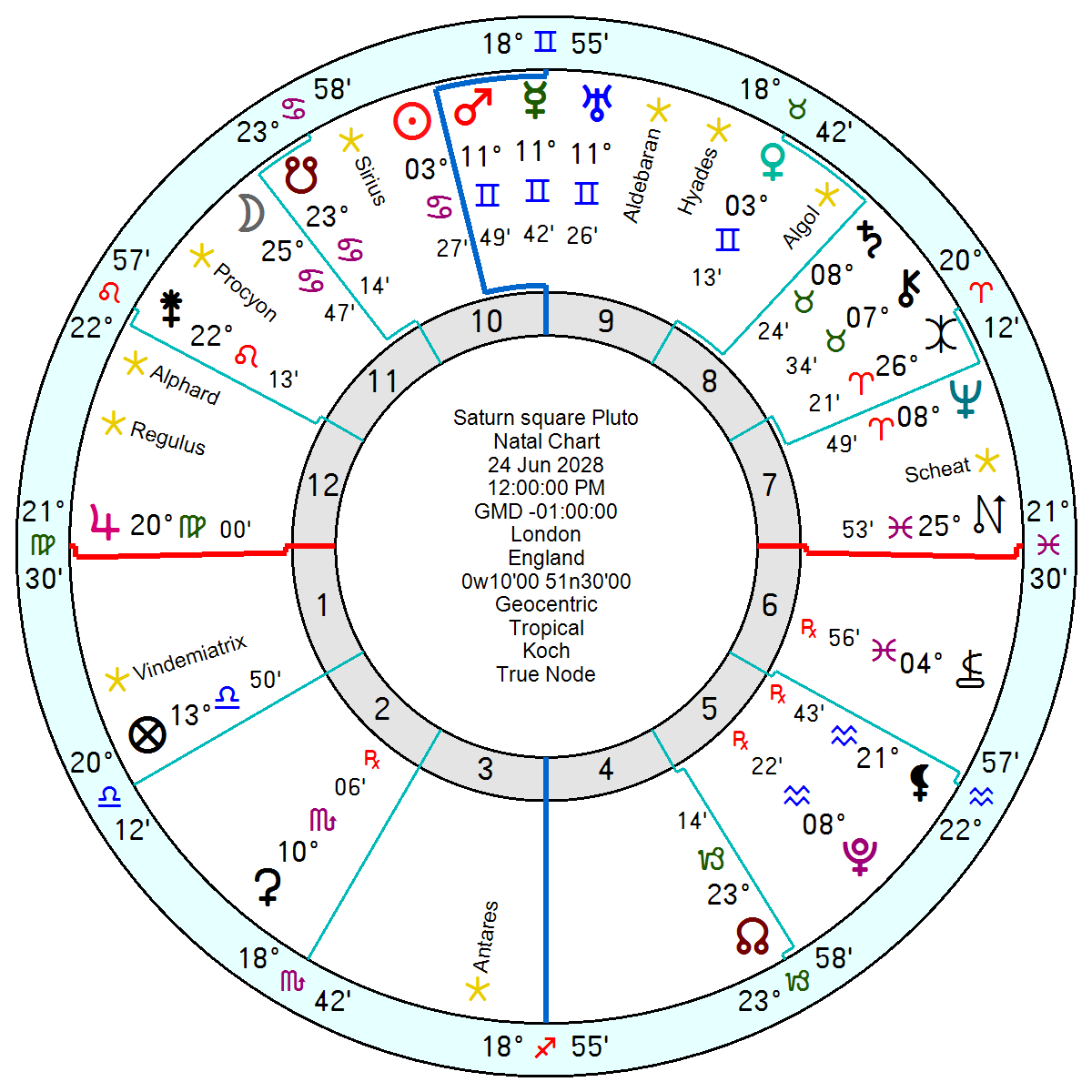
Getting fixated on the negative will narrow focus in a blinkered way. For example Saturn in aspect to Pluto has in the past occurred during war time. But the hard aspects recur every eight or nine years – next in 2028. And while there may well be a war somewhere it does not mean life as we have always known it everywhere will be destroyed.
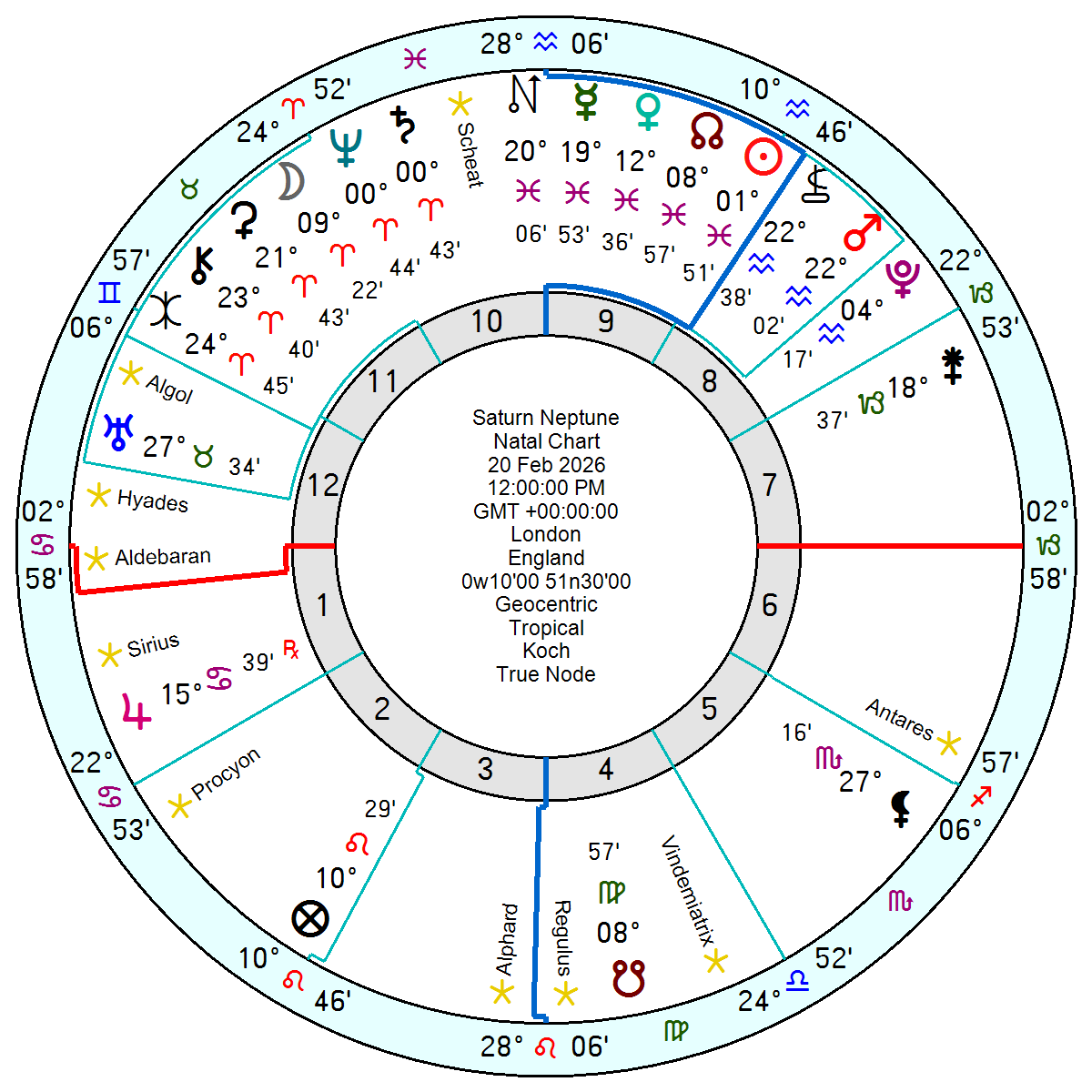
The Saturn Neptune conjunction on us next month comes round three times a century – associated with women’s and workers’ right, healing medicine and epidemics.
Certain Empires and dynasties were founded under Saturn–Neptune — both Queens Elizabeth being crowned (1558, 1953), and King Henry VII founding the Tudor Dynasty in England in 1485. But the principal theme is of dissolution and disintegration. The Boston Tea Party in 1773, with Saturn–Neptune in Virgo, was the beginning of the end for British colonial rule in North America. The Saturn–Neptune conjunction of 1881 in Taurus saw the British defeated in the Boer War, leading to the independence of the Transvaal. In the fifth century, the crumbling Roman Empire abandoned final claims to the British Isles under the 411 conjunction in Taurus. The next one, in Leo in 446, Britain was being over-run by Picts, Scots and Saxons, and the Dark Ages were beginning. Even earlier a chaotic period began for the Roman Empire in 233 (Saturn–Neptune in Aries), with 37 emperors in 35 years; in 411 in Taurus Rome was sacked by the Visigoths.
But since Saturn Neptune conjunctions come round three times a century clearly the end of empires is a sporadic rather than an inevitable outcome.
What happened before may not recur in exactly the same way. Learning to live with uncertainty and maintaining a balanced outlook – without hope and without expectation – while juggling with a mixed bag of positives and negatives is the imperative. Not easy and failures are inevitable but it is the way.
“No man ever steps in the same river twice, for it’s not the same river and he’s not the same man.” Heraclitus
“Life is wasted when we make it more terrifying, precisely because it is so easy to do so.” René Magritte
I should thank Marjorie for introducing me to astrology. My mother brought magazines from her library of college as professor for me to read and upgrade my English. It’s Indians aspiration to have children fluent in English and convent educated daughters. So, when internet came to India in 1998,I had just this website address to use internet browsing.
There is a movie Jyotish (Astrologer) in Bengali language of India which me n mom watched. The astrologer main character is so accurate in predicting downfall of King that he is ostracised by society on Kings orders to his young wife eloping with another man, also comes true.
In India, astrology as a profession is supposed to keep client coming back so fear has to be induced to keep getting bread for family of astrologer. Also, I have many family members,blaming astrologers when good doesn’t come true though it has but they don’t want to admit they blew it off.
As a country or politician,now new age Kings: one better be careful as most are tyrants,megalomaniac so save own head.
At times, astrologers who r friends get honest and inform about child being opposite of father which induces hatred in father for child,usually where saturn n sun r conjunct so again, u never know personal mindset of even friend.
It’s fascinating crossword to find ones prediction accurate as if lottery won ,kind of happiness as it’s maths. Fun part of brain exercise
Thank you Marjorie, very helpful and much to chew over!
I think Jung’s work on the collective unconscious and the archetypes can be an illuminating subject to consider re astrology and its interpretation too. Collectively we humans seem to love a binary picture – good vs bad, optimism vs pessimism as you write. Juggling the positives and negatives is hard work, with frequently uncertain results. This prompted me to think of The Magician card in the Major Arcana of the Tarot, a seductive archetype that seems to enjoy manifesting itself all over the internet, and certainly crops up regularly in world politics. The Trickster archetype appears in world mythology in so many cultures – a vital figure for us all to try and understand.
This figure’s old name and role in early Tarot decks was The Juggler – a crafty, clever trickster and street performer. When “positive” the Magician connects the worlds of spirit and matter. When manifesting on a more earthy, “negative” level, it depicts cunning manipulations which are nimble and skillful. As the Magus, or Magician, the street performer acquires wisdom and a higher purpose, blending the spiritual world with the physical. In some systems The Magician is associated with Mercury, the communicative god who can freely travel between the dark depths of Hades to the heights of Olympus. Is that part of the astrologer’s journey too?
It will be interesting to see how Mercury’s so-called “higher octave” planet, Uranus, manifests in Gemini too. Will it challenge our thinking? Our interpretations of mundane and personal astrology? I thought this quote from Jung was interesting regarding how Mercury and Uranus (“shattering, dangerous lightning”) might work in this context:
“The form the picture had taken was not unreservedly welcome to the patient’s conscious mind. Luckily, however, while painting it Miss X had discovered that two factors were involved. These, in her own words, were reason and the eyes. Reason always wanted to make the picture as it thought it ought to be; but the eyes held fast to their vision and finally forced the picture to come out as it actually did and not in accordance with rationalistic expectations. Her reason, she said, had really intended a daylight scene, with the sunshine melting the sphere free, but the eyes favoured a nocturne with “shattering, dangerous lightning.” This realization helped her to acknowledge the actual result of her artistic efforts and to admit that it was in fact an objective and impersonal process and not a personal relationship.”
― C.G. Jung, The Archetypes and the Collective Unconscious
Marjorie, thanks for the comment about the Arab astrologers. I didn’t know they said that, and it’s true astrology’s greatest use is understanding the past.
But its potential for understanding the future isn’t to be scoffed at either – if it only worked better than it does! The problem is we humans are limited in our understanding of ourselves, never mind understanding trends that involve all sorts of other people. We just don’t KNOW ourselves, or people in general. How can our little pea brains conceive of specific future events that involve a vast array of possibilities? We just ain’t built for that. WE are the prime limitation to predicting the future – and even if astrology were perfect (theoretically), we are not good at visualizing the future.
Which is the other problem: astrology must actually be a pretty crude tool. If a person even thinks astrology has validity (and much of humanity does not), sometimes it is dead simple to conclude that it does NOT work. I know I’ve interpreted charts based on my most confident understanding of the concepts and events just prove me and the chart wrong. I’ve chased precise birth times and event times all over the map until I’ve exhausted the possibilities as to accuracy and the chart refuses to match the results. It’s not only me. One must conclude in those cases that the interpreter is inadequate and the chart is also wrong. But hey, astrological concepts are very broad and undefined.
Think just of Saturn, the limiter, for example. Nobody argues that Saturn has a good side and a bad side, and the contradictory sides often do reward hard work and preparation, while punishing carelessness and lack of forethought. All the same, Robert Burns was so right when he wrote: “The best laid plans of mice and men often go astray, and leave us only grief and pain for promised joy.”
Then there’s good old lady luck. Totally useless (except mathematically) to predict much of anything in real life. I mean there are people who win the lottery 4 times! I’ve seen a chart for an old lady who has won thousands at Bingo over and over (no skill involved and not related to the manager). Yes, she has nice aspects, but spectacular – not good enough for repeated wins over decades – what’s that all about? Is there a luck asteroid we’ve missed somehow; maybe a level of interpreting “maturity” or “readiness” in aspects that applies to some people, but others are not there yet?
Or did the Greeks get it right when they said the gods play jokes on us for their amusement? Which makes a pretty discouraging point of view for people who would rather hope astrology can provide some insight! By definition you can’t predict what the gods will do. At least astrology is a step in the direction of understanding when there’s no hope with the Greek approach.
Does the mere existence of analytical astrology mean humanity has made some progress in the past 5000 years since the Babylonians were casting the first charts on mud pies? We hope. On the other hand, we have DJT to contemplate in our own era. He sure doesn’t make me feel too hopeful about progress or prediction, along with the other crazies in power around the world!
So, we’re not there yet. Something big is still missing from prediction. Perhaps progress IS slowly happening from the bottom up for humanity, but we do know it will be a while before we see the fruits…
What an interesting post. I feel it will take several reading to fully unpack. Thank you Marjorie!
“Life is wasted when we make it more terrifying, precisely because it is so easy to do so.”
René Magritte on the banality of pessimism.
I agree that astrology is a useful tool for understanding the dynamics of relationships but less so for prediction, not least because there are so many different conceivable versions of the future. My feeling is that we are not meant to know but to discover.
A very interesting article , Marjorie.
Personally I find astrology a very useful medium for understanding the past and analysing the present. Its record for predicting the future is perhaps rather shakier. It is noticeable that most astrologers limit their forecasts to the relatively near term where trends are perhaps easier to see. There is also an inevitable tendency for people to indulge in wish fulfilment where they see only the things they want to see for good or ill. In that respect the chart reading is really a reflection of their prejudices, hopes and fears. Of course, astrology is not the only area where this happens as anyone who follows economic and financial forecasts will be well aware.
Arab astrologers evidently believed the greatest use for astrology was in understanding the past
Marjorie, thank you for this remarkable post. Explains my thinking so well. This essay will be so helpful when I ‘talk’ astrology to my unbelieving friends/family. And I feel the Arabs are correct.
Marjorie, thank you for this remarkable post. Explains my thinking so well. This essay will be so helpful when I ‘talk’ astrology with my unbelieving friends/family. And I feel the Arabs are correct.
@Marjorie, I tend to agree. As with personal astrology, studying past passages in can also be used to prevent and prepara. For instance, the earthquakes brought by Saturn/Neptune tend to be less deathly now due to development of construction technology and other safety measures.
Making sense of the past is how my interest in Astrology started many years ago. My marriage ended quite suddenly and unexpectedly (Uranus), and I didn’t understand why, but then as I delved into Astrology I discovered that the relationship had started under a tr Uranus conjunction to my natal Moon and ended with a tr Uranus direct station and square to my natal Moon. As my ex husband’s natal Moon is directly opposite mine, tr Uranus influence played a part for him, too. Of course astrologically there were other factors, but that was the BIG one.
Similar with a relative here. He has moon n Venus together in 1h or 7h as from his mother’s clan side. So being a male, it’s predicted that since moon represents mother,she would be the one to end his 1st marriage which she did confess and bragged ,as did her mother to sons of family. Somethings r so hereditary yet I feel someone somewhere has to end it and it demands strong will. His 1st wife had but he didn’t. Now woth uranus in 1h, he is returning home after 46years…he never thought but signs were always there. Relationships demand collective will, I guess.
@Hugh Fowler, I agree on this. I was intially brought to mundane astrology specifically because of the doom and gloom predicted for Pluto in Capricorn. It prompted me to study historical events and cycles. After the passage was definitely over for the next 200 years, one could see bad things happened, good things happened, some times simultaneously, but very few of the boldest predictions became true.
Marjorie – thank you so, so much for this post. As someone who listens to mundane astrology podcasts (on a seemingly endless loop!), this is incredibly helpful to hear. I remember my astrologer in NYC during the 90s said so much of the reading of the chart is contingent on who is doing the interpreting. Thanks again!
Wonderful and timely post, thank you.
Very interesting read. Saturn is the last planet before the outer planets. Could Saturn be looked at as our inner planets boundary with every day occurrences? With the three outer slower planets introducing us to change Uranus , other nebulous, etherial or creative things Neptune, with forceful unforeseen uncomfortable eruptions and uncontrollable happenings Pluto? Just a thought!
Separating them from the personal and generational, I think Saturn & Jupiter are viewed as “social” planets, in how we grow personally within broader societal themes.
A great expansion on the dialogue and issues coming up around the chaos. Of course, all of life is uncertain, a truth we can avoid/deny when things are not as overtly turbulent.
predictions are always fraught, no one can know. Astrology for me is a guideline of energies and how to identify certain patterns or tendencies.
Thank you Marjorie; very helpful.
This is indeed very helpful! Thank you Majorie.